What should you check?
Decide whether you want 100% juice or an orange-flavoured alternative, then compare the amount you would actually drink at lunch.
100% orange juice
Choose when: You want orange juice itself and can pour a small serving with lunch.
Trade-off: Even juice with no added sugar contains free sugars; the NHS advises a combined 150ml daily limit for fruit juice and smoothies.
Lighter juice blend
Choose when: You want a juice-style drink and a particular blend has less sugar for your serving than the juice you are considering.
Trade-off: A blend can contain water and other fruits rather than being 100% orange juice.
Juice drink or squash
Choose when: Lower sugar in the drink you take to lunch matters more than 100% juice content.
Trade-off: Check the juice percentage and sweeteners; squash also needs diluting before you drink it.
| Priority | What to check | Your needs |
|---|
| Free sugars |
Read sugars per 100ml and for the serving you will drink. For 100% juice, allow for the NHS advice of no more than 150ml of fruit juice and smoothies combined per day, with meals. |
I want orange juice with lunch without mistaking its naturally occurring sugars for zero sugar. |
| Drink type |
Check whether the label says 100% juice, juice blend, juice drink or squash. Read the juice percentage and ingredients for sweeteners; ‘no added sugar’ does not mean sugar-free. |
I would rather choose between juice content and a lower-sugar orange drink deliberately than rely on the name on the front. |
| Pack size |
Compare sugars for the whole bottle or pouch with sugars per 100ml. If the pack contains more 100% juice than you intend to drink, plan how to portion it. |
For a lecture lunch, I want to know what is in the serving I will actually finish. |
| Preparation |
Check whether the drink is ready to drink or must be diluted. For squash, follow that product’s mixing instructions and compare nutrition on the stated prepared basis. |
A ready-to-drink pack is simpler to carry; squash works for me if I can prepare it before lunch. |
| Storage |
Read the pack’s instructions for chilling and use after opening. For example, Asda’s listing for Innocent Smooth Orange says to refrigerate it and use it within four days of opening. |
If I buy a larger carton for occasional lunches, I need a way to store and finish it as directed. |
Brand and product references
These examples show how orange juice, blends, juice drinks and squash differ; check the current pack when choosing a product.
Tropicana
Tropicana UK lists both Original Orange juice and Fresh & Light Morning Orange, a blend containing water and several fruit ingredients.
- Original Orange lists 14g sugars per 150ml; Fresh & Light Morning Orange lists 10g per 150ml on their respective brand pages.
- Fresh & Light Morning Orange is not 100% orange juice. Those figures describe these two products, not every Tropicana drink.
Innocent
Asda lists Innocent Smooth Orange as a 100% fruit juice that is not from concentrate.
- The Asda product listing gives 12g sugars per 150ml, making the serving size clear to compare.
- Its naturally occurring sugars still count as free sugars under NHS guidance; the listing calls for refrigeration and use within four days after opening.
Tesco
Tesco lists a ready-to-drink Fruit Splash orange juice drink and a concentrated No Added Sugar High Juice Orange squash.
- Tesco lists 2.7g sugars per 250ml bottle for Fruit Splash. Its High Juice lists 0.9g sugars per 100ml when diluted as directed.
- Fruit Splash contains 12% orange juice and sweeteners. Tesco instructs shoppers to mix one part High Juice squash with four parts water.
Sainsbury’s
Sainsbury’s lists Fruit Slurps No Added Sugar Orange Juice Drink in a 6 × 250ml format.
- Its listing gives 1.8g sugars per 250ml bottle.
- It contains 8% fruit juice and the sweeteners acesulfame K and sucralose; it is not 100% orange juice.
M&S
M&S lists both Smooth Orange Juice, which is not from concentrate, and Mediterranean Orange High Juice.
- The Smooth Orange Juice listing gives 9.3g sugars per 100g. Mediterranean Orange High Juice is listed as 50% fruit juice.
- Mediterranean Orange High Juice contains sucralose and requires dilution; compare its prepared serving using the pack instructions.
Asda
Asda’s listing for Innocent Smooth Orange provides an example of a 100% orange juice to compare with juice drinks and squash.
- The listing states 12g sugars per 150ml for that Innocent product.
- Check each own-label high-juice product’s nutrition panel, ingredients and dilution directions separately rather than applying the Innocent figures to it.
Orange drink options on Joybuy
These options cover portable orange juice drinks and a squash to prepare before lunch. Use the pack’s sugars and ingredients to assess each drink; the names ‘Zero’, ‘Low Sugar’ and ‘No Added Sugar’ do not mean the same thing as 100% juice or guarantee a sugar-free serving.
 No image available
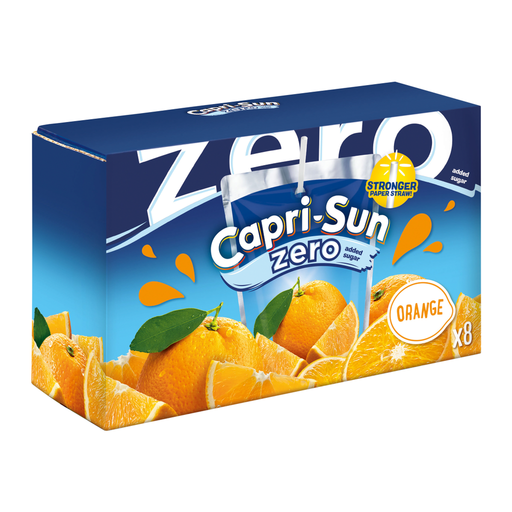
Capri-Sun Zero Orange 8 × 200ml
Individual 200ml pouches suit a lunch packed before lectures. Despite ‘Zero’ in the name, check the sugars for a whole pouch and the ingredients if sweeteners or juice content matter to you; do not treat the name as a sugar-free claim.
View on Joybuy
 No image available
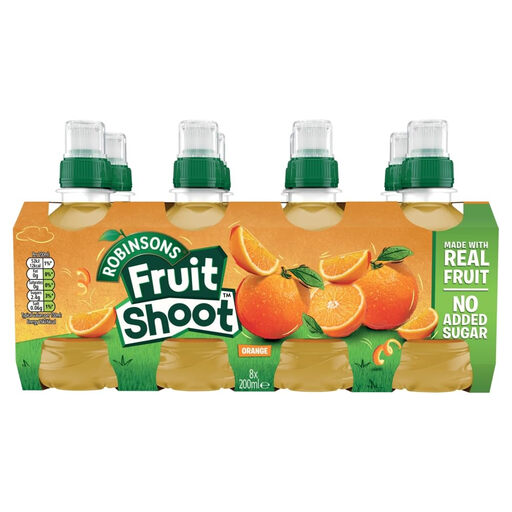
Fruitshoot Orange Low Sugar 8 × 200ml
The individual 200ml bottles offer a ready-to-drink format for lunch. Compare sugars for the full bottle and read the juice percentage and sweeteners before choosing it in place of 100% orange juice.
View on Joybuy
 No image available
Robinsons No Added Sugar Orange Squash 1L
This squash suits preparing a drink before lunch rather than carrying a ready-to-drink pack. Dilute it according to its own instructions; check the prepared-drink nutrition information and ingredients rather than comparing undiluted squash with orange juice.
View on Joybuy
Questions about orange drinks
Does ‘no added sugar’ orange juice contain no sugar?
No. The NHS says sugars naturally present in unsweetened fruit juice count as free sugars. Check the nutrition panel for sugars in the serving you intend to drink.
How much 100% orange juice should I have with lunch?
The NHS advises no more than 150ml of fruit juice and smoothies combined per day and recommends having them with meals. If your carton contains more, pour the amount you intend to drink rather than treating the whole carton as one serving.
Is a no-added-sugar orange juice drink the same as orange juice?
No: check the category and ingredients rather than relying on the orange flavour. Tesco lists Fruit Splash as a juice drink with 12% orange juice, and Sainsbury’s lists Fruit Slurps with 8% fruit juice; both list sweeteners rather than being 100% juice.
Is a lighter juice blend always lower in sugar than 100% orange juice?
Not necessarily; compare the specific products on the same serving basis. Tropicana UK lists 10g sugars per 150ml for Fresh & Light Morning Orange and 14g per 150ml for Original Orange. The former is a blend containing water and several fruit ingredients, not 100% orange juice.
What matters most when carrying an orange drink to lectures?
Check sugars for the whole pack, whether it needs diluting, and any storage instructions. A ready-to-drink pouch or bottle can go into a packed lunch without preparation, while squash needs to be mixed according to its own label before you take it.


