Choose 100% orange juice if juice content matters most, but plan a 150ml serving with breakfast rather than treating a larger bottle as one serving: the NHS says sugars in unsweetened juice still count as free sugars. If you would rather take one ready-to-drink bottle, a no-added-sugar orange juice drink may suit you; check its total sugars, juice percentage and sweeteners, as it need not be 100% juice.
Who each option suits
Commuters who want 100% orange juice
A small bottle can travel with breakfast, but check its volume and whether it must stay chilled. If you plan to follow the NHS advice of no more than 150ml of fruit juice or smoothies a day, a larger bottle needs portioning or sharing.
Buyers who want one ready-to-drink portion
An orange juice drink in an individual bottle may be easier to take out the door. Read the nutrition and ingredients labels if total sugars, sweeteners or the proportion of orange juice will decide which one you buy.
Households sharing breakfast juice
A larger bottle can be poured into separate servings at home. Check its storage instructions and how long it should be kept after opening before making it part of a daily routine.
What to check before buying
Decide whether you want 100% juice or a ready-to-drink juice drink, then compare the serving you will actually take with you.
100% orange juice
Choose it when: You want a drink made from orange juice rather than a diluted juice drink.
Bear in mind: According to the NHS, naturally occurring sugars in unsweetened juice count as free sugars, and its fruit-juice guidance refers to a 150ml serving with a meal.
No-added-sugar orange juice drink
Choose it when: An individual, ready-to-drink portion and its labelled sugar content matter more to you than 100% juice.
Bear in mind: No added sugar does not mean 100% juice or no sweeteners; check the ingredients of the particular drink.
| Priority | What to check | Your needs |
|---|
| Total sugars |
Read sugars per 100ml and per serving where shown. Compare the amount you intend to drink, not just the words ‘no added sugar’. |
I want to know how much sugar is in my breakfast drink. The NHS says naturally occurring sugars in unsweetened fruit juice still count as free sugars. |
| Juice content |
Check whether the product says 100% juice or ‘orange juice drink’. Read the orange-juice percentage and any listed sweeteners. |
Orange juice itself matters to me more than an orange-flavoured drink. Alternatively, I may accept less juice in exchange for a different ready-to-drink option. |
| Portion size |
Read the bottle volume and stated servings. The NHS advises no more than one small 150ml glass of fruit juice or smoothies a day, with a meal. |
If I take a bottle of 100% juice to breakfast, can I pour or share a 150ml serving? A portable bottle is not necessarily one serving. |
| Storage |
Check whether the unopened drink needs refrigeration and follow its instructions after opening. |
I need a drink that fits the time between leaving home and having breakfast, without overlooking chilled storage. |
Common buying mistakes
-
Reading ‘no added sugar’ as ‘sugar-free’
The NHS says sugars naturally present in unsweetened fruit juice count as free sugars. A juice drink can also contain sweeteners while carrying a no-added-sugar claim.
Read the total-sugars line and ingredients alongside the front-of-pack wording.
-
Treating a portable juice bottle as one serving
Sainsbury’s lists two servings in the 300ml Tropicana bottle, while the M&S orange-juice bottle is 350ml. Drinking either whole exceeds the NHS’s 150ml daily fruit-juice reference amount.
If choosing 100% juice, plan how you will pour or share a 150ml serving with breakfast.
-
Assuming every orange drink is mostly juice
Tesco Groceries lists 12% orange juice from concentrate in its Fruit Splash drink; Sainsbury’s lists 50% in its Stamford Street Co. orange juice drink. Both ingredient lists include sweeteners.
Check the stated juice percentage before deciding whether a juice drink meets your preference for orange content.
-
Overlooking chilled storage
A refrigerated bottle needs a different morning routine from a drink that can be kept unopened in a cupboard.
Read the current pack’s storage and after-opening instructions before putting it in your bag.
Brand and retailer examples
These examples describe particular listed products, not every orange drink sold under each name.
Tropicana
Sainsbury’s lists Tropicana Pure Smooth as a 300ml bottle of 100% pressed orange juice, not from concentrate.
- The listing states no added sugar and 8.6g sugars per 100ml.
- The bottle contains two servings; its full 300ml volume is more than the NHS’s 150ml daily fruit-juice reference amount.
innocent
Tesco Groceries lists a 900ml Smooth Orange Juice described as 100% orange juice with no added sugar.
- The listing defines 150ml as one serving, making it possible to plan portions at home.
- A 900ml bottle is not an individually portioned grab-and-go drink.
Tesco
Tesco Groceries lists Fruit Splash as a 250ml no-added-sugar orange juice drink.
- The listing gives 2.7g sugars per bottle in an individual ready-to-drink format.
- It contains 12% orange juice from concentrate and the sweeteners acesulfame K and sucralose; it is not 100% juice.
Sainsbury’s
Sainsbury’s lists Stamford Street Co. Orange Juice Drink as a 1L no-added-sugar juice drink.
- Its larger carton can be poured into separate breakfast portions.
- The ingredients list 50% orange juice from concentrate and sucralose; the carton is not a single-serve bottle.
M&S
Marks & Spencer lists a 350ml Collection Freshly Squeezed Smooth Orange Juice made from oranges with nothing else added.
- The listing specifies smooth juice in a portable bottle.
- It must be kept refrigerated at 0°C to +5°C, and the full 350ml bottle exceeds the NHS’s 150ml daily fruit-juice reference amount.
Portable orange drinks on Joybuy
These individually portioned orange drinks fit a grab-and-go routine, but neither should be assumed to be 100% orange juice or to carry a no-added-sugar claim. Check the current pack if that claim is essential to your choice.
 No image available
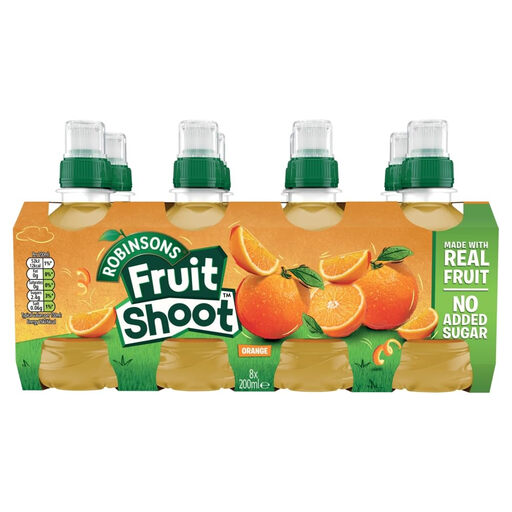
Fruitshoot Orange Low Sugar, 8 × 200ml
The individual bottles are a portable option for breakfast. Joybuy’s product information lists 12% orange juice from concentrate, sucralose and 1.2g sugars per 100ml; ‘Low Sugar’ in the name is not a no-added-sugar claim, so check the current pack if that wording matters to you. For children, note the listed small-cap choking warning and unsuitability for under-36-month-olds.
View on Joybuy
 No image available
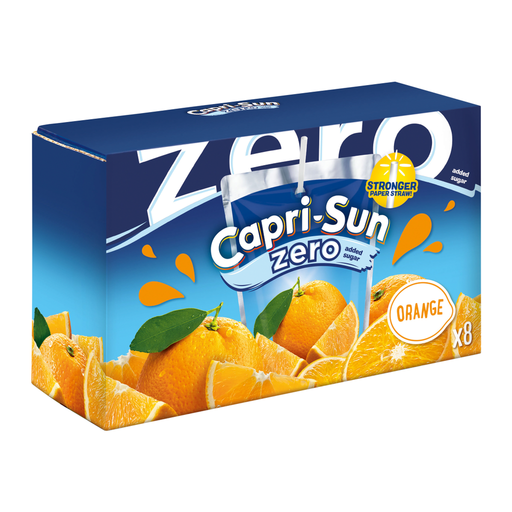
Capri-Sun Zero Orange, 8 × 200ml
Individual pouches offer another take-away format. Joybuy’s product information lists 6% orange juice, sucralose and 0.6g sugars per 100ml; its zero-sugar wording conflicts with that nutrition figure, so check the current pack rather than relying on ‘Zero’ in the name. The listed straw warning says the product is unsuitable for children under 3.
View on Joybuy
Questions about orange drinks
Does ‘no added sugar’ mean an orange drink is sugar-free?
No. The NHS says naturally occurring sugars in unsweetened fruit juice still count as free sugars. A no-added-sugar juice drink can also contain sweeteners, so read its total-sugars line and ingredients.
How much 100% orange juice fits with breakfast?
The NHS advises limiting fruit juice and smoothies to no more than one small 150ml glass a day and having it with a meal. That guidance still applies when the juice has no added sugar.
Is a no-added-sugar orange juice drink the same as 100% juice?
Not necessarily. Tesco Groceries lists its 250ml Fruit Splash drink as containing 12% orange juice from concentrate and sweeteners, whereas Sainsbury’s describes its 300ml Tropicana Pure Smooth as 100% pressed juice. Check the particular product’s juice percentage and ingredients.
What should I check before taking orange juice in a bag?
Check the bottle volume against the portion you intend to drink, then read its storage instructions. Marks & Spencer’s listed 350ml freshly squeezed juice must be refrigerated, for example; follow the current pack label for the drink you choose.


