Organisers offering a lower-sugar choice
Compare total sugars on the label, not just a no-added-sugar claim, and decide whether a drink containing sweeteners suits the event.


Choose 100% orange juice when you want an orange-only drink in small servings; no added sugar does not mean sugar-free. For a lower-sugar orange option, compare the nutrition information for ready-to-serve drinks and properly diluted squash, while checking sweeteners, allergens and preparation requirements. Offer water alongside either choice rather than describing every orange drink as a zero-sugar option.
Compare total sugars on the label, not just a no-added-sugar claim, and decide whether a drink containing sweeteners suits the event.
If guests expect 100% orange juice, plan a defined serving size and offer water alongside it. The NHS classifies sugars in unsweetened fruit juice as free sugars.
Check the delivered pack for sweeteners and declared allergens, particularly when choosing a high-juice concentrate that lists sulphites.
Choose when: You want conventional orange juice with an orange-only ingredient list for a breakfast-style service.
Trade-off: No added sugar does not remove the fruit’s sugars; plan small servings rather than treating it as an all-day lower-sugar drink.
Choose when: Individual portions or a drink that needs no mixing matter more than serving 100% juice.
Trade-off: Check the fruit content and sweeteners; a no-added-sugar juice drink is not the same product as pure juice.
Choose when: Staff can mix and serve the drink consistently at a beverage station.
Trade-off: Preparation needs water, equipment and attention to the pack’s dilution and ingredient instructions.
| Priority | What to check | Your needs |
|---|---|---|
| Total sugars | Read “of which sugars” per 100ml and per serving. Compare a concentrate using its prepared-drink figures at the stated dilution, not figures for the undiluted product. The NHS says sugars in unsweetened fruit juice count as free sugars. | I want guests to understand the difference between no added sugar and no sugar at all. |
| Product type | Check whether the label says 100% juice, juice drink or concentrate; then read the ingredients and fruit content. | Some guests may expect conventional orange juice, while others may prefer a different orange drink or water. |
| Ingredients | Check the exact variant for sweeteners and declared allergens. Tesco’s No Added Sugar High Juice Orange lists sweeteners and sodium metabisulphite. | I need ingredient information that staff can communicate accurately at the service point. |
| Service plan | Confirm pack size, dilution instructions where applicable, and the delivered pack’s storage directions after opening. | Can the team prepare the drink consistently and handle opened packs within the event timetable? |
A 100% juice can have no added sugar yet still contain fruit sugars. Tropicana lists 8.6g sugars per 100ml for Smooth Orange, and the NHS counts sugars in unsweetened fruit juice as free sugars.
Use the product’s actual claim and compare the “of which sugars” entry for the serving you intend to offer.
Tesco’s No Added Sugar High Juice Orange gives nutrition figures for the diluted drink, so those figures do not describe an undiluted serving.
For that product, measure one part concentrate to four parts water and make the method clear to service staff.
Allow time and equipment for mixing and serving it consistently.
Some no-added-sugar orange drinks use sweeteners, while some high-juice products list sulphites. GOV.UK guidance says food businesses must provide allergen information.
Check the exact delivered variant and keep its current ingredient and allergen information available to staff.
Individual drinks and larger cartons require different serving arrangements; a change of format can affect the event menu.
Confirm the pack format, delivery timing and available stock before finalising attendee communications.
Tropicana describes Smooth Orange as 100% pressed orange juice, not from concentrate, with no added sugar.
Tesco No Added Sugar High Juice Orange is a diluting orange drink for a service point where staff can control preparation.
Sainsbury's lists no-added-sugar orange juice drinks in a 1L ready-to-serve format and an individually portioned multipack.
M&S lists both Smooth Orange juice and Mediterranean Orange High Juice, which are different product types.
innocent is a fruit-juice reference for buyers considering conventional juice rather than a specified lower-sugar orange drink.
These options cover a diluting orange squash and individually portioned orange drinks for conference service. Check the format and delivered label against your serving plan.
 Image unavailable
A concentrate to consider for a staffed drinks station, rather than a ready-to-pour juice. Check the pack’s mixing directions before service and its sulphite information when preparing ingredient details for guests.
Image unavailable
Individual bottles offer a ready-to-serve orange drink rather than 100% orange juice. Check the nutrition and sweetener information on the delivered pack; if children attend, also follow its cap warning.
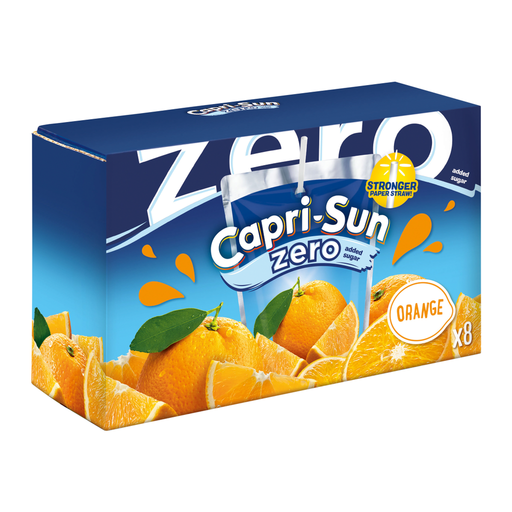 Image unavailable
Individual pouches are an option for portioned orange-drink service, not a substitute for 100% orange juice. Do not treat “Zero” in the name alone as a confirmed zero-sugar figure: check “of which sugars” on the delivered pack. Follow its straw warning if children attend.
No. Tropicana labels Smooth Orange as having no added sugar but lists 8.6g sugars per 100ml. The NHS says sugars in unsweetened fruit juice count as free sugars, so check total sugars as well as the front-of-pack claim.
Not if the aim is to offer a lower-sugar choice. Serve conventional juice in a defined portion if it suits the event, and make water and the type of any alternative orange drink clear to guests. Do not call 100% juice zero sugar.
Not necessarily. Tesco No Added Sugar High Juice Orange is a concentrate that specifies one part squash to four parts water. Prepare it consistently and describe it as an orange drink containing sweeteners, not pure orange juice.
Check the delivered product’s ingredients and allergen declaration, including any sweeteners or sulphites. GOV.UK guidance says food businesses must provide allergen information, so keep details for the exact drink being served available to staff.
Follow the delivered pack’s refrigeration and use-after-opening directions. These vary by product: M&S says to drink its Smooth Orange within 24 hours of opening, while Sainsbury's gives four days for its 1L no-added-sugar orange drink.