Canteen buyers specifying orange juice
If the lunch offer must be 100% orange juice, the product name and ingredients matter more than an orange-coloured can or fruit imagery.


If your workplace canteen needs to offer 100% orange juice, choose a product labelled as juice rather than assuming an orange-flavoured can is equivalent. Sealed single serves suit self-service lunches; larger cartons require staff to pour drinks and manage opened stock. If cans are essential, check the product name and ingredients: the J2O orange-and-passion-fruit can examined here is a soft drink, not 100% orange juice.
If the lunch offer must be 100% orange juice, the product name and ingredients matter more than an orange-coloured can or fruit imagery.
Individual bottles or cartons let employees pick up a sealed drink without staff pouring each serving. Check the volume of each pack before describing it as a 5 A Day portion.
Long-life juice cartons offer cupboard storage before opening. The canteen still needs a plan for serving and refrigerating the juice once a carton is opened.
Decide whether the offer must be orange juice or can be an orange-flavoured soft drink, then match the pack format to lunch service.
Choose when: Employees need to pick up individual packs of 100% orange juice without a pouring service.
Trade-off: A chilled pack needs refrigerated display, and a 200ml or 250ml unit is larger than the 150ml 5 A Day reference serving.
Choose when: Staff can pour drinks, or ambient storage before opening is useful for a long-life carton.
Trade-off: The canteen must manage serving sizes and follow the particular carton’s instructions after opening.
Choose when: A sealed can is the requirement and the canteen intends to offer a soft drink rather than 100% orange juice.
Trade-off: ASDA describes its J2O orange-and-passion-fruit cans as a soft drink, so they cannot stand in for a juice offer.
| Priority | What to check | Your needs |
|---|---|---|
| Drink identity | Read the product name and ingredients. Distinguish orange juice from an orange-flavoured soft drink, even when both come in individual packs. | If our menu says orange juice, I need the delivered drink to match that description. |
| Serving size | Check the volume per bottle, carton or can. GOV.UK 5 A Day guidance uses 150ml of 100% fruit juice as one portion; drinking more juice does not make it count as another portion that day. | A larger single serve may work for lunch, but I do not want its pack size to imply extra 5 A Day portions. |
| Storage and service | Check storage instructions before and after opening. For cartons, plan who will pour, refrigerate and use opened stock. | With a short self-service lunch period, sealed drinks avoid a pouring task; staffed service gives us another format to consider. |
| Pack information | Check the delivered ingredient and allergen information. Keep current packaging or product details available when serving, particularly after a substitution. | I need staff to be able to answer questions about the drink actually being served, not just the one originally ordered. |
ASDA describes its J2O orange-and-passion-fruit cans as a soft drink. Using that product for an offer described as 100% orange juice would misidentify the drink.
Specify the drink type when ordering, then check the product name and ingredients on the delivered pack.
GOV.UK guidance uses 150ml of 100% fruit juice as one portion and counts juice as no more than one portion a day, regardless of how much is consumed.
Describe a 200ml or 250ml bottle by its actual volume. If the menu mentions 5 A Day, keep the 150ml basis clear.
Larger cartons need pouring and opened-pack management. ASDA instructs buyers to refrigerate its orange juice from concentrate after opening and consume it within five days.
Check expected lunchtime demand, fridge space and the instructions on the carton before choosing this format.
Juice left in an opened carton may go unused if demand is lower than expected.
A change of product or pack information can leave staff referring to details for a different drink.
Keep the current pack or product information accessible at service, and recheck ingredients and allergen details when a substitute arrives.
These examples show why the drink type and pack format need checking separately; a brand’s inclusion does not establish that it offers orange juice in cans.
Sainsbury’s lists a 4 × 250ml multipack of Tropicana smooth 100% orange juice in bottles. Tropicana also describes a long-life smooth orange juice for cupboard storage before opening.
Sainsbury’s lists innocent smooth orange juice in 900ml, 1.35L and 1.75L formats.
Tesco’s drinks results distinguish Growers Harvest orange juice from concentrate in 6 × 200ml packs from Tesco Orange Zero in 6 × 330ml cans.
Sainsbury’s lists Pure Orange Juice in a 6 × 200ml pack.
ASDA lists a 4 × 1L orange juice-from-concentrate pack and, separately, J2O orange-and-passion-fruit soft drink cans.
Marks & Spencer lists a 1.2L smooth orange juice carton with cool, dry storage instructions.
This canned soft-drink option suits a canteen deliberately offering an orange-flavoured drink in sealed cans. It should not be listed as 100% orange juice.
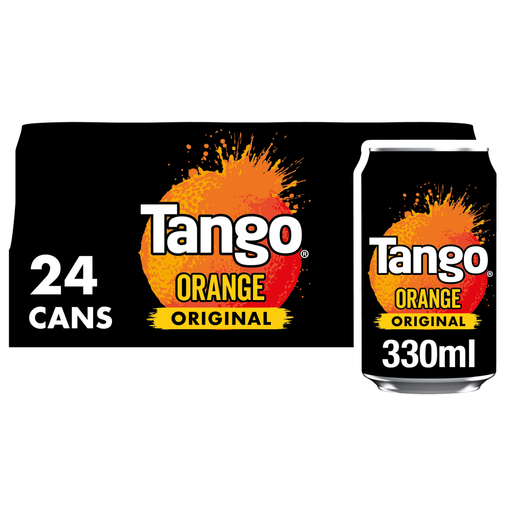 Image unavailable
For sealed, self-service lunches where an orange-flavoured soft drink is acceptable, this pack contains 24 × 330ml servings. It does not meet a 100% orange-juice requirement; check the delivered label before offering it in the canteen.
No: flavour and packaging do not establish that a drink is 100% orange juice. ASDA describes its J2O orange-and-passion-fruit cans as a soft drink; check the product name and ingredients of any can you intend to buy.
No. GOV.UK guidance uses 150ml of 100% fruit juice as one portion and says juice counts as a maximum of one portion a day, however much is consumed. A larger bottle can still be offered as a drink without claiming an extra portion.
Cartons suit a canteen that can pour servings and manage opened stock; sealed bottles avoid pouring at a self-service lunch point. If storage before opening matters, check whether the particular carton is long-life, then follow its instructions once opened.
Use the information on the drink actually delivered and keep its packaging or current product details accessible. Recheck ingredients and allergen information if the ordered drink is substituted.