Choose 100% orange juice if drinking juice is the point of your desk lunch, and measure out a 150ml serving rather than treating a large carton as one drink. For less sugar, compare a fruit-and-water blend on the same serving basis; if very little sugar matters more than juice content, an orange-flavoured soft drink is a different choice, often with sweeteners. NHS guidance counts sugars in unsweetened juice as free sugars, so “no added sugar” does not mean sugar-free.
Who is each drink for?
Lunch-time juice drinkers
If you specifically want orange juice, compare sugars for a measured serving. NHS guidance counts sugars in unsweetened fruit juice as free sugars and advises limiting juice and smoothies together to 150ml a day, taken with meals.
Shoppers considering a fruit blend
A blend may suit you if you want a fruit-based orange drink but are comfortable with added water and other fruits. Check its sugar figure against pure juice using the same serving size; the product name alone cannot make that comparison.
Orange-flavour drinkers prioritising very little sugar
A soft drink or squash may suit that preference if you accept sweeteners and do not expect 100% orange juice. Check whether the product is ready to drink or needs diluting before taking it to your desk.
What should you check before choosing?
Decide whether you want juice, a fruit blend or an orange-flavoured drink, then compare the amount you would actually drink at lunch.
100% orange juice
Choose it when: You want orange juice itself and can portion a carton for lunch.
Bear in mind: NHS guidance counts its naturally occurring sugars as free sugars, even when none has been added.
Orange-based fruit blend
Choose it when: You want a fruit-based drink and are willing to compare its sugar figure and ingredients with those of pure juice.
Bear in mind: A blend containing water and other fruits is not 100% orange juice.
Orange-flavoured soft drink
Choose it when: Very little sugar matters more to you than drinking juice.
Bear in mind: Check for sweeteners, carbonation and juice content; an orange flavour does not make the drink equivalent to orange juice.
| Priority |
What to check |
Your needs |
| Sugar per serving |
Read “of which sugars” and its serving size. Compare drinks using the amount you plan to pour or prepare, not unlike pack portions. |
I want to know how much sugar is in my lunch-time drink, especially if the front says “no added sugar”. NHS guidance treats sugars in unsweetened juice as free sugars. |
| Drink type |
Read the product name and ingredients for orange-juice content, water, other fruits and sweeteners. Check whether it is juice, a blend, squash or a soft drink. |
Is actual orange juice important to me, or would an orange-flavoured drink meet the need? Those choices should not be treated as the same product. |
| Preparation |
Check whether the drink is ready to serve or must be diluted. For squash, use the prepared-drink nutrition information when comparing a glass with another drink. |
At a quick desk lunch, I may prefer an individual ready-to-drink portion; squash only works for me if I can dilute it there. |
| Pack and storage |
Compare the pack size with the portions you expect to use. Read the specific pack’s refrigeration and after-opening instructions. |
A large carton makes sense for my routine only if I can store it as directed and finish it within the labelled period. |
| Juice processing |
If it matters to you, check whether a 100% juice is from concentrate or not from concentrate. Compare sugar figures separately, using the same serving size. |
I might have a processing preference, but I would not use that wording as a shortcut for judging sugar content. |
Common label and pack-size mistakes
-
Reading “no added sugar” as “sugar-free”
Tropicana UK lists 13g sugars per 150ml for Smooth Orange despite its no-added-sugar wording. NHS guidance counts sugars in unsweetened juice as free sugars.
Compare “of which sugars” for the portion you intend to drink, alongside any front-of-pack wording.
-
Treating an orange soft drink as pure juice
Tesco describes Orange Zero as a carbonated orange-flavoured soft drink with sweeteners and lists 5% comminuted orange from concentrate. It answers a different preference from a 100% orange juice.
Choose which product type you want first, then check the name and ingredients of the specific pack.
-
Using “from concentrate” to predict sugar content
Sainsbury’s lists 12g sugars per 150ml for its Smooth Pure Orange Juice from concentrate; Asda lists 15g per 150ml for its Pure Squeezed juice. These examples do not make the processing description a sugar measure.
Compare nutrition panels on the same serving basis and treat processing as a separate preference.
-
Opening a large carton for one lunch
A multi-serve carton needs a storage plan after its first serving. Asda and M&S each instruct shoppers to refrigerate the reviewed orange juice after opening and consume it within four days.
Check your own pack’s instructions and choose a size you can use within its stated period.
Otherwise, some of the carton may go unused.
Brand and product-line references
These examples show why the exact product label matters more than the retailer or brand name when comparing orange drinks.
Tropicana
Its Smooth Orange juice and Morning Orange fruit blend belong to different drink categories.
- Tropicana UK lists 13g sugars per 150ml for Smooth Orange and 10g per 150ml for Morning Orange.
- Morning Orange includes water and other fruit ingredients; those sugar figures describe different formulations, not a like-for-like test of every orange drink.
Tesco
Its reviewed range includes both 100% orange juice from concentrate and an orange-flavoured soft drink.
- Tesco describes Orange Juice Smooth as 100% pure juice.
- Tesco Orange Zero is a carbonated soft drink with sweeteners, not another name for that juice.
Sainsbury's
Smooth Pure Orange Juice is a 100% orange juice from concentrate.
- Sainsbury’s lists 12.0g sugars per 150ml serving for this product.
- Its 100% fruit description does not mean sugar-free.
Asda
Smooth Orange Juice is described by Asda as 100% Pure Squeezed and never from concentrate.
- Asda lists orange juice as its ingredient and 15g sugars per 150ml.
- Asda instructs shoppers to refrigerate this product after opening and use it within four days.
M&S
Smooth Orange Juice is described by M&S as not from concentrate.
- Its nutrition panel lists 9.3g sugars per 100g; keep that unit in mind when comparing it with figures stated per 150ml.
- M&S instructs shoppers to refrigerate the juice after opening and drink it within four days.
Joybuy orange-drink options
These are portioned orange drinks and a squash for shoppers considering alternatives to a carton of 100% orange juice. Check each pack’s ingredients, prepared serving and sugar information against the kind of lunch drink you want.
 No image available
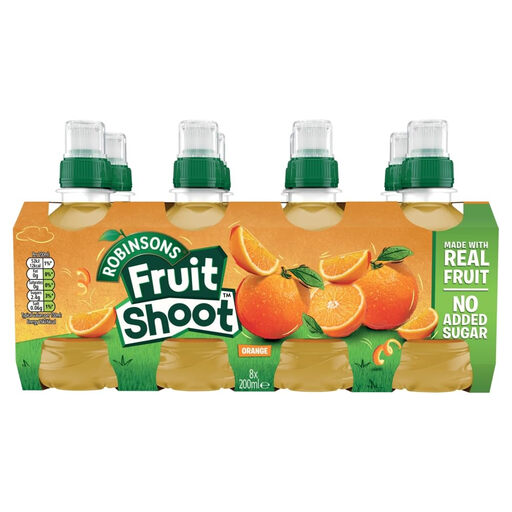
Fruitshoot Orange Low Sugar 8 × 200ml
The eight 200ml portions offer a ready-to-drink format for lunch. If juice content or sweeteners matter to your choice, check the pack ingredients rather than treating “Low Sugar” as a description of 100% orange juice.
View on Joybuy
 No image available
Robinsons No Added Sugar Orange Squash 1L
This is squash to dilute, so it suits a desk lunch only if you can prepare a glass. Compare the sugar information for the diluted drink, and do not read “No Added Sugar” as “sugar-free”.
View on Joybuy
 No image available
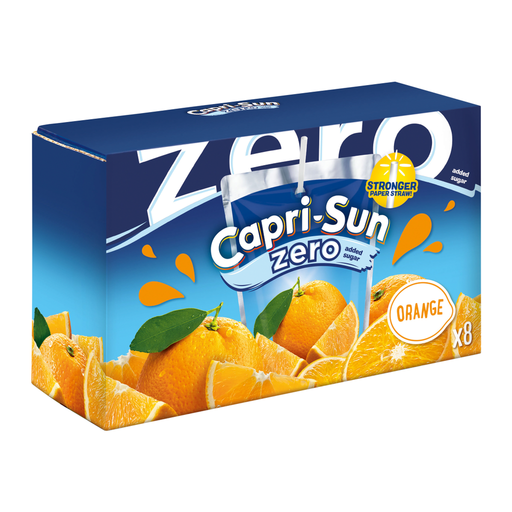
Capri-Sun Zero Orange 8 × 200ml
The eight 200ml pouches provide individual lunch portions. Check the current pack’s “of which sugars” figure before choosing it for a zero-sugar requirement; the word “Zero” in the name is not a substitute for that figure.
View on Joybuy
Questions about orange drinks at lunch
Does “no added sugar” mean orange juice is sugar-free?
No. Tropicana UK lists 13g sugars per 150ml for Smooth Orange and says its sugars occur naturally. NHS guidance counts sugars in unsweetened fruit juice as free sugars, so check the nutrition panel for the portion you will drink.
How much orange juice should I pour with lunch?
NHS guidance advises limiting fruit juice and smoothies together to 150ml a day and having them with meals. Measure a serving from a larger carton rather than using the carton’s size as your portion.
Is an orange-flavoured drink the same as orange juice?
No. Tesco describes Orange Zero as a carbonated orange-flavoured soft drink with sweeteners and lists 5% comminuted orange from concentrate. Check the product name and ingredients if you specifically want 100% orange juice.
What should I do with orange juice after opening it?
Follow the instructions on your particular pack. For example, Asda and M&S instruct shoppers to refrigerate their reviewed orange juices after opening and consume them within four days; do not assume every carton has the same opened-pack period.


