Choose 100% orange juice if you want juice itself, but plan the amount: the NHS advises limiting fruit juice, vegetable juice and smoothies to a combined 150ml a day, and a 250ml or 300ml bottle exceeds that amount. If the sugar figure matters more than drinking pure juice, compare diluted orange drinks or squash by their ingredients and nutrition labels; “no added sugar” does not mean a pure juice contains no sugar.
Who is choosing?
Shoppers who want 100% orange juice
If the point of the drink is orange juice itself, check that the ingredients identify pure juice rather than a diluted orange drink. For a portable bottle, also consider how much you will drink: the NHS advises a combined daily limit of 150ml for fruit juice, vegetable juice and smoothies.
Shoppers comparing sugar figures
A lower-sugar orange drink may contain water, other fruit and sweeteners instead of being 100% orange juice. Compare sugars using the same quantity on each nutrition label, then read the ingredients to understand what has changed.
Lunch shoppers choosing a single bottle
Portable 250ml and 300ml juice bottles are larger than the NHS’s 150ml combined daily amount for fruit juice, vegetable juice and smoothies. Check the pack size and serving information rather than treating the whole bottle as one recommended portion.
What matters when choosing?
100% orange juice
Choose it when: You want orange juice rather than an orange-flavoured drink.
Bear in mind: Pure juice still contains naturally occurring sugars, and the NHS advises a combined daily juice and smoothie limit of 150ml.
Lower-sugar orange juice drink
Choose it when: The declared sugar figure matters more to you than drinking pure orange juice.
Bear in mind: A diluted drink can contain water, other fruit or sweeteners, so check its ingredients as well as its nutrition panel.
No-added-sugar orange squash
Choose it when: You want an orange-flavoured drink and can prepare it before lunch.
Bear in mind: Squash must be diluted as directed and is not interchangeable with a ready-to-drink bottle of orange juice.
Once you have chosen a drink type, compare labels on the same basis and check whether the pack suits the amount you intend to have with lunch.
| Priority |
What to check |
Your needs |
| Sugars |
Compare sugars per 100ml, then check the serving or bottle size. Tesco Groceries lists 8.6g per 100ml for Tropicana Smooth Orange 300ml and 4.4g per 100ml for Tropicana Trop 50 Orange & Mango 300ml; these are different types of drink. |
I want to compare the amount I would actually drink, not assume that “no added sugar” means sugar-free. |
| Ingredients |
Check whether the label says 100% juice, juice drink or squash. Tesco Groceries lists water, 30% orange juice, 11% mango purée and a stevia sweetener in Tropicana Trop 50. |
Pure orange juice matters to me more than a lower sugar figure—or I am happy to choose a diluted drink instead. |
| Pack size |
Compare the bottle volume with the NHS’s combined 150ml daily limit for fruit juice, vegetable juice and smoothies. Check whether the label gives more than one serving per pack. |
Will I have 150ml of juice with lunch, or would a larger bottle make it harder to keep track of the amount? |
| Preparation |
Check whether the drink is ready to drink or needs diluting. For squash, follow the pack’s preparation directions and check ingredients in the prepared drink. |
I need a drink I can carry straight to lunch, or I can make up squash beforehand. |
| When to drink it |
The NHS advises having fruit juice and smoothies at mealtimes rather than sipping them between meals because juicing releases sugars that can damage teeth. |
I plan to have juice with lunch rather than keep sipping it through the afternoon. |
Common buying mistakes
-
Reading “no added sugar” as “zero sugar”
Pure orange juice contains naturally occurring sugars even when none are added. Tesco Groceries lists 8.6g sugars per 100ml for Tropicana Smooth Orange 300ml.
Read the sugars line on the nutrition panel and check whether the ingredients describe pure juice, a juice drink or squash.
-
Counting the whole bottle as one daily juice portion
The NHS advises limiting fruit juice, vegetable juice and smoothies to a combined 150ml a day. A 250ml or 300ml juice bottle is larger than that amount.
If you choose juice for lunch, check the pack volume and plan how much you intend to drink.
-
Comparing different drink types as if they were pure juice
Tesco Groceries lists Tropicana Trop 50 Orange & Mango as a drink containing water, 30% orange juice, 11% mango purée and a stevia sweetener. Sainsbury’s describes its Fruit & Barley Orange No Added Sugar as a squash with 10% fruit and sweeteners.
Decide whether you want pure orange juice, a diluted ready-to-drink option or squash before comparing their nutrition figures.
-
Sipping juice between meals
The NHS advises having fruit juice and smoothies at mealtimes rather than as between-meal drinks because juicing releases sugars that can damage teeth.
If you choose juice, have it with lunch rather than repeatedly sipping it afterwards.
Brands and retailer ranges
A brand or retailer name alone does not tell you whether a drink is pure juice, a diluted juice drink or squash; check the individual product label.
Tropicana
Its named 300ml products illustrate two different choices: Smooth Orange is labelled 100% pure juice, while Trop 50 Orange & Mango is a diluted juice drink.
- Tesco Groceries lists 8.6g sugars per 100ml for Smooth Orange and 4.4g per 100ml for Trop 50 Orange & Mango.
- The lower sugar figure does not make Trop 50 a 100% orange juice.
Innocent
Tesco Groceries describes Innocent Smooth Orange Juice 900ml as 100% pure orange juice.
- The listing declares 7.8g sugars per 100ml, making the nutrition figure available for label comparison.
- The named 900ml bottle is a multi-serve format, so check how much you will take for lunch.
Tesco
Tesco’s orange-drink listings include pure juice, a 200ml orange juice from concentrate and a 250ml no-added-sugar orange juice drink.
- The listed formats offer different pack sizes and drink types to check for a portable lunch.
- Compare the ingredients and nutrition panel of the particular product rather than treating the listings as equivalent.
Sainsbury’s
Sainsbury’s lists own-label pure orange juices as well as a Fruit & Barley Orange No Added Sugar squash.
- Its squash listing describes a prepared 250ml serving with less than 0.5g sugars.
- That squash contains 10% fruit and sweeteners; it is not 100% orange juice.
M&S
Marks & Spencer lists a 350ml M&S Collection freshly squeezed orange juice with bits alongside larger orange-juice formats.
- The 350ml format gives shoppers a smaller bottle to consider than a litre-sized juice.
- A 350ml juice bottle still exceeds the NHS’s combined 150ml daily amount for fruit juice, vegetable juice and smoothies.
Asda
Asda lists an own-label orange juice drink. Check the specific pack before deciding whether it fits a pure-juice or diluted-drink choice.
- Use the product’s ingredients, nutrition panel and pack size for a comparison rather than relying on “orange juice drink” in the name alone.
Joybuy orange-drink options
These options cover portable diluted orange drinks and a squash to prepare before lunch. Compare their pack labels if you are choosing on sugar content; none should be treated as a substitute for 100% orange juice without checking the drink type.
 No image available
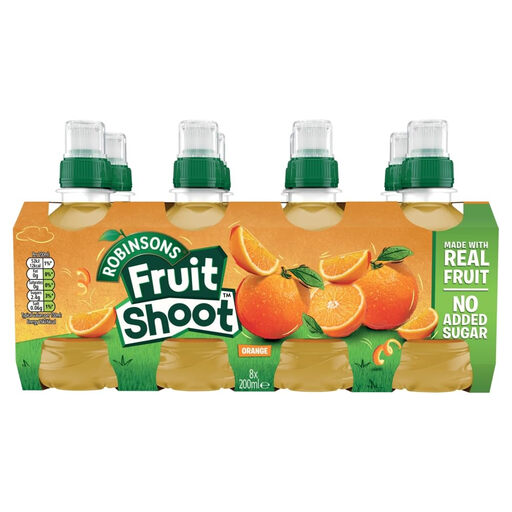
Fruitshoot Orange Low Sugar 8 x 200ml
The individual 200ml bottles are an option if you want to pack an orange drink for lunch rather than prepare squash. This is a diluted orange drink, not 100% orange juice; check the current pack for its ingredients and sugar figure. The product details warn that caps contain small parts and that the drink is unsuitable for children under 36 months.
View on Joybuy
 No image available
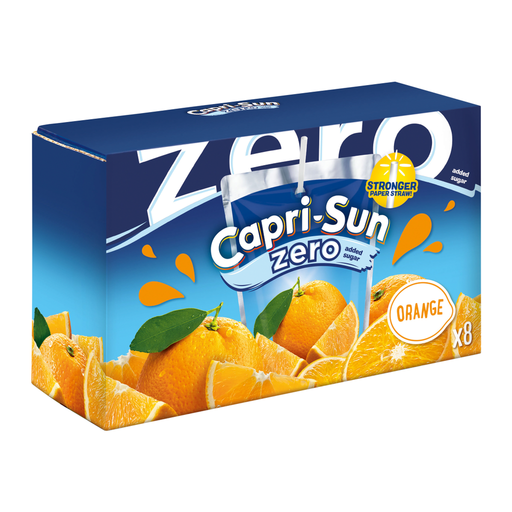
Capri-Sun Zero Orange 8 x 200ml
The 200ml pouches provide an individual orange drink for lunch, but this is not 100% orange juice. Do not take “Zero” in the product name to mean that the drink has no sugar: check the current pack’s nutrition panel before choosing it on that basis. The product details warn that the straw presents a choking hazard and that the drink is unsuitable for children under three.
View on Joybuy
 No image available
Robinsons No Added Sugar Orange Squash 1L
This 1L squash is an option if you can make up an orange-flavoured drink before lunch; it is neither 100% orange juice nor a ready-to-drink bottle. Follow the pack’s dilution directions and do not drink the squash undiluted. Check the ingredients, including sweeteners and sulphites; the product details also say it is unsuitable for children under 36 months.
View on Joybuy
Questions about orange drinks
Does “no added sugar” mean orange juice is sugar-free?
No. Pure orange juice can contain naturally occurring sugars: Tesco Groceries lists 8.6g sugars per 100ml for Tropicana Smooth Orange 300ml. Check the nutrition panel rather than using a no-added-sugar claim as a zero-sugar figure.
Is a 250ml or 300ml juice bottle one recommended daily portion?
No. The NHS advises limiting fruit juice, vegetable juice and smoothies to a combined 150ml a day, so a 250ml or 300ml juice bottle exceeds that amount. Check the bottle volume even if the label divides it into servings.
Should I have orange juice with lunch or sip it later?
The NHS advises having fruit juice and smoothies at mealtimes rather than between meals because juicing releases sugars that can damage teeth. If you choose juice for an on-the-go lunch, have it with the meal rather than repeatedly sipping it afterwards.
Is a lower-sugar orange drink the same as orange juice?
Not necessarily. Tesco Groceries lists Tropicana Trop 50 Orange & Mango 300ml as containing water, 30% orange juice, 11% mango purée and a stevia sweetener, whereas Tropicana Smooth Orange 300ml is labelled 100% pure juice. Compare the ingredients and drink description alongside the sugar figure.


