
24/7 Customer Support

Free returns

Same-day & Next-day Delivery

Quality Guaranteed

Unlock Your Welcome Offers: FREE Delivery | Up to 80% OFF | Free 30-day JoyPlus trial
Download the APP
As a Joybuy Product Recommendation Officer, my role is to help you navigate the crowded market of car care tools. Achieving that coveted showroom shine on your vehicle is satisfying, but choosing the right tool can be confusing. An orbital car polisher is often the go-to for enthusiasts, yet many end up with a tool that either gathers dust or, worse, damages their paintwork. This guide will help you understand the key features to look for and avoid the common purchasing traps.
Before you add an electric car polisher to your basket, be aware of these frequent marketing traps that can lead to disappointment and wasted money.
car buffer and polisher kit not only provides better value from the start but ensures all components are compatible and ready for the job.To make an informed choice, focus on these non-negotiable specifications. They are the true indicators of a tool's performance and safety.
The single most important feature for a non-professional is the polishing motion. This is where a dual action car polisher (also known as a random orbital polisher) excels.
polisher for removing swirl marks and light scratches without introducing new defects. For any DIY car paint correction tool, this feature is essential.The polishing pad is what makes contact with your car's paint. The size and type are critical.
Power, measured in Watts, is less important than control. Look for a polisher with variable speed settings. Different tasks require different speeds; a lower speed (around 2,500-3,000 OPM) is ideal for spreading wax, while a higher speed (4,000+ OPM) is needed for correction work. This control allows you to adapt the tool to the task, rather than using a one-speed-fits-all approach that can be ineffective or unsafe.
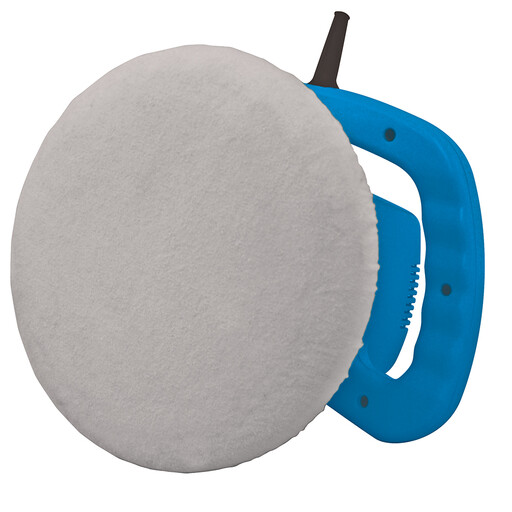
Why This Fits Their Persona: Ideal for the UK car owner who wants to maintain their vehicle's finish a few times a year. It's a straightforward, effective tool for applying wax, removing light oxidation and tackling minor swirl marks without a steep learning curve.
Its random orbit motion completely avoids the "Aggressive Power" trap, making it safe on paint. It also comes as a complete kit with two bonnets, sidestepping the "Tool-Only" false economy.
The ergonomic dual-handle design provides excellent stability and control, addressing the fatigue issue. The large 240mm pad makes quick work of larger panels like the roof and bonnet.
We have compiled a complete, real-time list of products that fully satisfy these strict selection criteria and UK safety regulations.
This depends on your car's condition and exposure. For paint correction to remove swirls, once or twice a year is usually sufficient. For applying a protective layer of wax or sealant, you can use the polisher every 3-4 months to maintain protection and shine. Over-polishing, especially with abrasive compounds, should be avoided.
A dual action polisher is excellent for removing light-to-moderate imperfections like swirl marks, water spots and oxidation. However, for deep scratches that you can feel with your fingernail, a machine polisher may not be enough. These often require professional attention, such as wet sanding or touch-up paint, as they may have penetrated the clear coat.
They are designed for different stages of the detailing process. A polishing bonnet (often a synthetic textile or terry cloth) has a slight texture and is used with a polishing compound to cut away a microscopic layer of the clear coat, levelling out imperfections. A finishing bonnet (typically made of soft wool or microfibre) has a much plusher, gentler pile. It is used as the final step with a wax or sealant to enhance gloss and add a layer of protection without being abrasive.