Hosts serving dairy-free drinks
An almond drink may suit guests avoiding dairy, but it cannot serve as the option for everyone until you have checked for nut allergies. The Food Standards Agency identifies almonds as tree nuts.


Choose a certified-organic almond drink for the birthday party if organic production matters to your guests and you have confirmed that nobody needs to avoid almonds or other tree nuts. Plenish offers a short-ingredient organic recipe, while Rude Health Pure Almond lists 5% organic almonds; if calcium and iodine fortification matters more, check a fortified drink such as Alpro Roasted Almond No Sugars instead. An almond drink is not a suitable default for a guest with an almond allergy, regardless of its organic or dairy-free label.
An almond drink may suit guests avoiding dairy, but it cannot serve as the option for everyone until you have checked for nut allergies. The Food Standards Agency identifies almonds as tree nuts.
If organic status and a short ingredient list matter for cold drinks or party food, compare claims on the specific cartons. Also check fortification separately if the drink will be used regularly as a main milk drink.
If the menu includes cappuccinos or cortados, look for a product formulated for foaming rather than assuming every organic almond drink will behave the same way in coffee. Plenish describes its organic Barista Almond drink as foamable.
Confirm allergies before choosing a recipe, then match the carton to how guests will use it and whether organic certification or fortification matters.
| Priority | What to check | Your needs |
|---|---|---|
| Nut allergies | Ask guests about almond and other tree-nut allergies. Read the current carton’s ingredients and allergen statement, including any stated traces or handling warnings. | I need a separately labelled non-nut drink if a guest must avoid almonds or other tree nuts. The Food Standards Agency identifies almonds as tree nuts. |
| Organic status | Check the claim on the specific product, not just its brand or dairy-free wording. Defra’s UK organic-labelling guidance, dated August 2025, specifies approved-control-body certification and at least 95% organic agricultural ingredients for food labelled organic. | Organic production matters for this party, so I want the actual carton to carry an organic claim rather than assuming that plant-based means organic. |
| Recipe | Compare ingredients on the carton. Plenish’s standard organic drink is listed by Sainsbury’s with water, 4% organic almonds and sea salt; Rude Health Pure Almond lists water and 5% organic Italian almonds. | For a simple pour, I would prefer a short ingredient list; for a different almond recipe, I want to see what is actually in it. |
| Fortification | Check calcium and iodine amounts on the exact carton. Frimley Healthier Together NHS guidance for a child using a plant drink as a main milk drink after age one specifies at least 120 mg calcium per 100 ml and iodine. | If this will also be a child’s regular main milk drink, I need to assess its fortification separately from its suitability as an occasional party drink. |
| Serving use | Check whether the product is intended for cold pouring, cooking or coffee foam. Plenish describes its organic Barista Almond drink as foamable for cappuccinos and cortados. | I am serving coffee as well as party food, so a carton chosen for cold drinks alone might not meet both plans. |
| Opened-carton storage | Follow each carton’s refrigeration and after-opening instructions. Sainsbury’s lists four days after opening for Plenish’s standard organic drink and five days for Rude Health’s standard Almond Drink. | When buying several cartons ahead, I want to open them at a time that fits the party and the instructions on each product. |
Almond remains a tree nut regardless of how the drink is produced or labelled for dairy.
Confirm guests’ allergies before buying, read each carton’s current allergen statement and arrange a separately labelled non-nut option where needed.
An organic almond recipe and a fortified almond drink answer different needs. The ingredients that make a drink suitable for occasional party use do not establish its suitability as a child’s regular main milk drink.
If regular main-milk use is relevant, check calcium and iodine on the exact pack against the applicable NHS guidance rather than relying on organic or dairy-free wording.
Plenish markets a separate organic Barista Almond recipe for foam, while its standard organic drink has a different stated use.
For cappuccinos or cortados, check that the particular carton is formulated for coffee foam.
After-opening instructions differ: Sainsbury’s lists four days for Plenish’s standard organic drink and five days for Rude Health’s standard Almond Drink.
Plan when to open the cartons and follow the storage directions printed on each one.
Its standard certified-organic almond drink is a short-ingredient option; Plenish also offers an organic barista version for coffee.
Its organic almond recipes differ: Pure Almond lists water and 5% organic Italian almonds, while the standard Almond Drink contains rice and 1% organic almonds.
Alpro Roasted Almond No Sugars is a fortification-led comparison for hosts who are not choosing solely by an organic claim.
These Alpro multipacks are almond-drink options for the party. If organic certification or particular nutrient amounts matter, check the details on the exact carton before choosing; confirm nut-allergy needs before serving either drink.
 No image available
This eight-carton multipack is an option when serving an almond drink labelled No Sugars. Check the carton for organic certification and nutrient amounts if either affects your choice. It contains almond, so establish guests’ allergy needs before serving.
 No image available
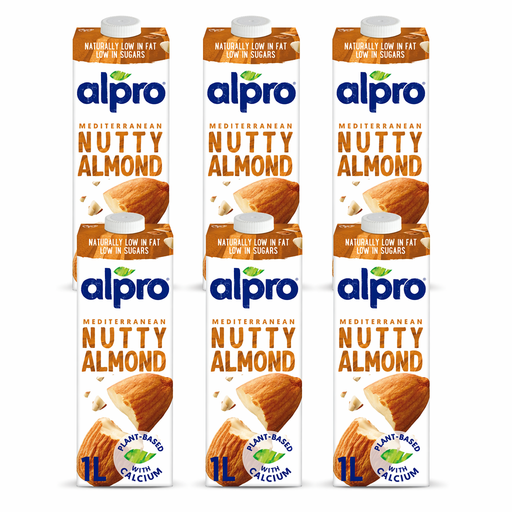
This six-carton almond-drink multipack offers another format for party serving. Compare its current ingredients, organic claim and fortification with your requirements rather than assuming it has the same recipe as Alpro No Sugars. It contains almond, so check guests’ allergies.
Defra’s UK organic-labelling guidance, dated August 2025, says that products and suppliers must be certified by an approved organic control body and that at least 95% of a food’s agricultural ingredients must be organic. Check the specific carton: dairy-free or vegan wording is not itself an organic claim.
No. The Food Standards Agency identifies almonds as tree nuts and almond-containing products as a possible risk for someone with a nut allergy. Ask about allergies before planning drinks or food and provide a separately labelled non-nut option where needed.
For an occasional party drink, first establish the child’s dietary and allergy needs. If a plant drink is also being used as a child’s regular main milk drink after age one, Frimley Healthier Together NHS guidance specifies fortification including at least 120 mg calcium per 100 ml and iodine; an organic claim does not establish those amounts.
Check a product formulated for foam if you plan to make cappuccinos or cortados. Plenish describes its organic Barista Almond drink as foamable; do not assume its standard organic recipe will give the same result.
Follow each carton’s after-opening instructions. Sainsbury’s lists refrigeration and use within four days for Plenish’s standard organic almond drink, compared with five days for Rude Health’s standard Almond Drink; check the pack you actually buy.