
24/7 Customer Support

Free returns

Same-day & Next-day Delivery

Quality Guaranteed

Unlock Your Welcome Offers: FREE Delivery | Up to 80% OFF | Free 30-day JoyPlus trial
Download the APP
As a parent, navigating the baby food aisle can feel like a full-time job. The shelves are brimming with colourful pouches and bags, all promising wholesome, organic goodness for your little one. But with so much choice, how do you separate the genuinely healthy options from the cleverly marketed junk food? Many well-intentioned parents find themselves with cupboards full of snacks their baby won't touch, or worse, snacks that aren't as healthy as they first appeared.
My role as Joybuy's Product Recommendation Officer is to help you cut through the clutter. We've seen where parents commonly go wrong, not through any fault of their own, but because of confusing marketing. Before you spend another pound, let's look at the most common pitfalls when buying organic baby snacks.
To avoid these traps, you need to become a savvy label-reader. It's simpler than it sounds. Focus on these three core parameters to ensure you're choosing genuinely healthy toddler snacks and appropriate weaning snacks.
The golden rule is to look for a short, recognisable ingredients list. If it reads like a science experiment, it's probably best to put it back. When it comes to sugar, distinguish between naturally occurring sugars within whole or minimally processed fruit and free sugars from juice concentrates. While both are "natural," whole ingredients also provide fibre, which slows sugar absorption. Look for snacks sweetened with whole fruit or vegetables where possible.
A baby's eating skills develop rapidly. The right snack supports this journey.
Look beyond the "organic" label and check the nutritional panel. A good snack should offer more than just empty calories. Look for a source of fibre (from wholegrains like oats) or protein. Salt content should always be very low. For busy families, convenience is key. Multipacks of individually wrapped portions are ideal for on the go baby snacks, ensuring they stay fresh in a changing bag or lunchbox. Many options are also designed as gluten free baby snacks to cater for dietary needs.
Based on these practical criteria, we've matched some suitable options to different parenting needs.
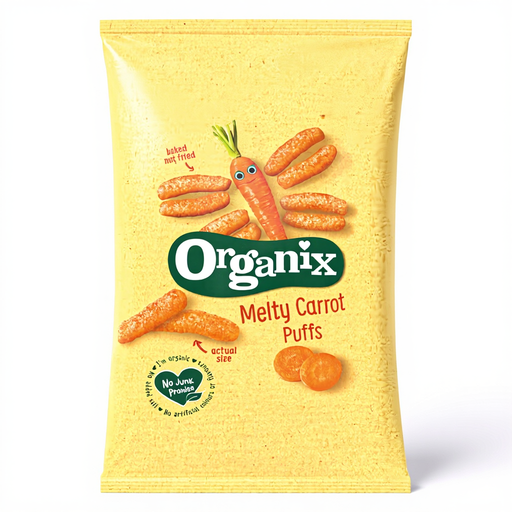
Why This Fits Their Persona: You're navigating the start of the weaning journey and safety is your top priority. You need a simple, safe first finger food that encourages self-feeding without causing worry.
Directly counters the "Texture Mismatch" trap. The 'melty' texture is specifically designed to dissolve in the mouth, making it appropriate for babies with few or no teeth.
Made from baked corn and carrot powder with no added salt. The chunky shape is easy for little hands to grip, supporting motor skill development.
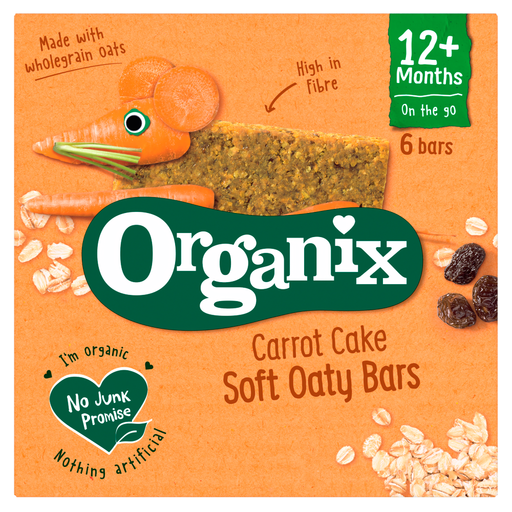
Why This Fits Their Persona: You're juggling nursery runs, park trips and a hungry toddler. You need a substantial, mess-free, on-the-go snack that provides slow-release energy without being "junk food".
This bar avoids the "Organic Junk Food" disguise. Its primary ingredient is wholegrain oats (49.1%), making it a rich source of fibre for sustained energy, unlike simple corn puffs.
Individually wrapped for ultimate convenience and portion control. The soft, chewy texture is satisfying for toddlers and it's made with real carrot and raisins for flavour.
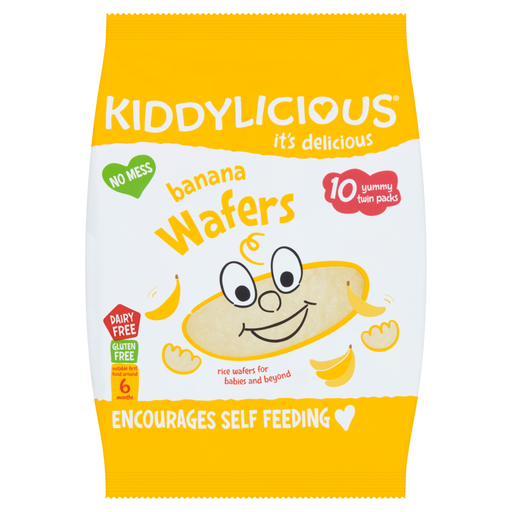
Why This Fits Their Persona: You need to be extra careful with ingredients due to a potential or diagnosed allergy. Finding snacks that are explicitly free from common allergens like gluten and dairy is your main goal.
This product is designed for parents who need to avoid specific ingredients. It clearly states "Dairy & gluten free" and "no gluten, milk or eggs," removing the guesswork and worry.
The wafers have a light, melty texture suitable for the 6+ month stage. They are made from jasmine rice flour and are individually portioned for hygiene and convenience.
We have compiled a complete, real-time list of products that fully satisfy these strict selection criteria and UK safety regulations.
You can typically introduce appropriate snacks around the 6-month mark, which is when most babies begin weaning onto solid foods. It's crucial to choose snacks specifically labelled for this age (e.g., 6+ months). These are formulated to have a texture that dissolves easily to minimise choking risk. Always supervise your baby while they are eating.
Not necessarily. The "organic" certification primarily refers to the farming methods used to grow the ingredients—without synthetic pesticides or fertilisers. This is a significant benefit for many parents. However, a snack's overall healthiness also depends on its sugar, salt and fat content, and its nutritional density. An organic biscuit loaded with fruit juice concentrate can be less healthy than a non-organic snack made with wholegrains and no added sugar. Always read the full nutritional label.
Most dry snacks like puffs, rice cakes and biscuits lose their crispness when exposed to air. Once a main pack is opened, it's best to transfer the contents to an airtight container and store it in a cool, dry cupboard. Check the packaging, as it will provide specific storage instructions to maintain the product's quality.