Parents packing school-day snacks
A portable bar may work for an after-school snack or lunchbox, provided its age guidance and current allergen label fit the child. Before packing it for school, check the school’s own allergy arrangements.


Choose an organic cereal bar by checking the current pack’s organic labelling, sugars per bar, age guidance and allergens—not by relying on the organic claim alone. An oat bar such as Organix Raspberry & Apple is an option when gluten and oats are suitable; if gluten must be avoided, a labelled gluten-free option such as FREEE Apple & Sultana is more relevant, but its oat warning and any school allergy policy still need checking.
A portable bar may work for an after-school snack or lunchbox, provided its age guidance and current allergen label fit the child. Before packing it for school, check the school’s own allergy arrangements.
A gluten-free organic oat bar is a different choice from a standard oat bar. FREEE says its Apple & Sultana bar is not suitable for people who react to avenin, a protein in oats.
Compare sugars and energy for the bar a child would actually eat, alongside any fibre claim. In its 2025 supermarket snack-bar audit, Action on Sugar reported that 31% of bars carrying a high-fibre claim were also high in sugars under UK traffic-light criteria.
Start with any dietary or school restrictions, then compare the organic claim and nutrition information on the exact packs you are considering.
Consider it when: Gluten and oats are suitable for the child and a portioned oat-and-fruit bar fits the occasion.
Keep in mind: Organix says its Raspberry & Apple bar contains gluten and oats and may contain traces of tree nuts, soya and milk.
Consider it when: Gluten avoidance is required and an oat bar is otherwise suitable.
Keep in mind: FREEE says its Apple & Sultana bar is not suitable for someone who reacts to avenin, despite its gluten-free labelling.
| Priority | What to check | Your needs |
|---|---|---|
| Organic labelling | Check the organic claim on the current pack rather than inferring it from the brand or packaging design. UK guidance from the Department for Environment, Food & Rural Affairs says organic-labelled food must meet production rules, the 95% organic agricultural-ingredients requirement and certification conditions. | I want an organic product, but I still need to judge its ingredients and nutrition separately. |
| Portion and nutrition | Compare sugars, energy, saturated fat and fibre per bar, noting each bar’s weight. Use the per 100g figures for a like-for-like comparison, then check what the individual portion contains. | A smaller bar may be the portion I plan to pack; a fibre or organic claim does not tell me its sugars per serving. |
| Gluten and oats | Read the exact pack’s ingredient and allergen statements. Organix says its Raspberry & Apple bar contains gluten and oats; FREEE describes its Apple & Sultana bar as gluten-free but warns that it is unsuitable for people who react to avenin. | If gluten must be avoided, I need a suitable labelled product—not an assumption that all oat bars are interchangeable. |
| Other allergens | Check declared allergens and may-contain wording for the chosen flavour and current batch. Organix lists possible traces of tree nuts, soya and milk for its Raspberry & Apple bar; do not transfer that statement to another flavour without reading its pack. | For a child with an allergy, the precise product label matters more than the brand’s general snack range. |
| School arrangements | Read the school’s current packed-lunch and allergy policy before sending a bar. The Department for Education’s guidance for England says schools must publish an allergy safety policy addressing contact with known allergens. | A snack we use at home might not fit my child’s school arrangements, particularly where allergens are restricted. |
Organic production and the nutrition in a serving answer different questions. Action on Sugar’s 2025 supermarket snack-bar audit found that 31% of bars carrying a high-fibre claim were also high in sugars under UK traffic-light criteria.
Compare sugars, energy, saturated fat and fibre on the current packs, paying attention to both per-bar portions and per 100g figures.
Organix says its Raspberry & Apple bar contains gluten and oats. FREEE describes its Apple & Sultana bar as gluten-free, while warning that it is unsuitable for people who react to avenin.
Use the exact product’s current allergen statement and any dietary advice applicable to the child; do not substitute one oat bar for another on the strength of its name.
The Department for Education’s guidance for England says schools must publish an allergy safety policy setting out arrangements to reduce contact with known allergens.
Check the individual school’s current policy and the bar’s allergen label before packing it.
These product examples illustrate different oat-bar labelling and allergen checks; a brand name alone does not establish whether another flavour meets the same requirements.
Organix positions its soft oaty bars as snacks for children aged 12 months and over. Its Raspberry & Apple bar provides a specific example of an oat bar that contains gluten.
FREEE is Doves Farm’s gluten-free brand. Its Apple & Sultana Organic Kids Oaty Bars provide a labelled gluten-free oat-bar example.
These Organix oat-bar flavours are options to consider for an after-school snack when oats are suitable. Check each current pack for its organic claim, nutrition and allergens; this selection does not cover the gluten-free oat-bar route.
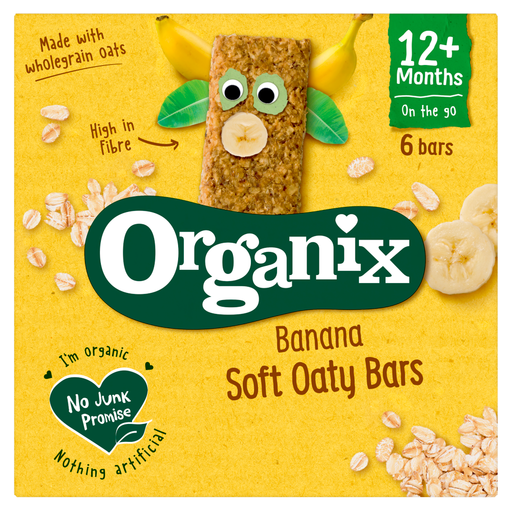 No image available
For a portioned after-school snack, check the current pack’s organic labelling, sugars per bar and allergen statement before choosing this flavour.
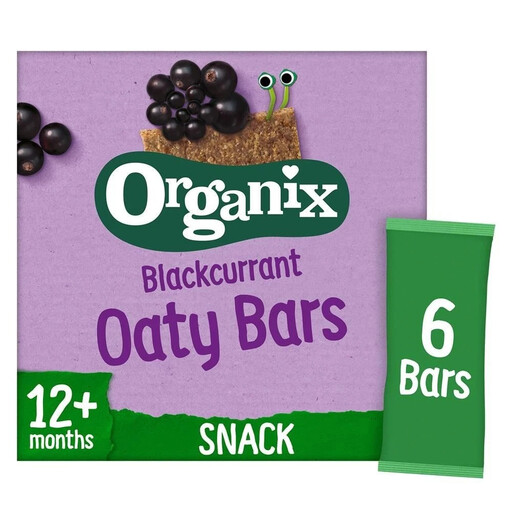 No image available
The product name identifies this as an organic oat-bar option. Compare its current per-bar nutrition and allergen label with any other flavour you are considering, especially if school restrictions apply.
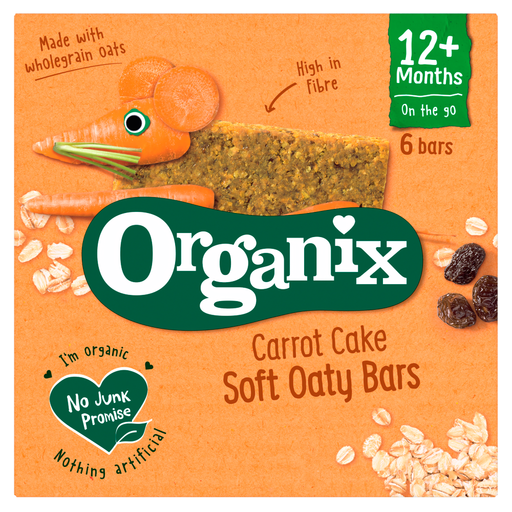 No image available
The listed pack weight is 138g. To compare an individual snack with other bars, check its current portion size, sugars per bar, organic labelling and allergen statement.
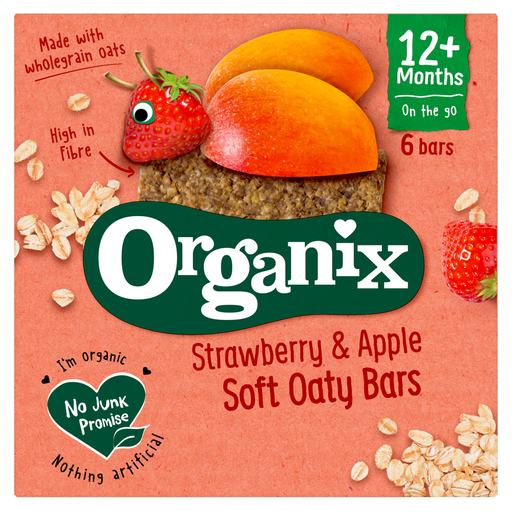 No image available
For a 23g-bar portion, compare the current sugars and energy per bar. Check this flavour’s own organic and allergen labelling rather than relying on information for another Organix bar.
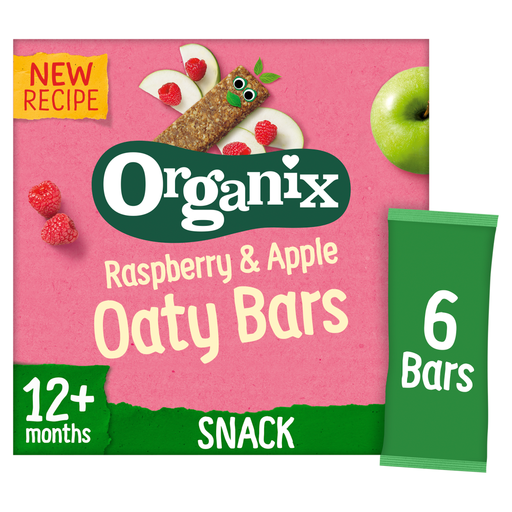 No image available
Organix lists 49% wholegrain oats for this flavour and says it contains gluten and oats and may contain traces of tree nuts, soya and milk. Check the current pack’s sugars per bar before comparing it with another flavour.
It is a regulated production claim, not a nutrition or allergen claim. The Department for Environment, Food & Rural Affairs says food labelled organic must meet organic production rules, contain at least 95% organic agricultural ingredients and meet approved control-body certification requirements. Check the current pack for the product’s claim.
No: organic labelling does not establish the sugars in a bar. Compare the current nutrition panels per bar and per 100g, allowing for different portion sizes. Action on Sugar’s 2025 UK supermarket snack-bar audit reported that 37% of bars assessed would be high in sugars under voluntary UK traffic-light criteria; that category finding does not determine the rating of an individual organic bar.
Check the particular school’s policy and the bar’s current allergen statement before packing it. The Department for Education’s guidance for England says schools must publish an allergy safety policy covering arrangements to reduce contact with known allergens; it does not provide a single answer for every product and school.
Not automatically. FREEE describes its Apple & Sultana bar as gluten-free but says it is not suitable for people who react to avenin, a protein in oats. Check the current pack and follow dietary guidance specific to the person concerned.