Hosts serving mixed preferences
If some guests avoid caffeine, distinguish black-tea chai from herbal-style blends and check the exact pack before serving.


For a book club seeking organic chai, look for an explicit organic claim rather than relying on words such as ‘chai’ or ‘natural’: UK government guidance ties organic labelling to production rules and certification. Clipper Organic & Fairtrade Indian Chai offers a black-tea blend, while Pukka Vanilla Chai offers a vanilla-spice herbal-style blend; check the exact pack’s ingredients and caffeine information when guests need to avoid caffeine.
If some guests avoid caffeine, distinguish black-tea chai from herbal-style blends and check the exact pack before serving.
Look for an organic claim on the product itself rather than treating spices or ‘natural’ wording as proof of certification. UK government guidance sets production and certification requirements for organic labelling.
Decide whether the group expects black tea with spices or a blend with more noticeable vanilla or liquorice notes; the ingredient lists point to different serving choices.
Check the organic claim first, then choose the tea base and flavour with the guests and meeting time in mind.
| Priority | What to check | Your needs |
|---|---|---|
| Organic status | Look for an explicit organic claim and check the current label for certification information. The UK Department for Environment, Food & Rural Affairs says organic labelling requires compliance with production rules and certification by an approved control body. | I want the finished chai to be sold as organic, not just described as spiced, natural or herbal. |
| Tea base and caffeine | Read the ingredients and any caffeine statement on the exact pack. Clipper lists black tea in its Organic Indian Chai; Pukka’s Original Chai page uses herbal-tea wording but also mentions black tea. | For an evening meeting or guests avoiding caffeine, I need to know what is in the drink rather than assuming that organic chai is caffeine-free. |
| Flavour | Compare the named ingredients: Clipper lists cinnamon, orange peel, cloves and fennel alongside black tea, while Pukka lists vanilla, cinnamon, ginger, cardamom, fennel and liquorice for Vanilla Chai. | A shared pot should fit the group’s taste; I would check before choosing a blend with prominent vanilla or liquorice notes. |
Chai describes a type of drink, not a certification. UK government guidance requires products labelled organic to meet the applicable production and certification rules.
Check the product’s organic claim and current label rather than relying on ‘natural’, ‘herbal’ or a spice list.
Clipper’s Organic Indian Chai contains black tea, and Teapigs says its black chai contains caffeine. Organic status does not answer the caffeine question.
Check the exact pack’s ingredients and caffeine information. If guests avoid caffeine, offer a separately identified drink that meets their needs.
Pukka Vanilla Chai lists vanilla and liquorice, whereas Clipper’s Indian Chai combines black tea with spices including orange peel and cloves. One blend may not suit everyone expecting the other.
Tell guests the main flavours in advance and keep the pack available so they can inspect the ingredients.
Clipper names Tesco and Sainsbury’s among retailers carrying its teas, but brand-level availability does not confirm stock of Organic Indian Chai at a particular branch.
Check the current listing and pack size before planning drinks for the meeting.
Compare specific chai products rather than assuming every blend from a brand has the same tea base or organic status.
Pukka offers Original Chai and Vanilla Chai for shoppers considering organic, spice-led blends.
Clipper Organic & Fairtrade Indian Chai is a tea-bag option for a group wanting black tea with spices.
Twinings provides a black-tea chai comparison for hosts considering familiar tea-and-spice flavours.
Teapigs chai is a black-tea option for hosts considering a milk-served drink.
This selection covers a vanilla-spice chai for a book-club serving.
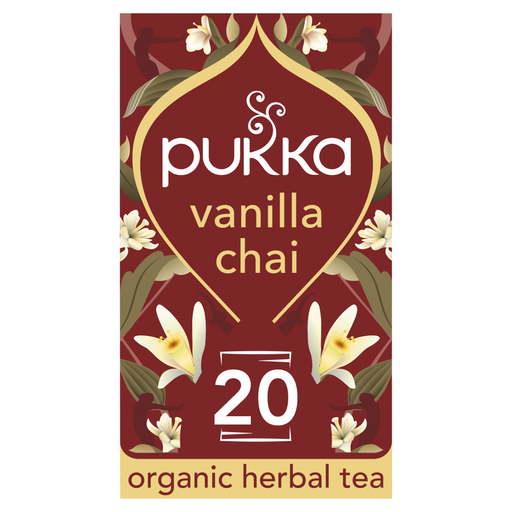 Image unavailable
For a group interested in vanilla-spice chai, Pukka lists vanilla, cinnamon, ginger, cardamom, fennel and liquorice. The pack contains 20 sachets (40g). Check the current pack’s organic certification details and caffeine statement if either affects your choice.
Look for an explicit organic claim on the product and check its current label for certification information. UK Department for Environment, Food & Rural Affairs guidance says products labelled organic must meet the applicable production rules and certification requirements; ‘chai’, ‘natural’ and ‘herbal’ alone do not establish this.
No. Organic status and caffeine content are separate considerations: Clipper’s organic Indian Chai lists black tea, while Teapigs states that its black chai contains caffeine. Check the exact pack’s ingredients and caffeine statement for guests avoiding caffeine.
A black-tea chai is one option to consider with milk: Twinings describes chai as typically served that way, and Teapigs specifically suggests plenty of milk with its black chai. Check guests’ preferences; not every blend needs to be served alike.
Do not assume the exact blend is in stock. Clipper lists Tesco and Sainsbury’s among retailers carrying its teas, but check the current product listing for your branch or delivery area before the book club meets.