Households cooking coconut-based meals
If curries, soups or desserts account for most of your use, look at culinary cans. Check the can size against planned recipes and its instructions for storing leftovers.


Choose the format by how your household will use it: canned coconut milk is the concentrated option for cooking, while a carton coconut drink suits cereal and drinks. If organic status matters, check for an explicit organic claim on the product; if a carton will regularly replace dairy milk, compare its declared calcium and vitamins too. Organic status alone does not establish nutritional equivalence or how long an opened pack will keep.
A large household may need coconut milk for cooking, coconut drink for everyday use, or both; the pack format matters more than a shared coconut name.
If curries, soups or desserts account for most of your use, look at culinary cans. Check the can size against planned recipes and its instructions for storing leftovers.
For cereal, smoothies or coffee, look for a drink explicitly labelled organic. A multipack may suit regular use, but check each carton’s opened-pack instructions and its nutrition panel if it will often replace dairy milk.
If calcium and vitamins are a deciding factor in a dairy-free drink, compare the figures on the specific cartons. Do not assume that coconut drinks have the same formulation merely because they share a flavour or format.
Decide whether the household needs a cooking ingredient or a drink, then compare organic labelling, nutrition and opened-pack use within that format.
Choose when: Planned curries, soups or desserts call for a concentrated coconut ingredient.
Bear in mind: Waitrose lists 15.8 g of saturates per 100 g for Duchy Organic Coconut Milk, and its opened can has a two-day use instruction.
Choose when: An explicitly organic drink for cereal or other everyday drinks is the priority; Plenish offers an 8 × 1 L multipack.
Bear in mind: A carton drink is not a direct substitute for concentrated coconut milk in a recipe.
Choose when: Declared calcium and vitamins matter more to the household than an organic claim.
Bear in mind: Check the individual drink’s ingredients and nutrition panel rather than assuming its formulation matches an organic carton.
| Priority | What to check | Your needs |
|---|---|---|
| Format | Check whether the pack is a culinary can or a carton drink, and read its stated uses. Waitrose lists 60% organic coconut extract for its Duchy cooking can. | For curries or desserts, I need the cooking ingredient; for cereal and coffee, I need a drink. |
| Organic labelling | Look for an explicit organic claim on the current product. The Department for Environment, Food & Rural Affairs says food labelled organic must meet organic production rules. | Organic status matters to me, so a coconut flavour or short ingredient list alone will not settle the choice. |
| Nutrition | Compare the specific carton’s declared calcium and vitamins if it will regularly replace dairy milk. Also check ingredients if sweetening or additives matter. | Our everyday drink needs the nutrient information on its own label, not an assumption based on the word ‘coconut’. |
| Opened-pack use | Match pack size to planned use and follow its storage instructions. Waitrose gives Duchy Organic Coconut Milk a two-day opened use period; Tesco lists five days for Koko Unsweetened, also subject to the date on its cap. | I want to use an opened can for planned meals, while cartons need to fit how quickly the household drinks them. |
A drink and a concentrated culinary product have different formulations, so a recipe calling for canned coconut milk may not turn out as intended with a carton drink.
Check the recipe and the pack’s stated use before adding either format to a large shop.
Organic labelling addresses production rules; it does not tell you how much calcium or which vitamins a drink contains.
If the carton will regularly replace dairy milk, compare the current nutrition panels as well as the organic claims.
The period for using an opened pack varies by product. Waitrose gives its Duchy can two days, while Tesco’s Koko Unsweetened listing says five days and no later than the date on the cap.
Plan cans around meals and follow the storage directions on each pack, rather than applying one rule to the whole shop.
Partly used packs can go to waste if the household cannot use them within their stated period.
Ingredients and pack information can change, which matters when a household needs to avoid a particular ingredient.
Check the physical pack received for its current ingredients, allergen information and directions.
These examples illustrate differences between cooking cans and carton drinks; the details apply to the named products, not every item made by each brand.
Plenish’s Coconut M*lk is an organic carton drink offered as an 8 × 1 L multipack.
Koko Unsweetened is a 1 L coconut-based carton drink with declared calcium and vitamins.
Alpro Coconut Original is a coconut-flavoured carton drink; it is a different product from the Alpro Barista multipack shown below.
Waitrose lists Duchy Organic Coconut Milk as a 400 ml culinary can for dishes including curries, soups and desserts.
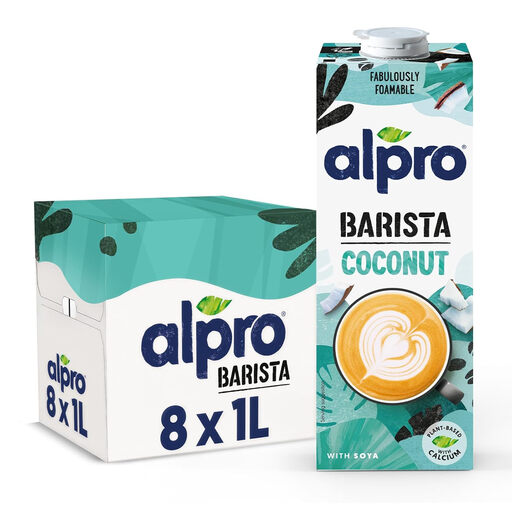
This Alpro Barista multipack represents the carton-drink side of the choice, rather than a concentrated cooking can. If certified organic status is essential, check the specific product pack before choosing it.
 No image available
The 8 × 1 L carton format is relevant if several household members use a coconut drink. Check the pack’s organic labelling, ingredients, nutrition and opened-carton instructions against your household’s needs.
Look for an explicit organic claim on the current pack rather than treating ‘natural’ or a short ingredient list as equivalent. The Department for Environment, Food & Rural Affairs says that food labelled organic must meet organic production rules.
No. Waitrose describes its Duchy Organic can as a culinary product for curries, soups and desserts, while Plenish describes Coconut M*lk as a carton drink made with water, organic coconut, rice and salt. Choose according to the recipe or drinking use.
No. Organic status does not establish a drink’s nutrient formulation. If added calcium or vitamins matter for regular use, check the nutrition panel on the exact carton you intend to buy.
Follow the individual pack. Waitrose instructs shoppers to refrigerate unused Duchy Organic Coconut Milk and use it within two days; Tesco lists five days after opening for Koko Unsweetened, also subject to the date on its cap.
Do not assume it is suitable for that use. Sainsbury’s Koko product information advises consulting a GP or qualified dietitian before using the drink as a main milk source for a child under two; check the current pack if this is relevant to your household.