Organic-first shoppers
If certified organic ingredients matter to you, check that claim on the pack alongside energy per bar and the rest of its nutrition information. Organic labelling is not a measure of portion size.


Choose an organic-labelled bar if certified organic sourcing is a priority; choose between bars for a weight-management eating pattern by comparing the portion you will eat, not by relying on an organic or protein claim alone. A conventional bar may better match the protein and sugar values you are looking for, but check its energy, ingredients, allergens and sweeteners as well. Organic status does not tell you how many kcal a bar contains.
If certified organic ingredients matter to you, check that claim on the pack alongside energy per bar and the rest of its nutrition information. Organic labelling is not a measure of portion size.
If you are considering a protein bar instead of another snack, compare the portion you would actually eat. A conventional bar’s protein and sugar figures may suit your criteria without meeting an organic-sourcing preference.
Allergens, precautionary statements and sweeteners can change which bar is suitable. Check the current pack for the particular flavour, even if you know another product from the same brand.
Start with the serving size and nutrition panel, then check organic labelling and ingredients. NHS food-labelling guidance explains the nutrition information on pre-packed food; GOV.UK’s UK organic-labelling guidance, dated 20 August 2025, addresses organic claims separately.
Consider it when: Certified organic sourcing and a plant-based ingredient list are priorities.
Check separately: Organic labelling does not tell you the energy or sugars in the portion you will eat.
Consider it when: Declared protein and sugars per bar matter more to you than organic sourcing.
Check separately: Ingredients, allergens and sweeteners vary by product; some bars carry excessive-consumption warnings.
| Priority | What to check | Your needs |
|---|---|---|
| Portion and energy | Compare kcal per bar and per 100g. Check whether the stated serving is the amount you intend to eat. | I want to account for the whole bar as a snack, rather than judge it by a front-of-pack protein claim. |
| Organic labelling | Check the pack’s organic claim and certification information. GOV.UK’s UK guidance says organic-labelled food must meet organic production rules, contain at least 95% organic agricultural ingredients and be certified by an approved organic control body. | Certified organic sourcing matters to me; a plant-based or natural-sounding description alone does not answer that question. |
| Nutrition balance | Read protein, total sugars, saturates and salt alongside energy. Compare per-bar figures as well as per-100g values when bar sizes differ. | A protein figure catches my eye, but I also want to know what else is in the portion. |
| Ingredients and warnings | Read the full ingredients, highlighted allergens, any “may contain” statement and sweetener or polyol warnings on the current flavour’s pack. | I need to avoid an ingredient or check whether a sweetened bar suits my preferences before choosing a flavour. |
Organic certification concerns production and labelling, not the energy in a bar. NHS weight-management guidance also emphasises what and how much you eat.
Use organic status to assess sourcing, then compare kcal and other nutrition values for the portion you would eat.
Bars can have different serving sizes, so a front-of-pack figure may not give you a like-for-like comparison.
Read the per-bar and per-100g nutrition figures, including energy, sugars, saturates and salt.
The BodyMe recipes described by the brand include cashews, while the reviewed Barebells Salty Peanut bar declares milk, peanuts and soya. Ingredients and precautionary statements need checking for the product you choose.
Read the current pack’s ingredients, highlighted allergens and “may contain” statement for that flavour.
Barebells and Grenade warn that excessive consumption of their reviewed bars may have a laxative effect. A low declared sugar figure does not replace a check of the ingredients and warnings.
If sweeteners or polyols affect your choice, read the formulation and pack warning before buying.
These examples show different product approaches; a brand mention does not establish the organic status or nutrition of every flavour.
BodyMe describes its vegan protein bars as made with organic ingredients and containing 16g plant protein.
Hammer Nutrition UK describes an organic vegan bar containing 14g plant protein.
Grenade’s reviewed Chocolate Chip Salted Caramel bar is described by the brand as containing 20g protein and 1.4g sugars.
PhD lists 250 kcal and 21g protein per 64g bar for its Smart Protein Bar Choc Brownie flavour.
Barebells declares 204 kcal and 20g protein per 55g Salty Peanut bar.
These conventional protein bar options can be compared with an organic-labelled bar. Check each pack’s portion, nutrition, ingredients and organic labelling against the criteria that matter to you.
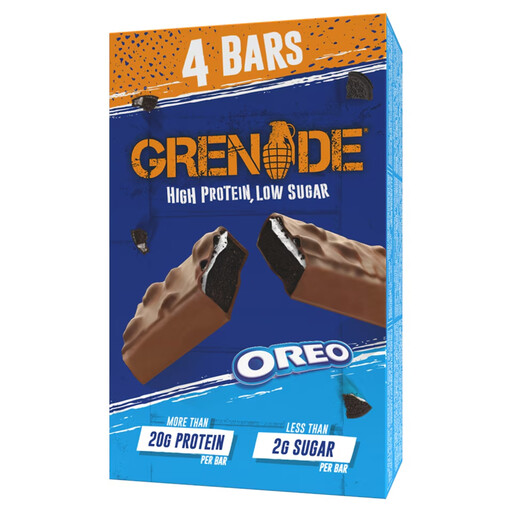 No image available
For a portion comparison, check the nutrition for one 60g bar rather than the four-bar pack. Read the current pack’s ingredients and allergens before choosing it in place of an organic-labelled option.
 No image available
If you are comparing snack portions, use the nutrition values for each 50g bar. Check the Double Chocolate pack’s ingredients, allergens and sweetener information rather than assuming they match another Grenade flavour.
 No image available
For a like-for-like snack comparison, read the values for each 40g bar as well as per 100g. Check the current pack’s allergen information and any organic claim before deciding whether it meets your requirements.
No. Organic labelling concerns how a food is produced and labelled, not its energy or portion size. Compare kcal per bar and per 100g, then read the other nutrition values for the portion you intend to eat.
Check the pack’s organic claim and certification information. GOV.UK’s UK organic-labelling guidance, dated 20 August 2025, says organic-labelled food must meet organic production rules, contain at least 95% organic agricultural ingredients and be certified by an approved organic control body.
Not on that figure alone. Compare protein alongside kcal, sugars, saturates and salt for the actual bar you would eat, and check how that snack fits into what and how much you eat overall.
No. Read total sugars and energy on the nutrition panel, plus the ingredients and any sweetener warnings. The reviewed Grenade and Barebells products carry warnings about laxative effects from excessive consumption.
Read the current pack’s ingredients, highlighted allergens and any “may contain” statement for the exact flavour. The Food Standards Agency explains that precautionary allergen labelling communicates possible unintended allergen presence; it is different from an allergen listed as an ingredient.