Cyclists looking for an organic savoury snack
If organic production matters to you, check the claim on the specific crisp and compare its ingredients and nutrition panel for the occasion when you plan to eat it.


Choose an explicitly organic-labelled crisp if you want a savoury snack around cycling, but compare the exact pack’s carbohydrate, fat and salt rather than treating its organic status as a fuelling claim. For high-intensity exercise lasting 1–2.5 hours, a 2015 review indexed by PubMed advises 30–60 g of carbohydrate per hour; plan food and drink together instead of assuming a packet of crisps will meet that intake.
If organic production matters to you, check the claim on the specific crisp and compare its ingredients and nutrition panel for the occasion when you plan to eat it.
A savoury snack can be part of your food choices, but its carbohydrate per pack needs to fit alongside your other ride food and drink.
If salt matters more to you than organic certification, compare declarations on organic and conventional crisps without assuming that either category has a fixed salt level.
Start with the reason for buying the crisp—an organic snack or food to carry on a ride—then compare the exact pack against that purpose.
| Priority | What to check | Your needs |
|---|---|---|
| Organic status | Look for an organic claim on the specific product and check its certification details. UK guidance from the Department for Environment, Food & Rural Affairs, updated in August 2025, says organic-labelled food must meet organic production rules, including the requirements for agricultural ingredients and approved certification. | I want an organic crisp, rather than a product labelled only vegan, gluten-free or lightly salted. |
| Ride carbohydrate | Read carbohydrate per pack, not just per 100 g, and count it with other food and drink. A 2015 review indexed by PubMed advises 30–60 g per hour for high-intensity exercise lasting 1–2.5 hours. | For a harder ride, I need to know what the packet contributes to my planned intake; its organic label does not answer that question. |
| Fat and salt | Compare both per 100 g and for the portion you will eat. The listed organic examples vary: Forest Whole Foods gives Junk Food crisps 28 g fat and 0.4 g salt per 100 g; Biona lists 37 g and 1.2 g; Abel & Cole lists Trafo Sea Salt & Vinegar at 34 g and 1.7 g. | I may want a savoury snack, but flavour names alone will not tell me its salt content. I would also check whether I want to carry and eat that portion during a ride. |
| Ingredients and pack | Check the exact flavour’s ingredients, allergen information, pack size and current label. Do not transfer details from another flavour or pack. | My dietary requirements and the amount I plan to carry matter as much as the product category. |
Organic certification concerns production and labelling; it does not establish how a crisp fits your carbohydrate or fluid plan.
Plan food and drink for the ride first. If you want to take crisps, count their stated carbohydrate and try the food on a training ride before relying on it for an event.
Salt differs between products. Forest Whole Foods lists 0.4 g per 100 g for Junk Food Organic Potato Crisps, while Abel & Cole lists 1.7 g per 100 g for Trafo Organic Sea Salt & Vinegar.
Compare the salt declaration on the exact pack and the portion you intend to eat. Do not treat a salty snack as a substitute for planning what you will drink.
Vegan, gluten-free and lower-salt claims describe different attributes; none establishes that a crisp meets UK organic-labelling requirements.
If organic status is essential, check the specific product’s organic claim and certification details separately from its dietary and nutrition claims.
A listing for one flavour or pack size may not describe the pack you eventually buy.
Before ordering, confirm the exact product, current availability, ingredients, nutrition panel and organic label.
These examples illustrate different label checks; the figures and claims apply to the named products, not to every crisp made by each brand.
Biona lists Organic Lightly Salted Potato Chips in a 100 g pack.
Abel & Cole lists Trafo Organic Sea Salt & Vinegar Potato Crisps in a 125 g pack.
Forest Whole Foods lists Junk Food Organic Potato Crisps in a 100 g pack.
Walkers Lightly Salted is a reference for comparing salt, not a confirmed organic option.
Tyrrells Naked offers a no-added-salt comparison when organic status is not essential.
The Joybuy item here is a baby snack labelled for ages 6 months and over, not an adult crisp or a cycling-fuelling product. Consider that age designation before treating it as an option for the cycling scenarios discussed here.
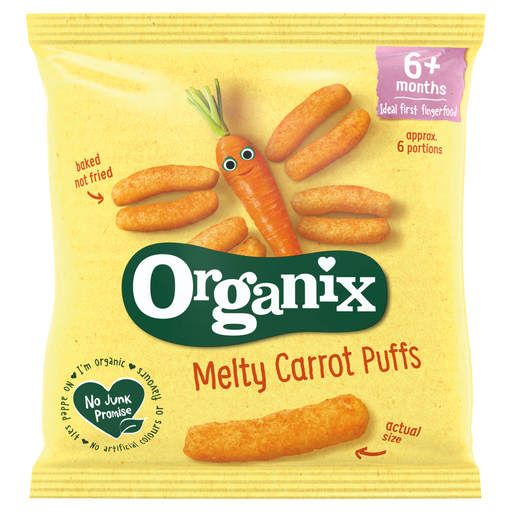 No image available
This 20 g carrot-stick snack is labelled for babies aged 6 months and over. That intended use makes it a poor match for an adult’s planned cycling food; check the current pack if buying it for its labelled age group.
No. Organic is a production and labelling claim, not a measure of ride fuelling. For high-intensity exercise lasting 1–2.5 hours, a 2015 review indexed by PubMed advises 30–60 g carbohydrate per hour; count food and drink together when planning that intake.
Check the claim and certification details on the specific product. Department for Environment, Food & Rural Affairs guidance updated in August 2025 says organic-labelled food must meet organic production rules, contain at least 95% organic agricultural ingredients, and have the product and suppliers certified by an approved organic control body.
They can be one food you carry if you tolerate them, but count their carbohydrate per pack within a deliberate food-and-drink plan. The organic products listed by Forest Whole Foods, Biona and Abel & Cole contain 28–37 g fat per 100 g, so their nutrition panels should not be treated as interchangeable with a planned carbohydrate product.
No. Those claims address different product attributes. Check the specific crisp’s organic claim and certification details independently, even if its label also says vegan or gluten-free.
If salt is your main comparison, read the amount on each exact product’s nutrition panel. Tyrrells Naked lists potatoes and sunflower oil as ingredients and 0.06 g salt per 100 g, but its referenced product information does not establish an organic claim; it does not meet a requirement for a confirmed organic crisp.