Organic-first black-tea drinkers
You want a traditional black-tea cup with a winter meal and look for an explicit organic claim, rather than relying on general sustainability wording.


For a familiar black-tea cup with winter food, choose an explicitly organic decaf black tea: Clipper Organic Everyday Decaf has a rich Assam-based description, while English Tea Shop describes an earthier Assam-and-Kenyan blend. If avoiding caffeine altogether matters more than black-tea flavour, check the ingredients and caffeine declaration of a specific organic herbal infusion instead; decaf black tea can retain traces.
You want a traditional black-tea cup with a winter meal and look for an explicit organic claim, rather than relying on general sustainability wording.
You enjoy black tea later in the day but need to account for the caffeine traces that can remain after decaffeination.
You want to compare the tea-bag count and net weight of packs, while making sure the chosen tea still meets your organic requirement.
Decide whether you want the flavour of black tea or a herbal infusion, then check organic labelling, caffeine information and the exact pack you plan to buy.
| Priority | What to check | Your needs |
|---|---|---|
| Organic status | Look for an explicit organic claim on the exact tea. Check its ingredients and certification details on the pack; a sustainability badge alone answers a different question. Tesco Groceries lists an organic code, GB-ORG-05, for its Clipper 40-bag pack. | I want the tea I actually buy to be identified as organic, not just the brand to have an environmentally minded image. |
| Caffeine | Check caffeine information for the specific product and note the serving or brewing basis. Yorkshire Tea estimates 1.5–2mg in a 200ml cup of its Decaf brewed for five minutes; that figure does not describe other teas. | An evening black tea may suit me if reducing caffeine is enough. If I need to avoid it altogether, I will check the ingredients and caffeine declaration of a particular herbal infusion rather than assume every decaf is caffeine-free. |
| Flavour and brewing | Compare the stated tea blend and brewing directions. Clipper describes a rich Assam-based black tea; English Tea Shop describes an earthy Assam-and-Kenyan tea and specifies 4–5 minutes at 100°C. | With winter food, I want to choose between a conventional black-tea flavour and an infusion with a different ingredient profile. |
| Pack format | Read both the tea-bag count and net weight, then confirm that any certification information applies to that pack. Tesco Groceries lists a Clipper 40-bag, 116g pack; the Joybuy selection below is an 80-bag, 277g listing. | For regular use, I need to know which pack size I am choosing without assuming that two listings for the same tea are the same pack. |
Sourcing and packaging information can be useful, but it does not identify a particular decaf tea as organic. The Tesco Groceries listing for Clipper's 40-bag pack separately identifies its organic ingredients and certification code.
If organic status is essential, check the claim and certification information on the exact product and pack.
Decaffeinated black tea can retain caffeine. Yorkshire Tea, for example, estimates 1.5–2mg for a 200ml cup of its Decaf brewed for five minutes.
Use product-specific information if you need to assess caffeine, and check a herbal infusion's ingredients and declaration if avoiding caffeine is essential.
Tesco Groceries lists Clipper Organic Decaf as 40 bags and 116g, while the Joybuy listing below specifies 80 bags and 277g. Pack details from one should not be applied to the other.
Check the bag count, net weight, ingredients and certification markings for the pack you intend to order.
These brand references describe particular decaf teas, not every product each brand makes or the range available on Joybuy.
Organic Everyday Decaf is a decaffeinated black tea that Clipper describes as a rich, Assam-based brew.
Its organic decaffeinated black tea is described by the brand as an earthy Assam-and-Kenyan blend.
Yorkshire Tea describes its Decaf as a strong-style black tea blend from Kenya.
Twinings offers Everyday Decaffeinated for shoppers seeking a black-tea blend rather than a herbal infusion.
Tetley Decaffeinated is another black-tea option when an explicit organic claim is not a requirement.
These two listings are for organic decaffeinated black tea in different pack formats. They are options for a conventional black-tea cup, not a comparison with herbal infusions.
 No image available
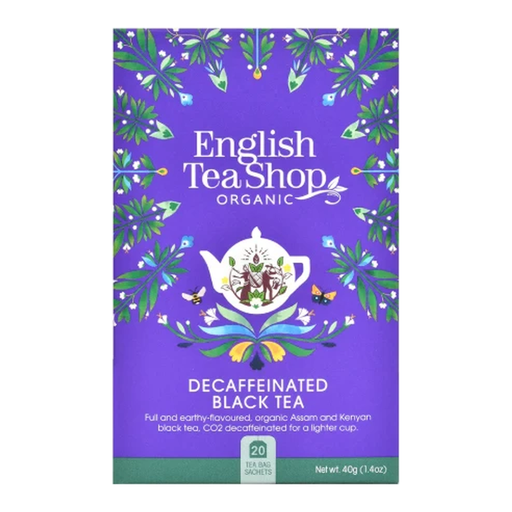
For a black-tea cup with winter food, English Tea Shop describes this tea as earthy, with Assam and Kenyan tea. Its brewing directions specify 4–5 minutes at 100°C; the listed pack is 20g.
If a defined caffeine limit or organic certification marking is decisive, check those details on this specific pack. Check the tea-bag count if pack format matters to you.
 No image available
For a traditional black-tea cup, Clipper describes its Organic Everyday Decaf as a rich, Assam-based brew. This Joybuy listing specifies 80 tea bags and 277g.
Check the organic certification markings on this pack if they matter to your choice, and seek product-specific caffeine information if you need a defined limit.
Look for an explicit organic claim and check the ingredients and certification information on the exact pack. For example, Tesco Groceries lists decaffeinated organically grown black tea and organic code GB-ORG-05 for its Clipper 40-bag pack; a general sustainability badge is not the same information.
Not necessarily. Yorkshire Tea estimates 1.5–2mg of caffeine in a 200ml cup of its Decaf brewed for five minutes. If avoiding caffeine is essential, check the declaration for the exact tea or infusion you intend to drink.
Choose organic decaf black tea if you want a conventional black-tea flavour: Clipper describes a rich Assam-based brew, while English Tea Shop describes an earthy Assam-and-Kenyan tea. If avoiding caffeine matters more than that flavour, assess a specific organic herbal infusion by its ingredients and caffeine declaration rather than assuming its status from the word “herbal”.
Follow the directions for the tea you buy. English Tea Shop specifies 4–5 minutes at 100°C for its organic decaffeinated black tea, while Clipper gives a 2–4 minute brewing range for Organic Everyday Decaf.