Cream-tea hosts choosing decaf
If you plan to serve tea with scones, jam and clotted cream, look for a decaffeinated black tea whose stated flavour and brewing guidance fit the cup you want, particularly if guests will add milk.


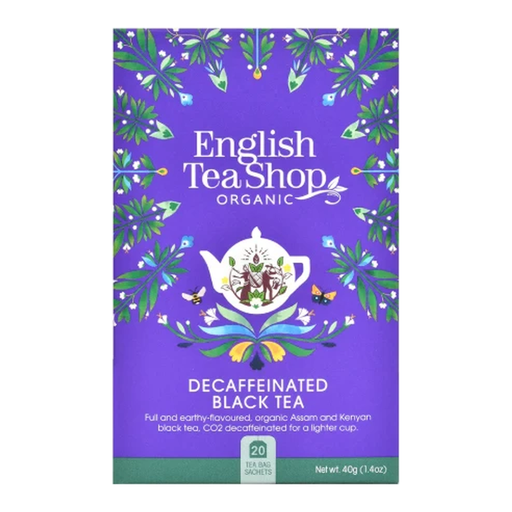
For a cream tea where organic production matters, start with decaffeinated black tea labelled organic: Clipper Organic Everyday Decaf and English Tea Shop Decaffeinated Black Tea both meet that product description. If an English Breakfast blend matters more than an organic claim, a conventional decaf is another route; check the exact pack for organic certification or caffeine information when either is a firm requirement.
The useful starting point is whether you want a traditional black-tea cup, an organic product, or a straightforward way to serve several guests.
If you plan to serve tea with scones, jam and clotted cream, look for a decaffeinated black tea whose stated flavour and brewing guidance fit the cup you want, particularly if guests will add milk.
If organic production is a requirement, look for an organic claim on the exact tea and check its certification information. Decaf, Fairtrade and packaging claims address different questions.
Tea bags offer a simple way to prepare individual cups. In its May 2025 Tea Census Study of more than 1,000 Britons, the UK Tea & Infusions Association reported that 93% preferred the convenience of making tea with a tea bag rather than loose leaf.
Choose the type of black tea first, then check the organic claim, pack format and instructions for the exact product you intend to serve.
| Priority | What to check | Your needs |
|---|---|---|
| Traditional black tea | Check that the product is decaffeinated black tea, then compare its stated blend and guidance for serving with milk. Twinings describes its decaf English Breakfast as an Assam, Kenyan and Ceylon blend. | I want a familiar black-tea cup with a cream tea. In the UK Tea & Infusions Association’s May 2025 study of more than 1,000 Britons, 71% named traditional black tea, with or without milk, as their main infusion; that was not a cream-tea-specific finding. |
| Organic credentials | Check the organic claim on the exact product and any control-body details shown for that pack. According to UK government organic-food labelling guidance, a food labelled organic must meet production rules, with the product and suppliers certified by an approved control body. | Organic production matters to me, so I would not use a decaf, Fairtrade or plastic-free claim as a substitute for an organic one. |
| Caffeine information | Check the current pack if a precise limit matters. Clipper and English Tea Shop describe CO2 decaffeination, but the process description does not establish that the finished tea contains no caffeine. | I am choosing decaf, but I need product-specific information rather than assuming every decaf tea has the same residual caffeine level. |
| Serving guests | Check the pack format and its own brew instructions. Clipper advises 2–5 minutes for Organic Everyday Decaf; English Tea Shop advises 4–5 minutes for its Decaffeinated Black Tea. | Tea bags would make individual cups easier to prepare. The UK Tea & Infusions Association reported in May 2025 that 93% of more than 1,000 Britons surveyed preferred the convenience of making tea with a tea bag rather than loose leaf; that preference is not a quality comparison. |
These terms describe different attributes. UK government organic-food labelling guidance requires organic-production compliance and certification by an approved control body for food labelled organic.
Check the organic description and certification information for the exact tea you buy, rather than relying on adjacent packaging claims.
The producers give different instructions: Clipper advises 2–5 minutes for Organic Everyday Decaf, while English Tea Shop advises 4–5 minutes for its Decaffeinated Black Tea.
Follow the instructions for your pack, then taste a cup alongside the cream tea before preparing several servings.
The Twinings English Breakfast Decaffeinated product page gives two different residual-caffeine figures, 0.2% and 0.02%, so it cannot establish a single precise figure for that product.
If a strict caffeine limit matters, check the current pack and ask the manufacturer for clarification rather than relying on that page’s figures.
These references describe specific decaf teas and their stated characteristics, not every tea made by each brand.
Clipper describes Organic Everyday Decaf as decaffeinated, organically grown black tea with a robust, rich-and-bright profile.
English Tea Shop describes its Decaffeinated Black Tea as 100% organic black tea made with Assam and Kenyan tea, with a full, earthy profile.
Twinings describes its English Breakfast Decaffeinated 20 Envelopes as an Assam, Kenyan and Ceylon blend that can be served with a splash of milk.
These Joybuy listings include organic decaf black-tea options and decaf black teas to consider when an organic claim is not your main requirement. Check the exact pack where format, certification details or brewing instructions matter.
 No image available
An organic decaf black-tea option in an 80-bag pack for serving individual cups. Clipper describes its Organic Everyday Decaf as robust and advises a 2–5 minute brew; check the pack for its organic-control-body details and preparation instructions.
 No image available
An organic decaf black-tea listing for an afternoon tea. The title specifies 20g but does not establish a sachet count or format, so check the exact pack before planning servings or applying brewing directions from another pack.
 No image available
A decaffeinated tea-bag option if you want to prepare individual cups for guests. The listing identifies 80 bags and a 250g pack; check the exact pack for organic credentials if those are part of your decision.
 No image available
A decaf black-tea option described in the listing as bold in character. The title specifies 250g but does not establish whether the pack contains bags or loose tea; check its format, brewing directions and any organic claim before choosing it for guests.
Look for an organic claim on the exact product and check the pack’s certification information. UK government organic-food labelling guidance says food labelled organic must meet organic-production rules, with the product and suppliers certified by an approved control body; ‘natural’, Fairtrade and CO2-decaffeinated are not substitutes for that claim.
Yes, if you want a traditional black-tea cup and organic production matters to you. Clipper describes Organic Everyday Decaf as robust, while English Tea Shop describes its Decaffeinated Black Tea as full and earthy; brew the tea according to its own pack and decide how you prefer it with the food.
Follow the instructions for the exact tea rather than using one time for every blend. Clipper advises 2–5 minutes for Organic Everyday Decaf, English Tea Shop advises 4–5 minutes for its Decaffeinated Black Tea, and Twinings gives a 2–4 minute range for English Breakfast Decaffeinated.
Do not assume a decaf label establishes zero caffeine. If a precise limit matters, check current product-specific information with the manufacturer; the Twinings English Breakfast Decaffeinated page gives conflicting figures of 0.2% and 0.02%, so it does not settle that product’s precise level.