What should you check?
Start with whether organic status is essential, then check caffeine information and whether the tea and pack format suit your routine.
| Priority | What to check | Your needs |
|---|
| Organic status |
Look for an organic claim on the exact tea and check the pack’s certification or approved control-body information. The UK Department for Environment, Food & Rural Affairs says organic food labelling requires the product and suppliers to be certified by an approved organic control body and to meet the applicable organic-production rules. |
I want the decaf tea itself to be organic, not just a product described as natural or ethically sourced. |
| Caffeine |
Distinguish decaf from caffeine-free. If an exact limit matters, check that the current pack or manufacturer gives a clear caffeine figure with a basis you can use. Lancashire Teaching Hospitals NHS Foundation Trust notes that decaf tea can retain very low levels of caffeine. |
For an evening cup, I want less caffeine than regular tea. If I must avoid caffeine to a particular threshold, I need information specific to the tea I am buying. |
| Everyday use |
Check that the ingredients identify black tea if that is the style you want. Compare bag count, pack size and brewing instructions for the exact product. |
A familiar black-tea brew matters to me, and I would rather choose a pack size that fits how often the household drinks it. |
Joybuy product options
These decaf black-tea options cover an 80-bag everyday pack, a smaller 15-bag pack and a 20g pack. Check the exact pack’s organic information when certification is essential to your first shop.
 No image available
Clipper Organic Fairtrade Decaf Everyday, 80 tea bags, 277g
For an organic-first everyday tea, the listing identifies decaffeinated organically grown black tea in an 80-bag, 277g pack. Check the current pack’s certification details if these are essential to your purchase, and do not assume that decaf means caffeine-free.
View on Joybuy
 No image available
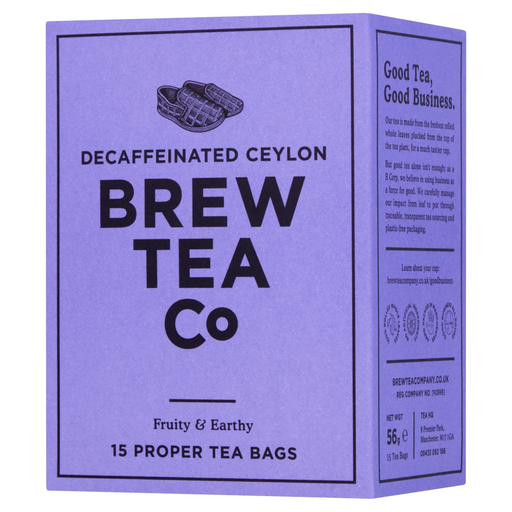
Brew Tea Co CO2 Decaffeinated Tea, 15 tea bags, 56g
The 15-bag, 56g format offers a smaller first purchase. The listing describes decaffeinated Ceylon black tea and lists organic black tea as an ingredient; if certification is a requirement, check the exact pack’s organic information. Do not use its caffeine wording as a precise amount per prepared cup without clarification.
View on Joybuy
 No image available
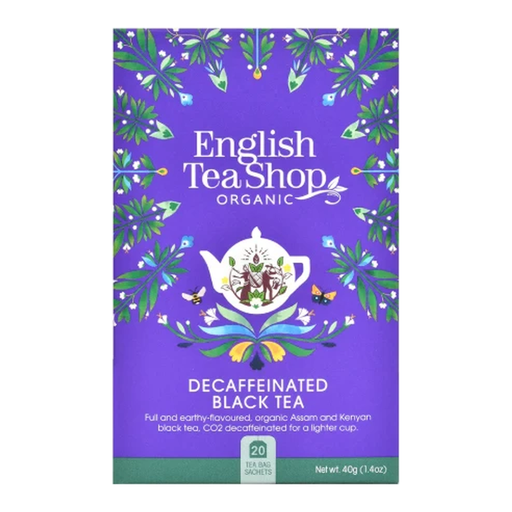
English Tea Shop Organic Decaffeinated Black Tea, 20g
This 20g product is described as organic decaffeinated black tea. Check the current pack for certification details, the tea-bag count and brewing instructions if these affect your choice. Its product descriptions give differing allergen statements, so check the pack carefully if allergens matter; seek clarification of the caffeine figure if you need an amount per prepared cup.
View on Joybuy
Questions about organic decaf tea
How can I check whether a decaf tea is organic?
Look for an organic claim on the exact product and check its pack for certification or approved control-body information. The UK Department for Environment, Food & Rural Affairs says organic food labelling requires compliance with the applicable organic-production rules and certification of the product and suppliers by an approved organic control body.
Is decaf tea caffeine-free?
Not necessarily. Lancashire Teaching Hospitals NHS Foundation Trust says decaffeinated tea may still contain very low caffeine levels, depending on production. If a particular limit matters, check information for the exact product rather than relying on the word ‘decaf’.
Does CO2 decaffeination establish that a tea is organic?
No. A decaffeination method describes how caffeine is removed, while organic status concerns the applicable production and certification requirements. Clipper describes a carbon-dioxide process for its Organic Everyday Decaf, but its organic claim is a separate point to check on the product pack.
Which tea should I try first if I usually drink black tea?
Start with a decaf product identified as black tea, then choose a pack size that suits how often you expect to use it. Clipper describes Organic Everyday Decaf as organically grown black tea; Twinings identifies its English Breakfast Decaffeinated 40 Tea Bags as 100% black tea, without making an organic claim on that product page.
How should I brew and store Clipper Organic Everyday Decaf?
Clipper’s shop instructions for this product say to store it in a cool, dry place and infuse a tea bag in boiling water for 2–5 minutes. Follow the instructions on the particular pack you buy, as brewing guidance can differ between teas.


