For a familiar tea break before sleep, choose a tea explicitly labelled organic and decaffeinated, then decide between plain black tea, bergamot-flavoured Earl Grey and green tea. Clipper’s product pages list all three styles; its 80-bag black tea suits a regular break-room routine, while a 40-bag format involves less commitment when trying a flavour. Decaf does not necessarily mean caffeine-free, so check the exact pack if trace caffeine matters.
Who is this for?
Night-shift workers planning to sleep after work
If a hot drink is part of your snack break, decaf offers an alternative to ordinary tea. Doncaster and Bassetlaw Teaching Hospitals NHS Foundation Trust advises that caffeine can remain in the body for up to six hours, so consider your planned sleep time when choosing your last caffeinated drink.
Black-tea drinkers who prioritise organic ingredients
Look for an organic claim on the specific decaf tea, rather than relying on words such as “natural”. Clipper’s Everyday Decaf product pages list decaffeinated organically grown black tea; UK government guidance sets certification requirements for foods labelled organic.
Workers trying a tea for a shared break room
A smaller pack lets you settle on a flavour before choosing a format for regular use. Clipper lists 40-bag plain black, Earl Grey and green decaf teas, as well as an 80-bag plain black tea; check the brewing directions for the style you choose.
What should you check?
Start with the organic and decaf claims on the specific tea, then choose a flavour and pack format that work for your breaks.
| Priority |
What to check |
Your needs |
| Caffeine |
Check that the tea is decaffeinated. If trace caffeine matters, check the exact pack for caffeine information rather than assuming decaf means none: Twinings UK lists its Everyday Decaffeinated tea as decaffeinated to 0.02% caffeine. |
I want a tea break with less caffeine than ordinary tea before my planned sleep, without assuming the drink is caffeine-free. |
| Organic status |
Look for an explicit organic claim and check the product’s labelling. UK government guidance published in August 2025 says foods labelled organic must meet organic-production requirements, with the product and suppliers certified by an approved organic control body. |
An organic claim matters to me; “natural”, Fairtrade or a particular decaffeination method is not a substitute for checking it on the tea I buy. |
| Flavour and preparation |
Compare plain black tea with bergamot-flavoured Earl Grey and green tea. Clipper lists 4% natural bergamot flavouring in its decaf Earl Grey; its decaf green-tea directions call for boiled water cooled for a minute and a 1–3 minute infusion. |
For a familiar cuppa, I would try plain black tea. Earl Grey appeals if I want bergamot; green tea means following different brewing directions during my break. |
| Pack format |
Check the stated bag count or pack weight. Clipper lists 40- and 80-bag organic decaf black-tea formats, alongside 40-bag Earl Grey and green-tea options. |
A smaller format makes sense while I work out which flavour I like; an 80-bag black-tea pack fits a routine that is already settled. |
Common buying mistakes
-
Assuming decaf means caffeine-free
Decaffeinated tea can still contain caffeine. Twinings UK, for example, lists its Everyday Decaffeinated tea as decaffeinated to 0.02% caffeine.
Check caffeine information for the exact product if avoiding even trace amounts is important to you.
-
Assuming any decaf tea is organic
A decaf label or a familiar brand name does not establish an organic claim. UK government guidance applies specific production and certification requirements to foods labelled organic.
Check the organic labelling on the particular tea rather than inferring it from ethical language or the decaffeination method.
-
Choosing a large pack before trying the flavour
Plain black tea, bergamot-flavoured Earl Grey and green tea have different ingredients or preparation needs; bag count alone does not tell you which you will prefer.
If the flavour is unfamiliar, consider a 40-bag format before choosing an 80-bag plain black-tea pack for regular use.
-
Leaving ordinary tea until just before planned sleep
Doncaster and Bassetlaw Teaching Hospitals NHS Foundation Trust says caffeine can remain in the body for up to six hours. A night-shift break may fall close to your intended sleep time.
Consider when to switch away from ordinary caffeinated tea, while remembering that decaf is not necessarily caffeine-free.
Relevant tea brands
These brand references describe particular decaf products, not an assurance that every tea from a brand is organic.
Clipper
Clipper’s product pages list organic decaf plain black, Earl Grey and green teas.
- Its Everyday Decaf black-tea pages list decaffeinated organically grown tea in 40- and 80-bag formats.
- Earl Grey contains bergamot flavouring, while green tea has different brewing directions; choose by flavour and preparation preference.
Twinings
Twinings Everyday Decaffeinated is a black-tea alternative for shoppers checking a stated caffeine figure.
- Twinings UK describes its Everyday Decaffeinated tea as decaffeinated to 0.02% caffeine.
- Check the specific pack for an organic claim if organic status is a priority.
Yorkshire Tea
Yorkshire Tea describes its Decaf range as a lower-caffeine option for a familiar tea break.
- The brand presents Decaf as an option for low-caffeine routines.
- Check the particular product’s labelling before treating it as an organic choice.
Tetley
Tetley Decaffeinated appears in Tesco’s UK decaf-tea category.
- Tesco lists 80- and 160-teabag Tetley Decaffeinated products.
- A decaf listing alone does not establish an organic claim; check the chosen pack.
PG Tips
PG Tips Decaf Black Tea is another black-tea option listed in Tesco’s UK decaf category.
- Tesco lists 70- and 160-bag formats.
- Check the specific product’s labelling if you require organic tea.
Tesco
Tesco lists an own-label Decaff Original Tea alongside branded decaf teas.
- Its decaf category includes Tesco Decaff Original Tea 80 Pack 250g.
- Do not assume the own-label decaf product is organic without an explicit product-level claim.
Joybuy decaf tea options
These decaffeinated black teas suit a familiar late-shift tea break. Compare the stated 80-bag and 20g formats, and check organic and caffeine information on the specific pack where those details matter to you.
 Image unavailable
Clipper Organic Fairtrade Decaf Everyday, 80 bags, 277g
A plain decaf black tea in an 80-bag format for a regular shift-break routine. The product information identifies decaffeinated organically grown black tea. Check the pack if you need a residual caffeine figure or brewing directions.
View on Joybuy
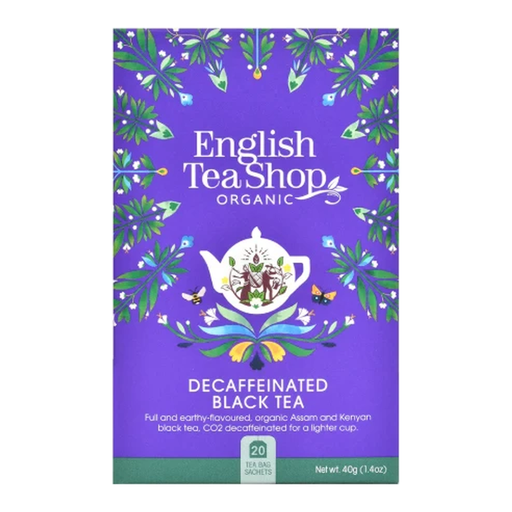 Image unavailable
English Tea Shop Organic Decaffeinated Black Tea, 20g
A decaffeinated black tea with a stated 20g pack size for trying a different tea at break time. Its name makes an organic claim; check the pack’s certification details if organic status is essential. Also check the bag count and caffeine information for the drink you prepare.
View on Joybuy
Frequently asked questions
Does decaf tea contain any caffeine?
It can. Twinings UK lists its Everyday Decaffeinated tea as decaffeinated to 0.02% caffeine. If trace caffeine matters, check the exact tea’s label rather than assuming “decaf” means caffeine-free.
How do I check an organic claim on UK tea?
Look for an explicit organic claim on the specific product and check its labelling. UK government guidance published in August 2025 says foods labelled organic must meet organic-production requirements, with the product and suppliers certified by an approved organic control body. Words such as “natural” do not establish that status.
Which organic decaf style suits a night-shift break?
Choose by the flavour and preparation you want: Clipper lists plain decaf black tea for a familiar cup, Earl Grey with 4% natural bergamot flavouring, and decaf green tea. For Clipper’s green tea, its directions say to let boiled water cool for a minute and infuse for 1–3 minutes.
Does the timing of a decaf tea break still matter?
Consider the timing of your other caffeinated drinks as well as the decaf tea. Doncaster and Bassetlaw Teaching Hospitals NHS Foundation Trust says caffeine can remain in the body for up to six hours; decaf provides a lower-caffeine alternative to ordinary tea, not a guarantee of zero caffeine before sleep.


