Shoppers looking for organic decaf
If organic certification matters to you, check the particular pack rather than relying on a brand’s reputation. Bag count and weight also matter when choosing a quantity you will use.


For organic decaf black tea, check the organic claim and certification details on the exact pack. Tesco Groceries lists both for Clipper’s 40-bag pack, but those details do not establish certification for every Clipper pack size. If organic certification is optional, conventional decaf gives you other pack choices; compare their contents without assuming that decaf means caffeine-free.
If organic certification matters to you, check the particular pack rather than relying on a brand’s reputation. Bag count and weight also matter when choosing a quantity you will use.
Decaffeinated black tea offers a familiar tea format for someone reducing caffeine. If you need an exact residual-caffeine amount, confirm it for the product you intend to buy.
Organic and Fairtrade are distinct claims. Check each one on the exact pack rather than treating general ethical or sustainability wording as evidence of organic certification.
Start with the exact pack’s organic status, then check its contents, caffeine information and black-tea style against how you plan to drink it.
| Priority | What to check | Your needs |
|---|---|---|
| Organic status | Look for an organic claim, the ingredient description and control-body information on the exact product. DEFRA’s UK guidance says organic food labelling depends on applicable production rules and certification by an approved control body. | I want the decaf tea I buy to have an organic claim supported by certification details, not just natural-sounding packaging. Tesco Groceries lists GB-ORG-05 and decaffeinated organically grown black tea for its Clipper 40-bag pack. |
| Pack contents | Compare bag counts and weights together. Check the quantity on the particular listing, especially when the same brand has several pack sizes. | A smaller pack may suit me when trying a tea for the first time; if I drink it regularly, I may prefer more bags in one box. |
| Residual caffeine | Choose a product identified as decaffeinated black tea, but do not read “decaf” as “caffeine-free”. Confirm the current pack information with the manufacturer if a precise amount matters. | I’m reducing caffeine while keeping black tea in my routine. An exact caffeine figure matters more to me than the general decaf label if I have a strict limit. |
| Tea style | Check whether the product is plain black tea and read its own brewing directions. Twinings describes Everyday Decaffeinated as a Kenyan-tea blend; Yorkshire Tea describes its Decaf blend in terms of its retained character. These are brand descriptions, not comparative taste tests. | For a regular cup of black tea, I want to choose a blend description and brewing method that appeal to me, rather than assuming organic status determines the flavour. |
A decaf tea can carry other claims without those claims establishing that the exact pack is certified organic. DEFRA’s UK guidance sets separate conditions for organic food labelling.
Check the organic wording, ingredient list and certification or control-body details for the pack you intend to buy.
Decaffeination does not, by itself, establish zero residual caffeine. Twinings’ Everyday Decaffeinated page gives differing non-zero caffeine figures, so neither figure is a sound basis for a precise calculation.
If an exact amount matters, check current information for that product with the manufacturer rather than relying on the word “decaf”.
These examples describe particular decaf products and lines; a claim attached to one pack should not be assumed to apply across a brand’s range.
Tesco Groceries identifies its Clipper Fairtrade Organic Decaf Tea 40-bag pack as organic and lists decaffeinated organically grown black tea as the ingredient.
Twinings describes Everyday Decaffeinated as a Kenyan-tea blend with a hearty, well-rounded profile.
Yorkshire Tea describes its Decaf as a blend intended to retain the character of its black tea after decaffeination.
Tesco Groceries lists Tesco Decaff Original Tea as an own-label decaf option.
These options include decaf black teas labelled organic alongside conventional decaf alternatives. Check certification on the exact pack before relying on an organic claim.
 No image available
This 80-bag option is for shoppers seeking decaffeinated black tea with an organic claim. Its tea-specific description lists organically grown black tea; check certification details on this exact pack if organic status is essential.
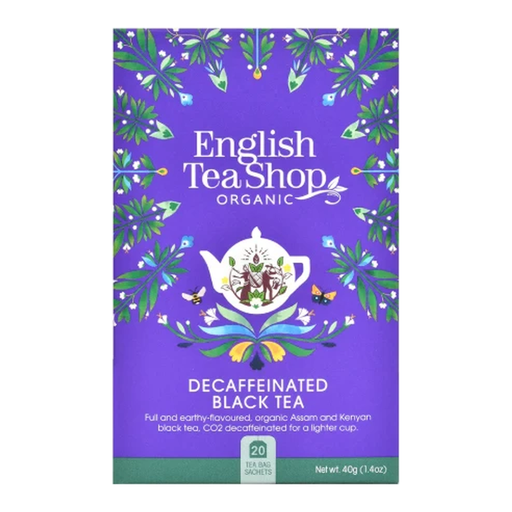 No image available
The product is described as decaffeinated black tea made with organically grown tea, in a 20g pack. Check certification on the exact pack if required; confirm the basis of any stated caffeine figure before using it as a precise amount.
 No image available
This conventional decaffeinated black tea comes in an 80-bag, 250g pack, with a stated brewing time of 2–3 minutes. Check the exact pack for organic certification if that is a requirement, and do not treat decaf wording as a guarantee of zero caffeine.
 No image available
This 250g decaffeinated black tea is an option when an everyday black-tea blend matters more than an organic claim. The blend’s bold character is a product description, not an independent taste finding; check the exact pack if organic status or a precise caffeine amount matters.
Check the organic claim and certification information for the exact pack. DEFRA’s UK guidance says food labelled organic must meet applicable production rules and supplier-certification conditions; Tesco Groceries lists an organic claim and GB-ORG-05 for its Clipper 40-bag decaf pack.
Do not assume that it contains none. Twinings gives non-zero but inconsistent residual-caffeine figures for its Everyday Decaffeinated tea; if a precise amount matters, confirm current information for the particular product with its manufacturer.
No. Check both the bag count and the weight, then choose a quantity that fits how often you drink the tea. A different pack size also needs its own organic-certification check rather than inheriting the claim documented for another variant.