Organic-first everyday tea drinkers
You want a plain decaf black tea and need an organic claim on the specific product, rather than relying on a brand name or general wording about how the tea is made.


For an everyday decaf black tea with an organic claim, Clipper Organic Everyday Decaf offers a choice between 40 and 80 bags: the larger pack suits regular household use, while 40 bags makes more sense if you are trying the blend or drink it less often. Choose its Earl Grey instead only if you want bergamot flavour. Check the organic details on the exact pack, and do not assume that decaf means caffeine-free.
Start with the type of tea your household drinks, then decide whether the organic claim and pack quantity meet your weekly-shop needs.
You want a plain decaf black tea and need an organic claim on the specific product, rather than relying on a brand name or general wording about how the tea is made.
You buy decaf often enough for bag count to matter. Clipper Tea Shop describes its Organic Everyday Decaf in both 40- and 80-bag formats, so you can choose a quantity that fits how quickly your household uses tea.
You want decaf without treating it as a promise of zero caffeine. Check the exact pack when residual caffeine matters; NHS guidance also identifies tea as one of several sources of caffeine.
Choose the tea style first, then check the product-level organic claim and a pack size that matches household use.
| Priority | What to check | Your needs |
|---|---|---|
| Organic claim | Read the claim and certification details on the exact pack. The Department for Environment, Food & Rural Affairs explains that organic food labelling depends on production rules and approved-body certification. | I want the decaf tea I actually buy to carry an organic claim, not just wording such as “natural” elsewhere in the range. |
| Pack quantity | Check the number of bags and consider how regularly they will be used. Clipper Tea Shop identifies 40- and 80-bag Organic Everyday Decaf packs. | An 80-bag pack suits us if decaf is a regular household drink; for an occasional cup or a first try, I would choose fewer bags. |
| Tea style | Check whether the tea is plain black tea or flavoured. Clipper describes its Everyday Decaf as decaffeinated organically grown black tea; its decaf Earl Grey contains black tea and natural flavour. | I want a plain daily brew, unless the household specifically enjoys Earl Grey’s bergamot flavour. |
| Caffeine information | Read the named product’s pack information rather than treating “decaf” as “caffeine-free”. If a stated figure matters, check what it measures. | I am reducing caffeine, so I need to know what the exact product says without assuming every decaf tea has the same residual amount. |
A decaf label describes the tea’s caffeine status, not its organic status. Tesco Groceries lists larger conventional decaf packs alongside products that explicitly carry an organic claim.
Check “organic” and its certification details on the exact tea pack or current product page.
An 80-bag pack may be practical for regular household drinking, but it is more tea to store and use than a 40-bag pack.
Match bag count to how often your household drinks decaf, especially if you have not tried the blend.
Decaffeinated tea should not be assumed to contain zero caffeine. Where intake matters, the wording on the particular product is more useful than a figure taken from another blend.
Check the exact pack’s caffeine information and consider caffeine from other foods and drinks too.
Clipper describes its organic decaf Earl Grey as bergamot-flavoured, while its Organic Everyday Decaf is described as decaffeinated organically grown black tea. They meet different flavour preferences.
Choose the plain Everyday blend for an unflavoured cup; choose Earl Grey when bergamot is wanted.
Brand ranges vary: check the claim on the particular decaf product rather than assuming it applies across every tea a brand makes.
Clipper Tea Shop describes Organic Everyday Decaf in 40- and 80-bag formats and also has an organic decaf Earl Grey.
Twinings Everyday Decaffeinated is an everyday black-tea option for shoppers who do not require an organic claim.
Yorkshire Tea Decaf is a conventional decaf option for households looking at larger packs.
PG Tips Decaf Black Tea is another conventional larger-pack format to consider when organic status is not a requirement.
Tetley has decaffeinated tea options, including black- and green-tea formats.
Tesco is a weekly-shop retailer reference for comparing decaf products, rather than a tea blend.
These are organic-labelled decaf black-tea options to consider for the weekly shop. Check each pack’s details, particularly if certification or the number of servings will decide your choice.
 No image available
The 80-bag format is worth considering if your household drinks decaf regularly. Clipper Tea Shop describes its Organic Everyday Decaf as decaffeinated organically grown black tea; check the exact Joybuy pack’s organic details and listed 277g weight before buying.
 No image available
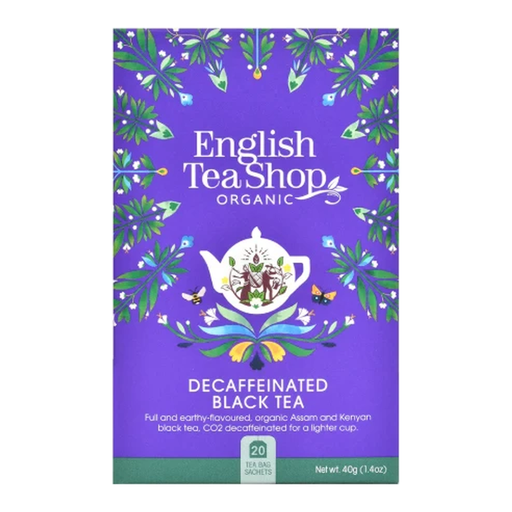
The listed 20g box is a smaller-format option to consider if you are trying an organic-labelled decaf black tea. Check the box’s tea-bag count before comparing weekly-shop quantities, and confirm its organic details on the exact product.
Check the organic wording and certification details on the exact pack or current product page. The Department for Environment, Food & Rural Affairs explains that UK organic food labelling depends on production rules and certification by an approved control body; a general “natural” description is not the same claim.
Do not assume so: organic status concerns how a product is produced and labelled, while decaf concerns caffeine reduction. Check the named tea’s current pack if its residual caffeine matters to you, rather than applying another product’s figure to it.
Choose by how often your household drinks the tea. Clipper Tea Shop lists Organic Everyday Decaf in both sizes: 80 bags may suit regular use, while 40 bags limits the quantity you commit to when trying the blend or drinking it occasionally.
No. Fairtrade and organic are separate product claims. Clipper’s Everyday Decaf pages describe both, but you should check each claim on any other tea’s exact pack rather than assuming one establishes the other.
No: the flavour choice differs. Clipper describes its organic decaf Earl Grey as black tea with natural flavour and a bergamot character, whereas its Organic Everyday Decaf is described as decaffeinated organically grown black tea. Choose according to whether you want a flavoured or plain cup.