Canteen buyers with an organic requirement
You need to check the organic claim and certification details on the exact tea pack ordered, rather than relying on words such as “natural”.


For a workplace canteen that requires organic decaf tea, choose a black or green tea whose exact pack carries an organic claim and certification details. Black tea is the route for a conventional canteen cup, while green tea offers a different flavour and brewing method; a non-organic decaf catering format only fits if organic status is optional. Decaf tea can retain traces of caffeine, so check a separate caffeine-free infusion if zero caffeine is required.
You need to check the organic claim and certification details on the exact tea pack ordered, rather than relying on words such as “natural”.
Pack count, storage and the way bags are dispensed matter when deciding between a catering pack and a smaller pack for a trial.
Decaf black or green tea may suit a reduced-caffeine preference. A zero-caffeine requirement calls for a separate check of caffeine-free infusions and their ingredients.
Start with the organic requirement and tea type, then choose a pack and brewing method that the canteen can use consistently.
| Priority | What to check | Your needs |
|---|---|---|
| Organic status | Check the organic claim and control-body details on the exact pack or current supplier specification. Department for Environment, Food & Rural Affairs guidance dated 20 August 2025 says UK organic food labelling requires compliance with organic-production rules and approved-control-body certification. | I need a decaf tea the canteen can identify as organic from the pack it actually receives. |
| Caffeine requirement | Distinguish decaffeinated tea from a caffeine-free infusion. Twinings explains that minor traces of caffeine can remain in decaf tea; check infusion ingredients if zero caffeine is required. | If zero caffeine matters, I cannot treat a decaf label as a caffeine-free claim. |
| Tea type | Choose black or green tea according to the flavour requested, and check the instructions for that product. Clipper Tea Shop lists its organic decaf black catering tea as a 2–4 minute brew; Tesco Groceries lists a 1–3 minute infusion for Clipper organic decaf green tea. | Our lunch service needs a tea people want to drink and preparation instructions staff can follow. |
| Pack format | Check bag count, whether bags are individually wrapped, and how the opened pack will be stored and dispensed. Twinings describes its 40-bag All Day Decaf catering pouch as containing bags that are not individually wrapped. | For predictable demand, a larger pack may be practical; for a trial or lower turnover, I would start smaller. |
Twinings notes that decaffeinated tea can retain minor caffeine traces, which matters when the requirement is zero caffeine rather than reduced caffeine.
Set out which requirement applies. For zero caffeine, assess a separately labelled caffeine-free infusion and check its blend ingredients.
For UK food labelling, Department for Environment, Food & Rural Affairs guidance dated 20 August 2025 ties an organic claim to organic-production rules and approved-control-body certification.
Check the organic claim and certification identifier for the exact pack supplied; Tesco Groceries lists GB-ORG-05 for the Clipper Fairtrade Organic Decaf 40-pack.
A high-count pack commits the canteen to one tea and pack format before staff preferences and lunchtime use are clear.
Where demand is uncertain, try a smaller pack that meets the same organic requirement before choosing a catering quantity.
These examples distinguish organic tea choices from decaf catering formats; a brand name alone does not establish certification for every product it sells.
Clipper Tea Shop lists Organic Everyday Decaf black tea in a 250-bag catering format; Tesco Groceries lists separate organic decaf black and green tea packs.
Twinings describes its All Day Decaf 40-bag pouch as a format for smaller catering settings.
Tesco Groceries lists its own Decaff Original 80-pack alongside other decaf teas.
These listings are for decaffeinated black tea described as organic. Check certification details on the exact supplied pack before using either for a canteen with a firm organic requirement.
 No image available
An 80-bag decaf black tea listing for a canteen considering a shared-service pack. Joybuy describes the bags as plastic-free and unbleached; check the delivered pack’s organic certification details, brewing instructions and wrapping format against the canteen’s requirements.
 No image available
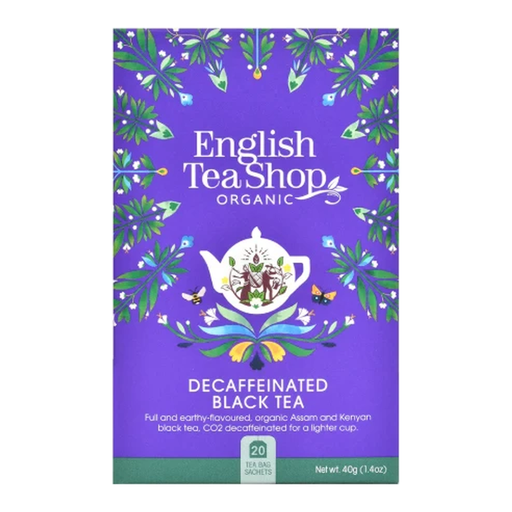
A 20g box listed as organic decaffeinated black tea may be considered for a small trial. Before planning canteen servings, check the bag count and brewing instructions, along with the organic certification details on the supplied pack.
Check the organic claim and certification details for the exact pack being supplied. Department for Environment, Food & Rural Affairs guidance dated 20 August 2025 says UK organic food labelling requires compliance with organic-production rules and approved-control-body certification; Tesco Groceries displays code GB-ORG-05 for the Clipper Fairtrade Organic Decaf 40-pack.
No: Twinings explains that minor traces can remain after tea is decaffeinated. If zero caffeine is required, check a separately labelled caffeine-free infusion and its blend ingredients rather than relying on a decaf tea label.
Choose the pack count after considering expected lunchtime use and how the bags will be stored and dispensed. A smaller pack allows a trial when demand is uncertain; for a catering pouch, check whether bags are wrapped individually, as Twinings says its 40-bag All Day Decaf pouch is not.
Not in the Clipper examples listed by Clipper Tea Shop and Tesco Groceries: the organic decaf black catering tea has a 2–4 minute instruction, while the listed organic decaf green tea has a 1–3 minute infusion instruction. Use the directions on the particular pack served.
Check the current delivered label for each product relied on in workplace dietary information. Tesco Groceries advises that ingredients, allergens and other food information can change when products are reformulated.