Everyday tea drinkers seeking organic decaf
If black tea is your regular pantry staple, check that the organic claim belongs to the decaf product you intend to buy, alongside its ingredients and certification details.


Choose organic decaf tea by checking the claim on the exact product, then choosing a tea style and pack size you will use regularly. Clipper’s reviewed black and green decaf products list organically grown tea; other decaf choices may suit a different flavour or pack-size preference, but a brand name or the word “decaf” alone does not establish organic status.
If black tea is your regular pantry staple, check that the organic claim belongs to the decaf product you intend to buy, alongside its ingredients and certification details.
Compare black, green and flavoured decaf by the cup you prefer. Organic production and decaffeination are separate claims, so check both when they matter to you.
Bag count, net weight and storage instructions help you decide whether a pack fits your usual consumption, rather than choosing by pack size alone.
Start with the exact product’s organic claim and tea type; then compare its decaf information, quantity and storage instructions.
| Priority | What to check | Your needs |
|---|---|---|
| Organic status | Check the exact pack’s organic claim, ingredients and certification information. Defra’s UK organic-labelling guidance says an organic product and its suppliers must be certified by an approved organic control body. | I want the decaf tea I buy to carry an organic claim, not just to come from a brand that also sells organic products. |
| Tea style | Read the ingredients for black or green tea and any flavourings; follow the brewing directions for that product. Clipper’s reviewed decaf green tea gives a 1–3 minute infusion time. | For routine cups, I would choose the tea style I already drink. If I want bergamot flavour, I would check an Earl Grey’s ingredients and its separate organic status. |
| Decaf information | Check that the exact product is identified as decaffeinated and whether it names a process. Clipper says it uses carbon dioxide for its decaf range; that does not describe every brand’s tea. | If the processing method matters to me, I want it stated for the product. If I need a naturally caffeine-free drink, I would check an infusion’s ingredients instead of relying on “decaf”. |
| Pantry quantity | Compare bag count and net weight together, then read storage instructions. Tesco’s Clipper organic black decaf listing identifies a 40-bag, 116 g pack and advises cool, dry storage. | A larger pack only suits my cupboard if I will use that tea style regularly; a smaller one may make more sense for an occasional cup. |
A decaf listing establishes the tea style, not an organic claim for every product in the range.
Check the name, ingredients and certification information on the exact pack before committing to a larger quantity.
Decaffeinated tea and a naturally caffeine-free herbal or fruit infusion are different products. The UK Tea & Infusions Association identifies naturally caffeine-free infusion ingredients, including rooibos and chamomile.
If avoiding caffeine is essential, check the full ingredients and current product information rather than assuming the word “decaf” meets that need.
Bag count does not tell you the net weight, tea type or how the product should be stored.
Compare the stated bag count and weight, then make sure the tea is one your household will use.
Tesco identifies a Clipper organic black decaf pack of 40 bags and 116 g; the Joybuy Clipper listing identifies 80 bags and 277 g. Those pack details matter when comparing listings.
Check the current pack’s bag count, weight, ingredients and organic information rather than transferring details from another size.
These examples describe particular decaf products, not every tea sold under each brand.
Clipper’s reviewed everyday black and green decaf products both list decaffeinated organically grown tea.
Twinings lists an 80-bag Everyday Decaffeinated tea and a 40-bag Earl Grey Decaffeinated tea.
Tesco’s decaf category lists a Yorkshire Tea 160-bag pack for households considering a larger black-tea format.
Tesco’s decaf category includes a Tetley Smooth Decaf 75-bag listing.
These Joybuy listings are for black decaf tea in different stated pack formats. Check each current pack’s organic details separately before choosing one for your pantry.
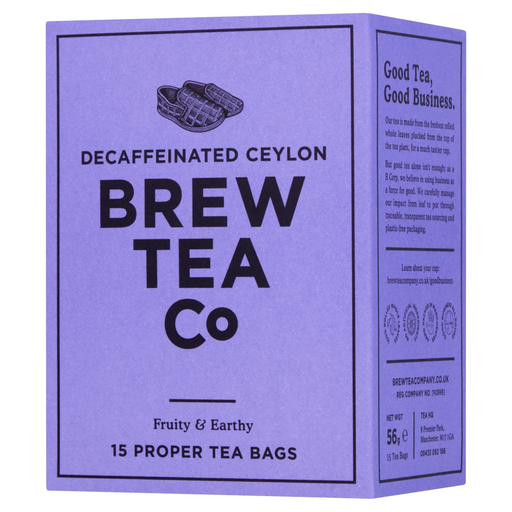 No image available
A stated 15-bag black decaf format to consider for occasional pantry use. The listing names CO2 processing and cool, dry storage; check the current ingredient label and organic certification information if an organic claim is essential.
 No image available
An 80-bag everyday black-tea listing for households that use decaf regularly. It describes organically grown black tea and advises cool, dry storage; check the current pack’s decaf ingredient wording and organic control-body details.
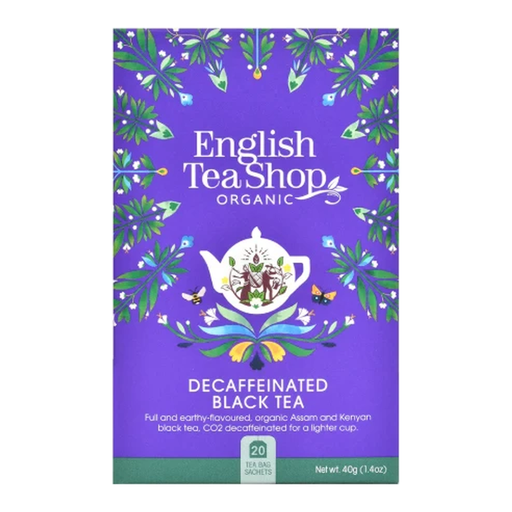 No image available
A 20 g black-tea listing whose ingredients identify decaffeinated organically grown tea. It advises cool, dry storage; check the bag count, brewing directions and organic certification details on the current pack when assessing how it fits your pantry.
Check the organic claim and certification information for the exact product. Defra’s UK organic-labelling guidance requires an organically labelled product and its suppliers to be certified by an approved organic control body; Tesco’s Clipper 40-bag black decaf listing, for example, displays the code GB-ORG-05.
No. Organic describes a certified production and labelling claim, while decaf describes tea that has undergone caffeine removal. If a naturally caffeine-free drink is what you want, check the ingredients of a herbal or fruit infusion rather than treating decaf tea as equivalent.
No. Clipper says it uses carbon dioxide for its decaf range, but another product’s method needs to be checked in its own information. An organic claim alone does not specify a decaffeination method.
Check tea type, ingredients, organic information, bag count, net weight and storage instructions on the exact pack. A larger bag count is useful only if the tea suits your usual cups and you can store the pack as directed.