Choose an organic-labelled decaf black tea if organic production is essential to your elevenses cup; Clipper Organic & Fairtrade Everyday Decaf lists decaffeinated organically grown black tea. If organic status is not essential, a conventional decaf may better match the blend or pack format you want. Decaf does not necessarily mean caffeine-free, so check the exact product’s caffeine statement and how it is measured.
Who is this choice for?
Organic-first tea drinkers
If organic production is a requirement for your elevenses tea, check the claim on the exact decaf pack. GOV.UK explains that organic food claims are subject to certification and labelling rules; general sustainability wording is not the same claim.
Tea drinkers checking caffeine
If residual caffeine matters to you, look for a statement about the exact tea. Brands express it in different ways, including an amount per brewed cup or a percentage, which cannot be compared directly without a common basis.
Regular tea-break drinkers
If you make decaf tea often, compare the number of bags and net weight after deciding which tea style and organic designation you want. Packs with different bag counts are not interchangeable simply because both are decaf.
What should you check?
Decide whether organic status is essential, then check the tea base, caffeine statement and pack format against the way you make elevenses.
Organic-labelled decaf black tea
Choose it when: You want a black-tea elevenses cup and require an organic product claim on the tea you buy.
Bear in mind: Check the designation on the exact pack rather than treating Fairtrade, sustainability wording or decaffeination as proof of organic status.
Conventional decaf black tea
Choose it when: Organic status is not required and a particular everyday blend or pack format matters more to you.
Bear in mind: A decaf label does not establish zero caffeine or an organic claim for that product.
| Priority |
What to check |
Your needs |
| Organic designation |
Read the organic claim and associated labelling on the exact pack. Check the ingredient description rather than relying on general ethical or sustainability wording. |
I only want decaf tea with an organic claim for the product itself. Clipper describes its Organic & Fairtrade Everyday Decaf ingredient as decaffeinated organically grown black tea. |
| Residual caffeine |
Check the exact product’s figure and whether it refers to a brewed cup or a percentage. Yorkshire Tea states 1.5–2 mg per average 200 ml cup brewed for five minutes; Tesco lists PG Tips Decaf at less than 0.2% caffeine. Those figures use different bases. |
I want to know what the caffeine statement means for the tea I am considering, rather than assume that every decaf cup is caffeine-free. |
| Black-tea style |
Confirm that the tea is decaffeinated black tea if you want a familiar elevenses brew. Check the maker’s brewing directions for that product; Clipper advises infusing its Organic & Fairtrade Everyday Decaf for 2–5 minutes. |
For my mid-morning cup, I want black tea rather than a herbal infusion, and I want a preparation method that fits my tea break. |
| Pack format |
Compare bag count and net weight on the packs you are considering. Confirm whether the tea is supplied in bags or another format if that affects how you prepare it. |
A pack for frequent tea breaks needs to suit how often I make tea; if I am trying a new blend, I may prefer a smaller pack first. |
Common buying mistakes
-
Treating “natural”, “ethical” or “decaf” as proof of organic status
Those descriptions do not establish an organic product claim. GOV.UK sets out specific certification and labelling rules for organic food.
If organic status is essential, inspect the organic designation and associated information on the exact tea pack.
-
Assuming decaf means zero caffeine
Residual caffeine statements differ by product and measurement basis. Yorkshire Tea gives a figure per brewed cup for its Decaf, while the cited PG Tips Decaf pack gives a percentage.
Use the statement for the exact tea and compare figures only when their serving and measurement bases match.
-
Overlooking the number of bags in a pack
Clipper’s cited organic decaf listing contains 40 bags, while the cited Tesco Decaff Original listing contains 80. The packs therefore cover different numbers of tea breaks.
Check bag count and net weight after deciding whether the tea meets your organic and black-tea preferences.
Relevant tea brands
These references concern particular decaf products or ranges; a brand name alone does not establish that every tea it sells is organic.
Clipper
Clipper Organic & Fairtrade Everyday Decaf is an organic-labelled black-tea option for elevenses.
- Clipper lists decaffeinated organically grown black tea as the ingredient in its 40-bag product.
- If a particular certification mark or control-body detail matters to you, inspect the exact pack.
Yorkshire Tea
Yorkshire Tea Decaf is an everyday black-tea alternative when an organic claim is not a requirement.
- Yorkshire Tea states that its Decaf contains 1.5–2 mg caffeine per average 200 ml cup brewed for five minutes.
- Check the exact pack if you require an organic designation; a decaf claim does not establish one.
Tetley
Tetley Decaffeinated appears in Tesco’s UK decaf-tea listing in several bag counts.
- The cited listing includes 40-, 80- and 160-bag formats.
- Check the exact pack for any organic claim or product-specific caffeine figure you need.
PG Tips
PG Tips Decaf is another everyday black-tea option.
- Tesco’s listing for the 70-bag PG Tips Decaf pack states less than 0.2% caffeine.
- That percentage cannot be directly compared with a figure stated in milligrams per brewed cup.
Twinings
Twinings offers several decaf tea styles, including Everyday Decaffeinated.
- Twinings states that its Everyday Decaffeinated blend has been decaffeinated to 0.02% caffeine.
- Check the specific tea if organic designation is essential; the caffeine percentage does not establish organic status.
Tesco
Tesco Decaff Original is an own-label decaf tea for regular tea breaks.
- Tesco lists Decaff Original as an 80-bag, 250g pack.
- Inspect the exact product information if an organic claim is a requirement.
Joybuy decaf tea options
These options include organic-labelled decaf black teas and a Tetley decaf black tea for elevenses. Check the exact pack if organic designation or a particular caffeine statement is essential to your choice.
 No image available
Clipper Organic Fairtrade Decaf Everyday, 80 tea bags, 277g
An 80-bag black-tea option for elevenses when an organic product claim matters to you.
The product description identifies decaffeinated organically grown black tea. Check the exact pack for any specific certification detail you require, and check its caffeine statement if residual caffeine affects your choice.
View on Joybuy
 No image available
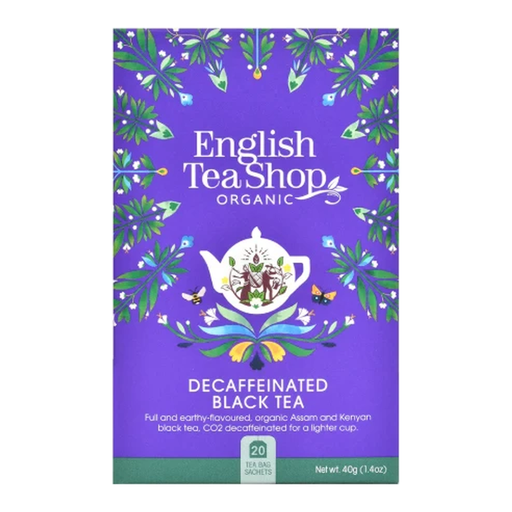
English Tea Shop Organic Decaffeinated Black Tea, 20g
A 20g organic-labelled decaf black tea to consider if you want a smaller pack for elevenses.
Check the pack’s tea format and brewing instructions if you need tea bags or a particular preparation method. Check its caffeine statement on a brewed-serving basis if that matters to you.
View on Joybuy
 No image available
Tetley Decaffeinated Tea, 80 bags, 250g
An 80-bag decaf black tea for elevenses if organic designation is not a requirement.
The product description gives a 2–3 minute brewing instruction. Check the exact pack if you need an organic claim or a product-specific residual-caffeine figure.
View on Joybuy
Questions about organic decaf tea
How can I check whether a decaf tea is organic?
Look for an organic claim and its associated labelling information on the exact pack. GOV.UK explains that organic food claims are governed by certification and labelling rules; words such as “natural” or “ethical” do not replace an organic product claim.
Is decaf tea completely caffeine-free?
No: a decaf tea can retain caffeine, and statements use different measurement bases. Yorkshire Tea states 1.5–2 mg per average 200 ml cup brewed for five minutes for its Decaf, while Tesco’s cited PG Tips Decaf listing states less than 0.2% caffeine. Check the exact product rather than comparing those figures directly.
What organic decaf tea suits a traditional elevenses cup?
An organic-labelled decaf black tea suits you if you want black tea rather than a herbal infusion and organic production is essential. Clipper lists decaffeinated organically grown black tea for its Organic & Fairtrade Everyday Decaf and advises infusing it for 2–5 minutes.
Should I choose a smaller or larger pack?
A smaller pack may suit a first try of an unfamiliar blend; a larger bag count may suit frequent tea breaks. Compare the exact teas’ bag counts and formats only after checking that they meet your organic and tea-style requirements.


