What should you check?
Start with when you plan to eat, then compare the labelled portion and ingredients of the particular fruit you are considering.
| Priority | What to check | Your needs |
|---|
| Timing and meal size |
Consider how long you have before running and whether you want a small snack or a light meal. The British Dietetic Association suggests a low-fat, high-carbohydrate snack or light meal two to three hours before exercise. |
If I have time for breakfast and want more than a small fruit portion, I can choose a familiar meal instead. The UK Sports Institute says a 5k does not call for marathon-style fuelling. |
| Portion and carbohydrate |
Compare the stated serving size and carbohydrate on the nutrition panel. Tesco Groceries lists 22.1g available carbohydrate and 20.3g sugars per 30g of Tesco Organic Raisins; those figures describe that product and portion. |
A small, measured portion is easier for me to trial than eating straight from a large bag. I would check the figures for the product I actually buy. |
| Organic designation |
Look for the organic label and certification details on the particular pack. The UK Department for Environment, Food & Rural Affairs says organic food labelling requires compliance with production rules, at least 95% organic agricultural ingredients and certification of the product and suppliers by an approved control body. |
I want an identifiable organic product, rather than assuming that words such as “natural” tell me how it was produced. |
| Ingredients and sulphites |
Read the current ingredient and allergen information, including when buying a familiar fruit in a different pack. The Food Standards Agency says sulphur dioxide or sulphites are often used in dried fruit, including raisins, apricots and prunes. |
If I need to avoid sulphites, or have asthma-related concerns, the fruit type alone is not enough for me to judge a product. |
| Fruit and pack format |
Check whether you prefer loose raisins or sultanas, or individually portioned pieces such as dates. Compare pack sizes and plan a portion you can carry and try in training. |
I might prefer a small raisin pack for carrying, or dates if I would rather portion individual pieces. Either way, I would try the exact food before relying on it on run day. |
Which brands offer useful reference points?
These named product lines offer different fruits and pack formats; check the individual listing or pack rather than extending one product's details to a whole brand.
Tesco Organic
Tesco Organic Raisins are a specifically labelled organic raisin option in a 375g pack.
- Tesco Groceries lists raisins and sunflower oil, with 22.1g available carbohydrate and 20.3g sugars per 30g serving.
- Check the physical pack for current ingredients, nutrition and allergen information, which may change.
Sainsbury's SO Organic
Sainsbury's Groceries lists SO Organic raisins and sultanas in 500g packs, soft apricots in a 250g pack and partially rehydrated organic dates in a 250g pack.
- The listed formats give shoppers a choice between loose dried fruit and larger individual pieces.
- Check the chosen product's own ingredients, nutrition and allergen details before use.
M&S Organic
M&S lists Organic Raisins in a 375g pack containing organic raisins and organic sunflower oil.
- Marks & Spencer states 69.3g carbohydrate and 4.9g fibre per 100g for this product.
- Its UK product information says availability may vary by store; check the current pack for ingredients and nutrition.
Whitworths
Whitworths offers dried-fruit products including Sunny Raisins, dates, apricots and prunes.
- Whitworths lists raisins and sunflower oil as the ingredients of Sunny Raisins.
- If organic status matters to you, check for an organic designation on the specific product rather than assuming it applies to the range.
Joybuy dried-fruit options
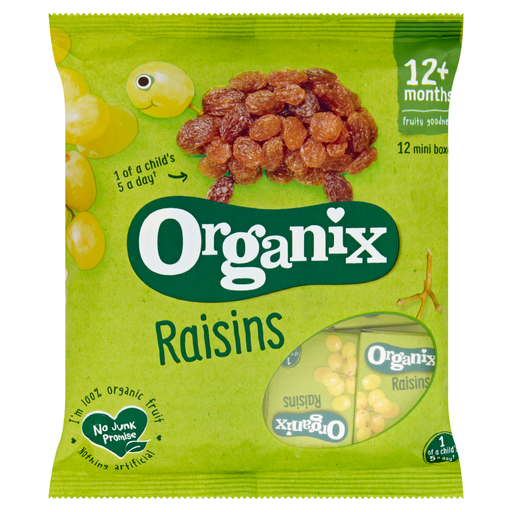
This raisin option comes in small boxes that may be convenient for trialling a portion before a 5k. Check its pack information against your organic, ingredient and nutrition requirements.
 No image available
Organix Goodies Raisins 12+ Months, 12 x 14g
The individual 14g boxes offer a small portion to try on a training day. This product is labelled for ages 12+ months rather than specifically for runners; check the pack's organic designation, ingredients and nutrition before deciding whether it meets your needs.
Joybuy
Frequently asked questions
Do I need dried fruit before a 5k?
No, dried fruit is optional. The UK Sports Institute says runners need not fuel as if they were running a marathon. If you have time and want to eat beforehand, a familiar carbohydrate-based breakfast or snack is another option; the British Dietetic Association suggests a low-fat, high-carbohydrate snack or light meal two to three hours before exercise.
What does a 30g dried-fruit portion mean?
The NHS says 30g of dried fruit counts as one 5 A Day portion, equivalent to around 80g of fresh fruit. That is a general fruit-and-vegetable portion reference, not a pre-run carbohydrate target.
Does organic dried fruit contain less sugar?
Organic status does not establish that a dried fruit is lower in sugar. UK organic labelling rules concern production and certification; for a product-specific reference, Tesco Groceries lists 20.3g sugars per 30g of Tesco Organic Raisins. Compare the serving sizes and nutrition panels of the products you are considering.
How can I check an organic claim in the UK?
Look for the organic designation and certification details on the particular product. The UK Department for Environment, Food & Rural Affairs says organic food labelling requires compliance with organic production rules, at least 95% organic agricultural ingredients and certification of the product and suppliers by an approved organic control body.
Should I check dried fruit for sulphites?
Check the current pack if sulphites are a concern, particularly if you have asthma. The Food Standards Agency says sulphur dioxide and sulphites are often used in dried fruit such as raisins, dried apricots and prunes, and identifies asthma as a higher-risk context for a reaction. Do not rely on the fruit type or a previous purchase to establish what is in the pack.


