What should you check before buying?
Choose the fruit and serving format first, then check the exact pack for the claims, warnings and storage directions that matter to your guests.
| Priority | What to check | Your needs |
|---|
| Organic labelling |
Look for an explicit organic claim and control-body information on the pack or listing. Defra’s UK organic-food guidance, published in August 2025, distinguishes regulated organic labelling from vague descriptions such as “natural”. |
I want fruit that is labelled organic, not just described in a way that sounds similar. |
| Ingredients and warnings |
Read the ingredient list, the precise sulphite wording and any precautionary allergen statement. An organic claim alone does not establish that a product is sulphite-free or suitable for every guest. |
For guests checking sulphites or allergens, I need to keep the information from each pack available at the buffet. |
| Portions and timing |
Check pack and serving sizes before deciding how much to put out. The NHS counts 30g of dried fruit as one 5 A Day portion and advises eating it at mealtimes rather than between meals to reduce tooth-decay risk. |
I’d like guests to take a portion alongside the meal, especially when children can return to the buffet. |
| Texture and storage |
Distinguish whole dried fruit from soft or partially rehydrated products. Check for remaining-stone warnings and follow the exact pack’s instructions after opening. |
If I choose softer apricots, I need a plan for serving them and storing what is left. |
Which brands provide useful points of reference?
These product and retailer listings illustrate different checks to make; a brand name alone does not establish the ingredients or warnings of another product in its range.
Minton & Donello
Ocado lists its Organic Apricots Unsulphured as whole dried organic apricots and identifies Soil Association Organic code GB-ORG-05.
- The listed ingredient is organic dried whole apricots.
- The listing carries may-contain warnings for cereals containing gluten, nuts, peanuts, sesame and soya.
Crazy Jack
Its Organic Soft Apricots offer a softer, ready-to-eat format; the Ocado listing explicitly states that they are free from sulphur dioxide and sulphites.
- The listing gives a product-specific sulphite statement.
- Refrigerate after opening and use within 14 days; fruit stones may remain.
Sainsbury’s SO Organic
Sainsbury’s lists a 250g pack of SO Organic Dried Apricots with dried apricots as the ingredient and states that the product contains no preservatives.
- The ingredient list is straightforward to check when planning a fruit bowl.
- Sainsbury’s says the apricots may be drier than expected and warns that stones may remain.
M&S
Ocado describes M&S Organic Soft Apricots as partially rehydrated, pitted dried organic apricots.
- The soft format gives hosts an alternative to whole dried apricots.
- The listing says to reseal and eat within seven days of opening, and warns that stones may remain.
Tesco
Tesco’s dried-fruit listing includes Tesco Organic Dried Mango 100g, a different fruit format from the apricots above.
- Mango is worth considering if an apricot-only bowl would not suit the buffet.
- Check the individual mango pack for its ingredients, allergen statements and storage directions.
Joybuy raisin option
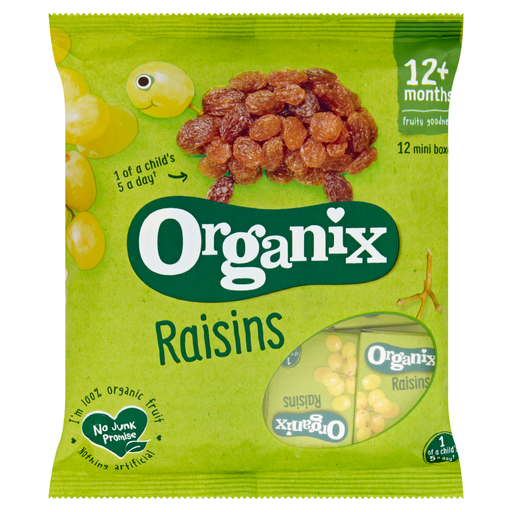
These individual raisin boxes offer a different serving format from a shared bowl of apricots. Check the pack’s organic wording and other label details if an organic product is essential for your buffet.
 No image available
Organix Goodies Raisins 12+ Months, 12 x 14g
The twelve 14g boxes allow you to put out individual portions instead of serving raisins from a shared bowl. If children are eating them, serve dried fruit with the meal, in line with NHS advice, and supervise eating. Check the pack for its organic claim, ingredients and allergen information.
View on Joybuy
Questions about organic dried fruit
How can I check an organic claim on dried fruit?
Look for an explicit organic claim and any control-body information on the product pack. Defra’s UK organic-food guidance, published in August 2025, says food described as organic must meet organic production rules and be certified through an approved control body; a description such as “natural” is not the same claim.
Does organic dried fruit automatically have no sulphites?
No. Check the exact product’s sulphite wording separately from its organic claim. Ocado lists Crazy Jack Organic Soft Apricots as free from sulphur dioxide and sulphites, for example, but that statement does not apply to every organic dried fruit.
How much dried fruit counts as a portion?
The NHS counts 30g of dried fruit as one 5 A Day portion. For a buffet, that gives you a reference for serving amounts; the NHS also advises eating dried fruit at mealtimes rather than between meals to reduce tooth-decay risk.
What should I check before serving dried fruit to children?
Serve dried fruit with the meal rather than as a between-meal snack, as the NHS advises for toddlers. Check the pack for relevant warnings too: several of the organic apricot listings above say that stones may remain.
Which pack information should guests be able to see?
Keep the original packaging available so guests can read ingredients, allergen statements, storage directions and any warnings for themselves. Those details matter more than assuming every fruit in a shared bowl has the same ingredients or handling requirements.


