Organic-first snackers
If organic status is essential, look for an explicit organic label rather than relying on words such as “natural”. Then check the ingredients and serving information on the particular pack.


For a TV-night snack, start with dried fruit labelled organic, then choose the ingredients, fruit texture and portion format that suit how you snack. Organic labelling does not tell you whether sugar or other ingredients have been added: Sainsbury's SO Organic mango lists only mango, yet its label declares 20.3g sugars per 30g serving.
If organic status is essential, look for an explicit organic label rather than relying on words such as “natural”. Then check the ingredients and serving information on the particular pack.
A single-fruit recipe may suit you, but read its nutrition panel separately. Sainsbury's SO Organic mango, for example, lists mango as its only ingredient and 20.3g sugars per 30g serving.
If you tend to snack throughout a film, a stated serving size or smaller pack units can help you decide how much to put in a bowl before watching. Check the storage instructions for anything left over.
Check the organic label first, then compare the exact recipe and serving information before choosing a fruit format for the evening.
| Priority | What to check | Your needs |
|---|---|---|
| Organic status | Look for “organic” on the exact product label. Defra's UK guidance says food described as organic must meet production and certification rules; “natural” is not a substitute for that claim. | I want an explicitly organic product, not simply dried fruit with natural-sounding packaging. |
| Ingredients and sugars | Read the ingredient list for added sugar or other ingredients, then compare sugars using the stated serving size. Sainsbury's SO Organic mango lists only mango and declares 20.3g sugars per 30g serving. | A short ingredient list matters to me, but I also want to know what the portion's nutrition panel says. |
| Fruit format | Choose between small pieces such as raisins or sultanas and larger soft fruits such as apricots, dates or prunes. Check the exact product name so that a fruit-snack listing is not mistaken for an organic label. | For a long programme, I would rather pick a texture I enjoy than buy a pack solely because it sits in the dried-fruit category. |
| Portions and storage | Check the serving size, number of units or servings, and instructions for an opened pack. Sainsbury's 100g SO Organic mango pack states approximately three 30g servings. | I'd like to put out a defined amount before viewing and know how to keep the remainder according to its pack instructions. |
Organic status and the sugars figure answer different questions. Sainsbury's SO Organic mango lists mango alone but declares 20.3g sugars in a 30g serving.
Check organic labelling for the production requirement, then use the nutrition panel and serving size to assess the snack separately.
Sainsbury's SO Organic mango lists only mango. Joybuy's Bestore Dried Mango 108g listing instead names mango, sugar, citric acid, potassium sorbate and sulphur dioxide; the two recipes should not be treated as interchangeable.
Read the ingredients and allergen declaration for the exact pack, particularly if you need to avoid sulphites or want a single-fruit recipe.
A pack's serving information can be easy to overlook when snacking during a programme. Sainsbury's 100g SO Organic mango pack, for example, states approximately three servings rather than one.
Check the stated serving and put your chosen amount in a bowl before sitting down; follow the pack's instructions for the remainder.
These examples show why the exact product label matters; a brand or fruit-snack category does not establish the ingredients of every pack.
Sainsbury's lists organic mango, raisins, sultanas, soft apricots and cranberries in its dried-fruit range.
Tesco Groceries lists organic mango, cranberries, raisins and sultanas.
M&S lists organic soft apricots, dates and prunes, as well as organic raisins and sultanas.
Whitworths provides a dried-fruit comparison for shoppers whose organic requirement is flexible.
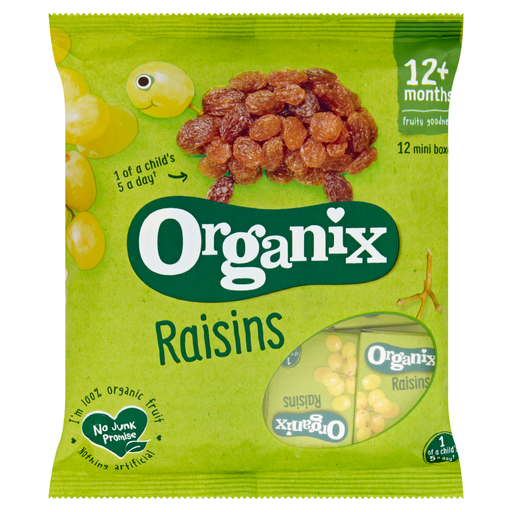
This 12 x 14g raisin pack is an option if smaller snack units appeal to you. If organic status is essential, check the exact pack's organic label alongside its ingredients and nutrition information.
 No image available
The 12 x 14g format gives you a defined amount to set aside for a TV snack. The product is marked 12+ months; check its exact label for organic status, ingredients and nutrition if those determine your choice.
Look for “organic” on the particular product's label rather than relying on descriptions such as “natural”. Defra's UK guidance says food described as organic must meet organic production rules and be certified through an approved organic control body.
No: check organic status and added ingredients separately. Sainsbury's SO Organic mango lists only mango, while Joybuy's Bestore Dried Mango 108g listing includes sugar and other ingredients; read the panel for the exact product you intend to buy.
Use the pack's serving information to choose an amount and put it in a bowl before watching. As one concrete reference, Sainsbury's SO Organic mango states a 30g serving and approximately three servings in its 100g pack.
NHS guidance for toddlers says dried fruit such as raisins should be given with meals rather than as a snack between meals because the sugars they contain can cause tooth decay. That guidance is specifically about young children, including when considering a pack marked 12+ months.