Families planning food at home
A larger organic pack can be portioned for breakfast, baking or a meal dessert. For routine snacks between meals, NHS guidance points families towards fresh fruit or vegetables instead.


Choose a clearly labelled organic dried-fruit product for breakfasts or other meals, rather than treating it as an all-day snack: the NHS advises having dried fruit with a meal and choosing fresh fruit or vegetables for routine between-meal snacks. Mini boxes provide a fixed quantity where the child meets the pack’s age guidance; larger bags let you portion fruit for family meals. Check the ingredients and sugars as well as the organic label, since organic status does not describe the product’s sugar content.
A larger organic pack can be portioned for breakfast, baking or a meal dessert. For routine snacks between meals, NHS guidance points families towards fresh fruit or vegetables instead.
Individual boxes offer a fixed quantity to take out or serve at a meal. Check the stated lower age limit: the Organix raisin boxes listed by Tesco are labelled for children aged 12 months and over.
Look for an explicit organic label, then compare the current ingredients and nutrition panel. An organic claim concerns production and labelling; it does not tell you how much sugar a serving contains.
Start with when the fruit will be eaten, then check the organic label, ingredients and pack format against that plan.
| Priority | What to check | Your needs |
|---|---|---|
| Organic label | Look for an explicit organic claim on the current product label. UK organic labelling rules published by the Department for Environment, Food & Rural Affairs require products labelled organic to meet organic production rules; words such as ‘natural’ are not the same claim. | I’m choosing organic dried fruit, so I want the pack itself to identify it as organic. |
| Snack timing | Plan dried fruit as part of a meal. The NHS advises fresh fruit or vegetables for children’s routine between-meal snacks. | For breakfast or a meal dessert, I can serve dried fruit with the meal. Between meals, I’d choose fresh fruit or vegetables instead. |
| Ingredients | Read beyond fruit imagery or ‘no added sugar’ wording. Check whether the product contains whole dried fruit or ingredients such as purées, juice concentrates and coatings. Action on Sugar’s 2020 survey discusses free sugars in the processed fruit snacks it examined, not every whole dried-fruit product. | I want whole dried fruit, not a processed fruit snack chosen because its front label says it is made from fruit. |
| Quantity and age | Check the pack weight, any individual-box weight and stated age guidance. Tesco lists Organix raisins in 12 x 14g boxes with a lower age limit of 12 months. The NHS’s 30g dried-fruit portion is a general reference, not a child-specific target. | A fixed-size box would be useful to take out; at home, I may prefer to portion a larger bag myself. For a toddler, I also need to check the pack’s age guidance. |
| Current pack details | Compare sugars using the same stated serving size or per-100g basis, and read the current ingredient, allergen and storage information. Tesco lists 20.3g sugars per 30g serving for its Organic Raisins. | Before serving or packing the fruit, I want to check the actual label, especially where an allergy, dietary restriction or food policy matters. |
Organic labelling describes how a product is produced; it does not remove its sugars. The NHS advises having dried fruit with a meal rather than frequently between meals.
Use it with breakfast or another meal, and consider fresh fruit or vegetables for routine snacks between meals.
A product made with purées, juices or concentrates has a different ingredient profile from whole raisins. Action on Sugar’s 2020 survey discusses free sugars in the processed fruit snacks it examined.
Read the full ingredient list when whole dried fruit is what you intend to buy; do not rely on fruit imagery or a ‘no added sugar’ claim alone.
Adult figures on a nutrition panel are not child-specific targets. The NHS notes that children’s portion needs vary with age, body size and activity.
Check the product’s age guidance and the amount in a box or serving. Treat the NHS’s 30g dried-fruit portion as a general reference, not a required amount for a child.
Ingredients and allergen statements matter particularly when a snack contains more than plain dried fruit.
If an allergy, dietary restriction or school or club food policy applies, check the actual pack’s ingredients and allergen information before serving or packing it.
A larger organic-raisin pack for portioning at home or using with meals.
An organic raisin option in individual boxes labelled for children aged 12 months and over.
A 500g organic-raisin pack for household use.
Organic dried-fruit options listed by M&S include raisins and sultanas, alongside other fruit varieties.
A portion-format comparison, not an organic choice based on the cited product listing.
A portioned organic-raisin option for meals involving a child aged 12 months or over; check the pack guidance before serving.
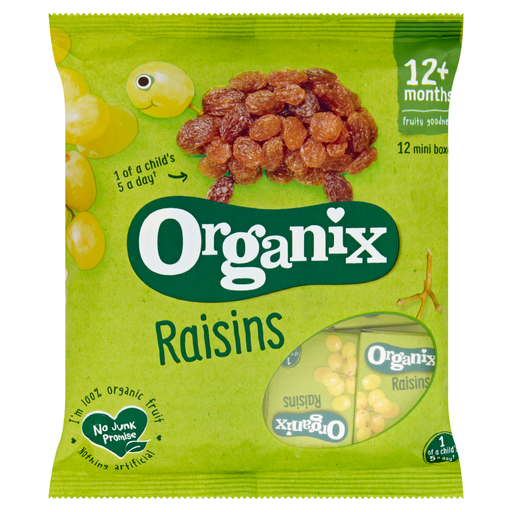 Image unavailable
The individual boxes provide a fixed quantity for a child who meets the stated 12-month lower age guidance.
The product information identifies the contents as 100% organic raisins in 12 x 14g boxes. The NHS advises serving dried fruit as part of a meal rather than as a frequent between-meal snack.
No. Organic is a production and labelling claim, not a description of sugar content. Tesco lists 20.3g sugars per 30g serving for its Organic Raisins, and the NHS advises having dried fruit with a meal rather than grazing on it between meals.
Choose mini boxes if a fixed pack quantity and portability matter, or a larger bag if you will portion fruit for family meals. Check any age guidance on the chosen product. Neither format changes NHS advice on having dried fruit with a meal.
The NHS gives around 30g as a general dried-fruit portion reference, not a required amount for every child. Children’s portions vary with age, body size and activity; also follow the chosen pack’s age guidance.
Read the ingredients: a whole-raisin product may list raisins alone or with sunflower oil, while a processed fruit snack may contain purées, juices, concentrates or coatings. Action on Sugar’s 2020 fruit-snack survey discusses free sugars in the processed products it examined; that finding should not be applied to every whole dried-fruit product.
If organic status matters, check that the product is explicitly labelled organic. Then read the current ingredients, nutrition panel, age guidance, storage directions and allergen statement, particularly if an allergy, dietary restriction or food policy applies.