Organic dried fruit can be a portable, carbohydrate-containing choice before a workout, but the portion and timing matter more than the organic claim alone. University College London Hospitals NHS Foundation Trust advises a snack containing carbohydrate and protein, with minimal fat, 60–90 minutes before exercise; organic certification does not establish a lower sugar content or make dried fruit a complete pre-workout snack.
Who is this for?
People training after a gap since their last meal
If exercise is 60–90 minutes away, consider dried fruit as the carbohydrate part of a snack rather than the whole snack. University College London Hospitals NHS Foundation Trust advises including protein and keeping fat minimal at this interval.
Commuters carrying a pre-session snack
Individual portions are easier to carry and measure than a loose bag. Sainsbury’s lists Crazy Jack Organic Mango in four 30g packs; check whether that format suits your journey and when you plan to eat.
Organic shoppers checking the whole label
An organic claim and an ingredient list answer different questions. Check the exact pack for certification details, ingredients, allergen statements and stone warnings before choosing a fruit.
What should you check?
Start with when you will eat, then compare the serving information and label on the fruit you intend to carry.
| Priority | What to check | Your needs |
|---|
| Workout timing |
Check the time until exercise and whether you have recently eaten. University College London Hospitals NHS Foundation Trust advises carbohydrate and protein with minimal fat 60–90 minutes beforehand; its 15–30-minute guidance refers to faster-acting carbohydrate. |
If I have a longer gap before training, I can plan fruit as one part of a snack. Closer to the session, I need to consider whether dried fruit is the right format for me. |
| Organic label |
Check the organic claim on the exact product, then read its ingredients separately. GOV.UK says UK organic labelling requires organic production rules to be met, at least 95% of agricultural ingredients to be organic, and certification by an approved control body. |
I want a product with a regulated organic claim, without assuming that ‘organic’ also means no added sugar or less naturally occurring sugar. |
| Serving and sugars |
Compare carbohydrate and sugars using the same stated serving size. The NHS counts 30g of dried fruit as one 5 A Day portion and advises eating dried fruit at mealtimes rather than as a between-meal snack to reduce tooth-decay risk. |
A measured portion helps me compare packs; I do not want to treat a large bag as one snack or graze on it throughout the day. |
| Pack warnings |
Read the current ingredient and allergen statements, including any precautionary warnings. The Food Standards Agency identifies sulphur dioxide and sulphites as ingredients used in some dried fruit; some date and prune listings also warn that stones may remain. |
If allergens, sulphites or stones matter to me, I need the warning for the particular pack, not an assumption based on the fruit name. |
What is easy to overlook?
-
Reading ‘organic’ as a nutrition claim
UK organic labelling rules concern production and certification. They do not establish the product’s sugar content or its suitability for a particular workout.
Check the organic label, ingredients and nutrition per serving separately. For a snack 60–90 minutes before exercise, consider the protein component advised by University College London Hospitals NHS Foundation Trust.
-
Eating straight from a large bag
A pack can contain several servings. The NHS uses 30g as its dried-fruit 5 A Day portion reference, while nutrition values on retailer labels are stated for particular serving sizes.
Measure the amount you intend to take and compare products on a consistent serving basis.
-
Overlooking warnings on a familiar fruit
The Food Standards Agency says sulphites are used in some dried fruit and notes a higher risk of reaction for people with asthma. Individual products may also carry precautionary allergen statements or stone warnings.
Read the current pack’s ingredients and warnings each time you choose a product, particularly when those details affect what you can eat.
-
Grazing on dried fruit between meals
The NHS advises eating dried fruit at mealtimes rather than as a between-meal snack to reduce tooth-decay risk.
If you choose it before exercise, plan when to eat it rather than repeatedly snacking from the pack.
Which brands and ranges are relevant?
These are examples of dried-fruit ranges to compare; a brand’s inclusion does not establish that every product in its range is organic.
Sainsbury’s SO Organic
Sainsbury’s product pages list organic mango, dates and prunes with nutrition information per 30g serving.
- The mango page lists mango as its ingredient; the dates and prunes are described as partially rehydrated.
- The mango carries a nuts and sesame manufacturing warning, while the date and prune listings warn that stones may remain. Check the current pack.
Tesco
Tesco Groceries lists organic raisins and sultanas in 375g packs, organic Medjool dates in a 200g pack and organic dried mango in a 100g pack.
- The larger raisin and sultana packs offer a format for measuring portions at home.
- Check the individual product label and current availability when choosing a pack.
Crazy Jack
Sainsbury’s lists Crazy Jack Organic Mango as four separate 30g portions.
- The listing states that the mango is organic, with no added sugar or preservatives.
- No added sugar does not mean sugar-free: compare the pack’s nutrition information if sugars per serving matter to your choice.
Whitworths
Whitworths lists dried-fruit products including apricots, dates, mango, raisins and sultanas.
- The range offers several fruit types and snack formats to compare.
- Whitworths says it is accredited to supply organic ingredients to businesses; that statement does not establish that a particular consumer pack is organic. Check its label.
M&S Food
The M&S Food catalogue lists organic soft apricots, soft dates, soft prunes, raisins and sultanas.
- The listed organic options include both softer fruit and raisin or sultana packs.
- Confirm availability at your selected Foodhall and read the label of the item you choose.
Joybuy product options
This Joybuy option is a small, individually boxed raisin snack marketed for toddlers. For an adult pre-workout snack, compare its 14g box size with the amount you intend to eat and check the pack’s organic and ingredient information.
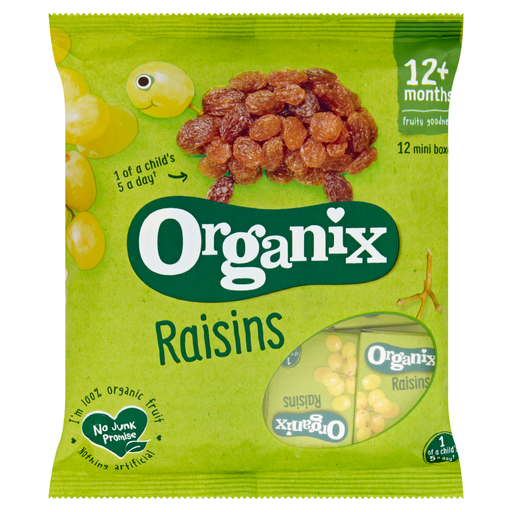 Image unavailable
Organix Goodies Raisins 12+ Months, 12 × 14g
The individual boxes are a portable format if you want to measure what you take before exercise. This product is marketed for children aged 12+ months, and each 14g box is smaller than the NHS 30g dried-fruit 5 A Day portion reference. Check the current pack for its organic claim, ingredients and any sulphite or allergen information relevant to you.
View on Joybuy
Questions about dried fruit before exercise
Does organic dried fruit contain less sugar?
Not necessarily. UK organic rules govern production and certification, not a product’s sugar content. Compare the exact pack’s nutrition panel: Sainsbury’s lists 20.3g sugars per 30g serving for its SO Organic mango and 17.4g per 30g serving for its SO Organic dates.
How much dried fruit counts as one 5 A Day portion?
The NHS says 30g of dried fruit counts as one 5 A Day portion. That is a reference for measuring dried fruit, not a prescribed amount to eat before every workout.
When does dried fruit fit into a pre-workout snack?
It can provide the carbohydrate part of a planned snack. University College London Hospitals NHS Foundation Trust advises carbohydrate and protein with minimal fat 60–90 minutes before exercise; for 15–30 minutes beforehand, its guidance instead calls for faster-acting carbohydrate. Consider your meal timing and the session rather than assuming dried fruit fits both intervals equally.
Does an organic label rule out sulphites?
No. Check the exact product’s ingredients and allergen information rather than treating ‘organic’ as a sulphite-free claim. The Food Standards Agency says sulphur dioxide and sulphites are used in some dried fruit and that people with asthma have a higher risk of reaction.
Is dried fruit suited to frequent between-meal snacking?
The NHS advises eating dried fruit at mealtimes rather than as a between-meal snack to reduce tooth-decay risk. If you choose it before training, account for when you will eat it instead of grazing on it repeatedly.


