Organic-first shoppers
You want an organic fruit infusion and need to check that the claim applies to the product you are buying, rather than relying on its packaging or the retailer category.


For a premium fruit infusion where organic status matters, check the claim on the exact product and read its ingredient list before choosing a flavour. Pukka describes its range as certified organic and offers a spiced apple blend; Clipper offers an organic-labelled blackcurrant and blueberry infusion containing both fruit pieces and flavourings. A premium fruit-infusion format alone does not establish that a product is organic.
You want an organic fruit infusion and need to check that the claim applies to the product you are buying, rather than relying on its packaging or the retailer category.
You want a fruity drink for later in the day. Look for a caffeine-free statement on the exact blend rather than assuming every product called fruit tea has the same ingredients.
You like blackcurrant or blueberry flavours but want to distinguish fruit pieces from flavourings and check whether a blend contains herbs you prefer to avoid.
Start with the organic claim on the exact product, then compare ingredients, caffeine information and the format you will use.
| Priority | What to check | Your needs |
|---|---|---|
| Organic status | Look for an organic claim and certification information on the exact pack or product page. The Department for Environment, Food & Rural Affairs states that at least 95% of a food product’s agricultural ingredients must be organic for organic food labelling. | I want the organic claim to apply to the blend I take home, not just to another product in the range. |
| Flavour and ingredients | Compare named fruits, herbs and flavourings. Clipper lists 3% natural blueberry flavouring, 2% natural blackcurrant flavouring and 1% each of blackcurrant and blueberry pieces in its Organic Blackcurrant & Blueberry infusion. | A berry flavour appeals to me, but I also want to know whether it comes from fruit pieces, flavourings or both. |
| Caffeine | Check for a caffeine-free statement on the chosen product. Twinings describes fruit tea as containing no leaves from the Camellia sinensis plant; Pukka describes its Wild Apple & Cinnamon and Elderberry & Echinacea blends as naturally caffeine-free. | For a later-in-the-day drink, I would check the caffeine information on the exact blend before buying. |
| Format and variety | Check the number of flavours and whether the product uses envelopes, tea temples or loose tea. Twinings describes its Fruit Discovery Collection as containing four fruity infusions. | I might prefer several flavours to try or a format that suits how I serve tea, even if that means checking organic status separately. |
A fruit infusion can have premium packaging without making an organic claim for that product. UK organic food labelling has ingredient requirements, including the 95% threshold described by the Department for Environment, Food & Rural Affairs.
Check the exact pack or official product page for its organic claim and certification information.
A berry-style infusion can combine fruit pieces, herbs and flavourings. For example, Clipper lists both fruit pieces and natural flavourings in its Organic Blackcurrant & Blueberry infusion.
Read the complete ingredient list if particular herbs or flavourings affect your choice.
A fruit or herbal tea’s name and ingredients do not establish that it treats a condition. The NHS notes that herbal products are not suitable for everybody.
Choose a blend for its stated ingredients and flavour; seek advice from a pharmacist or GP if you have concerns about an ingredient alongside medicines you take.
These examples show different products and shopping routes; a brand or retailer name does not establish the status of every blend it offers.
Pukka states that all its products are certified organic. Its Wild Apple & Cinnamon product is described by Pukka as containing 100% organically grown ingredients.
Clipper’s Organic Blackcurrant & Blueberry infusion is a berry-style option with declared fruit-piece and natural-flavouring percentages.
Twinings’ Fruit Discovery Collection offers four fruity infusions for shoppers who want variety.
teapigs lists hibiscus, elderberries, currants and other fruit ingredients for its Super Fruit tea.
Tesco’s fruit-and-herbal tea category includes organic-branded herbal products alongside other infusions.
Sainsbury's fruit-and-herbal tea category includes organic-branded herbal teas.
The Joybuy option here is a Pukka organic-labelled berry herbal infusion for shoppers considering that flavour direction.
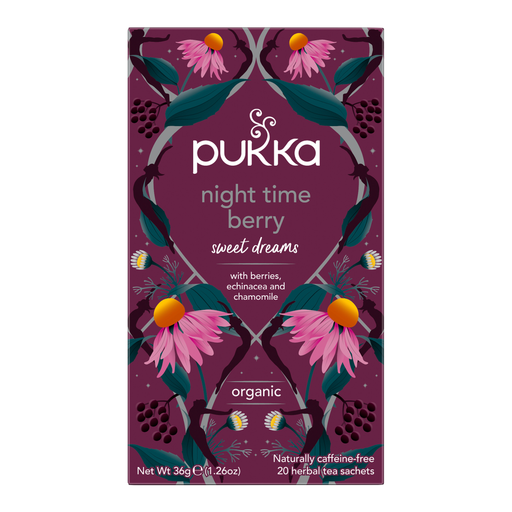 No image available
Consider this berry-style herbal tea if an organic-labelled blend is your priority; Pukka states that its products are certified organic. The pack is labelled as 20 tea sachets weighing 36g. If avoiding caffeine is essential, confirm the status of this exact blend on the pack. Check its full ingredients if liquorice root, valerian root or echinacea herb affect your choice; the name does not establish a sleep benefit.
Check that the organic claim applies to the exact product, then read its ingredients and certification information. The Department for Environment, Food & Rural Affairs states that at least 95% of the agricultural ingredients in an organic-labelled food product must be organic.
Do not assume so from the category name alone: check the chosen pack. Twinings describes fruit tea as containing no Camellia sinensis leaves, while Pukka explicitly describes its Wild Apple & Cinnamon and Elderberry & Echinacea products as naturally caffeine-free.
No. Organic status and a preference for no flavourings are separate checks. Clipper lists natural blueberry and blackcurrant flavourings as well as fruit pieces in its Organic Blackcurrant & Blueberry infusion.
Check the ingredient list if you avoid liquorice or are concerned about how it fits with medicines you take. An NHS GP practice notes that black liquorice can interact with some medicines and supplements; that does not establish that a normal cup of a particular infusion is unsafe.
No. Tesco and Sainsbury's list organic-branded herbal teas within broader fruit-and-herbal categories, so check the organic claim and ingredients on the individual product before buying.