What should you check?
Start with the individual tea’s organic claim, then compare its caffeine statement and full ingredients with the break you have in mind.
| Priority |
What to check |
Your needs |
| Organic status |
Check the individual pack’s organic claim and certification information. Defra’s UK guidance says organic-labelled food must meet production rules, contain at least 95% organic agricultural ingredients, and have the product and suppliers certified by an approved organic control body. |
I want an organic fruit tea, not just a blend described as natural or sustainably made. |
| Caffeine |
Look for an explicit caffeine-free statement for the exact tea. Pukka describes Elderberry & Echinacea as naturally caffeine-free, and teapigs says the same of Super Fruit. |
For an afternoon tea-and-biscuits break, I may prefer a fruity drink without caffeine. |
| Ingredients |
Read beyond the fruit name for botanicals, fruit pieces and flavourings. Clipper’s Blackcurrant & Blueberry lists hibiscus, rosehip, liquorice, nettle, berry pieces and natural flavourings. |
I want to know what shapes the flavour before choosing a tea to serve with biscuits. |
| Pregnancy |
Check for liquorice and other botanicals in the exact blend. NHS pregnancy guidance advises avoiding teas containing liquorice root and drinking no more than four cups of herbal tea a day. |
If I am choosing tea during pregnancy, the full botanical list matters as much as the fruit flavour. |
Fruit tea brand references
These examples show why the claim and ingredient list on a particular blend matter more than a brand name alone.
Pukka
Pukka describes its UK fruit-tea range as organic and its Elderberry & Echinacea fruit tea as naturally caffeine-free.
- The Elderberry & Echinacea product provides a specific organic fruit-tea example.
- Flavours and botanicals vary by blend, so check the individual pack rather than treating the range as interchangeable.
Clipper
Clipper’s Organic Blackcurrant & Blueberry infusion identifies organically produced ingredients in its ingredient list.
- The product lists its botanicals, berry pieces and natural flavourings, making the blend easier to assess beyond its front-label flavour.
- It lists liquorice; NHS pregnancy guidance advises avoiding teas containing liquorice root.
Twinings
Twinings has a fruit-and-herbal infusion range. Sainsbury’s lists its Peach & Orange tea as caffeine-free.
- The Peach & Orange listing identifies ingredients including hibiscus, rosehips, apple pieces, baobab and orange peel.
- A caffeine-free statement does not establish that this particular tea is organic; check its pack if organic status is your priority.
teapigs
teapigs describes its Super Fruit tea as naturally caffeine-free and lists several berries alongside hibiscus.
- The Super Fruit ingredient list names elderberries, currants, blackcurrants, cranberries and blueberries.
- The caffeine-free description does not establish an organic claim for Super Fruit; check the individual pack if that matters to you.
Fruit tea options on Joybuy
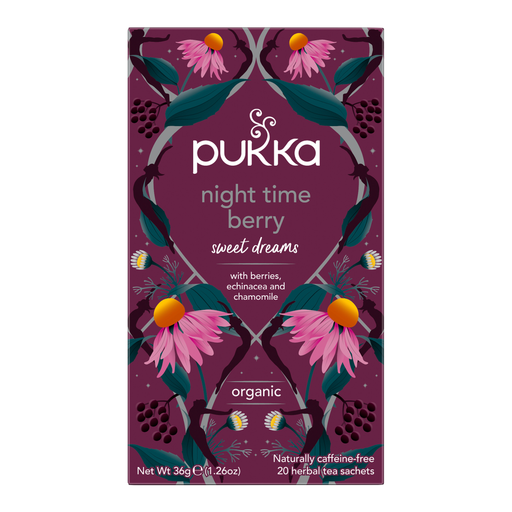
This Pukka Night Time Berry option suits a berry-flavoured tea break. Check its individual pack for organic certification information and a caffeine statement if those are deciding factors.
 No image available
Pukka Night Time Berry Organic, 20 tea sachets, 36g
This berry tea is an option for a tea-and-biscuits break. Its title describes it as organic; check the pack’s certification information before relying on that claim, and confirm its caffeine status if you need a caffeine-free drink. Its ingredients include liquorice root, which NHS guidance advises avoiding in tea during pregnancy.
View on Joybuy
Frequently asked questions
How can I check whether fruit tea is organic in the UK?
Check the organic claim and certification information for the individual product. Defra’s UK guidance says organic-labelled food must meet production rules, contain at least 95% organic agricultural ingredients, and have the product and suppliers certified by an approved organic control body. ‘Natural’ and ‘caffeine-free’ do not establish organic status.
Is every fruit tea caffeine-free?
Do not assume so from the words ‘fruit tea’; check the exact product. Pukka describes Elderberry & Echinacea as naturally caffeine-free, Sainsbury’s lists Twinings Peach & Orange as caffeine-free, and teapigs describes Super Fruit as naturally caffeine-free. Those statements do not cover every tea with a fruit flavour.
Which ingredients should I check in a berry tea?
Read the full panel for botanicals, fruit pieces and flavourings, not just the named berries. Clipper Organic Blackcurrant & Blueberry, for example, lists hibiscus, rosehip, liquorice, nettle, natural flavourings and berry pieces.
What should I check in fruit tea during pregnancy?
Check the exact blend for liquorice root: NHS pregnancy guidance advises avoiding teas containing it. The NHS also advises drinking no more than four cups of herbal tea a day, noting that research on herbal teas in pregnancy is limited. Clipper Organic Blackcurrant & Blueberry lists liquorice among its ingredients.
Where can I look for Clipper organic fruit infusions?
Clipper says its teas are sold through Waitrose, Sainsbury’s, Tesco, Ocado and independent UK retailers. Ranges and stock vary by store, so check for the particular infusion and its organic label when shopping.


