Organic-first desk tea drinkers
If organic certification is essential, check the claim for the exact fruit infusion. A fruit or herbal description alone does not establish that it is organic.


For a quick desk lunch, choose an explicitly organic fruit infusion in individual bags, then check its brewing time and ingredients against your break and preferences. If avoiding caffeine matters, confirm the status of the exact blend rather than relying on its fruit flavour; Clipper Organic Lemon & Ginger specifies a 2–5 minute brew but contains liquorice.
If organic certification is essential, check the claim for the exact fruit infusion. A fruit or herbal description alone does not establish that it is organic.
A fruit infusion can offer an alternative to conventional tea during an afternoon break. Check the exact blend: Pukka describes Wild Apple & Cinnamon and Elderberry & Echinacea as naturally caffeine-free, as does Clipper for Organic Lemon & Ginger.
Individual tea bags work for a mug-based break without measuring loose tea. Preparation times still differ: Clipper specifies 2–5 minutes for Organic Lemon & Ginger, while Twinings specifies three minutes for Peach & Orange.
Start with the organic claim, then check caffeine status, brewing time and the full ingredients of the blend you intend to buy.
| Priority | What to check | Your needs |
|---|---|---|
| Organic status | Check that the exact product is presented as organic, rather than relying on words such as fruit, herbal or natural. In its UK guidance dated 20 August 2025, the Department for Environment, Food & Rural Affairs says organic food labelling requires applicable production rules, at least 95% organic agricultural ingredients, and certification of the product and suppliers by an approved control body. | I want the organic claim to apply to the blend I buy, not just to its flavour or general branding. |
| Caffeine | Read the exact product description for its caffeine status. Twinings distinguishes fruit infusions without Camellia sinensis leaves from conventional tea; do not assume every flavoured tea has the same formulation. | For an afternoon break, I may prefer a blend explicitly described as naturally caffeine-free. |
| Preparation | Check whether the format needs a strainer and follow the stated infusion time. Clipper gives 2–5 minutes for Organic Lemon & Ginger; Twinings gives three minutes for Peach & Orange. | A single bag I can brew in a mug fits a short desk lunch better than a preparation routine I cannot finish during my break. |
| Ingredients | Read beyond the fruit name for herbs and other botanicals. Clipper says Organic Lemon & Ginger contains liquorice and warns people with hypertension to avoid excessive consumption. | Before choosing a multipack, I want to know whether its full ingredient list suits my circumstances and whether I will enjoy its flavour. |
A caffeine-free fruit infusion is not necessarily an organic-certified product. That distinction matters when organic status is the reason for buying it.
Check the exact product’s organic labelling or official product information. UK organic labelling has production, ingredient and certification conditions, as set out in guidance from the Department for Environment, Food & Rural Affairs.
A citrus or fruit-led name may not reveal every botanical ingredient. Clipper says its Organic Lemon & Ginger contains liquorice and warns people with hypertension to avoid excessive consumption.
Read the full ingredient list before choosing a multipack. NHS pregnancy guidance also advises avoiding herbal teas containing liquorice root.
An ingredient such as elderberry or echinacea identifies part of a blend; its presence alone does not establish a health benefit from drinking the tea.
Choose using the stated ingredients, flavour, organic status, caffeine information and preparation directions rather than an assumed medical effect.
Apple-and-spice, berry and citrus-and-ginger infusions offer different flavours, while preparation directions may not fit every short break.
Check the ingredients and brewing instructions before buying a larger format; if you are uncertain about the flavour, consider a smaller pack where available.
These examples show why the organic claim, ingredients and preparation directions need checking at product level; a brand name alone does not settle the choice.
Pukka states that all its products are certified organic. Its named fruit and herbal blends include options described by Pukka as naturally caffeine-free.
Clipper’s Organic Lemon & Ginger is a 20-bag organic infusion described by the brand as naturally caffeine-free.
Twinings’ Peach & Orange is a fruit-infusion reference for shoppers whose priority is a stated flavour and short brewing time rather than organic certification.
teapigs describes Super Fruit as a fruit blend offered in tea temples and loose-leaf formats.
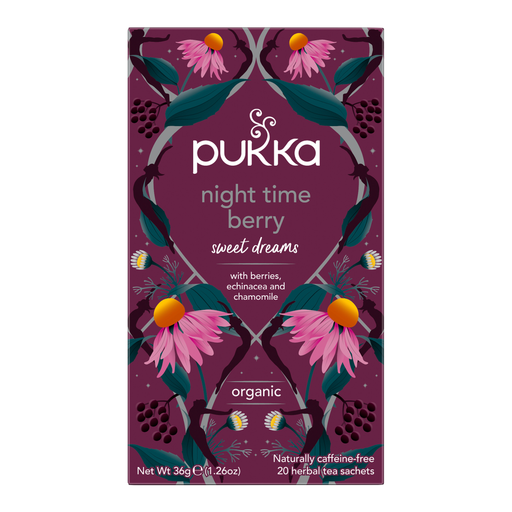
This organic berry blend comes in individual sachets for a mug-based desk lunch. Check its caffeine information and brewing directions if either affects your choice.
 No image available
The individual sachets offer a berry-blend option for a mug-based lunch break.
Pukka states that all its products are certified organic. This blend contains liquorice root, so check whether that ingredient suits your circumstances. Check the exact pack for caffeine information and brewing directions if those are important to your lunch routine.
Check the organic claim for the exact product, not just its fruit or herbal description. In guidance dated 20 August 2025, the Department for Environment, Food & Rural Affairs says UK organic food labelling requires applicable production rules, at least 95% organic agricultural ingredients, and certification of the product and suppliers by an approved control body.
Check the exact blend rather than assuming every fruit-flavoured tea is caffeine-free. Pukka describes Wild Apple & Cinnamon and Elderberry & Echinacea as naturally caffeine-free, and Clipper says the same of Organic Lemon & Ginger.
Follow the directions for the product you choose. Clipper specifies 2–5 minutes for Organic Lemon & Ginger, while Twinings specifies three minutes for Peach & Orange; check a different blend’s pack rather than applying either time to it.
Read the ingredient list and any product warning before choosing it. Clipper warns people with hypertension to avoid excessive consumption of its liquorice-containing Organic Lemon & Ginger; NHS pregnancy guidance advises avoiding herbal teas containing liquorice root.
No health outcome follows from the ingredient name alone. For a desk-lunch drink, compare the stated ingredients, flavour, organic claim, caffeine status and brewing directions instead.