Shoppers choosing by organic status
You want a fruity drink with your mid-morning snack and need a product-level organic claim, rather than a name that simply sounds natural.


Choose an organic-labelled fruit infusion if organic production matters to you: UK organic labelling has defined conditions, as set out by the Department for Environment, Food & Rural Affairs. For a mid-morning cup, also check the individual blend’s ingredients, caffeine statement and brewing directions; an organic claim does not settle those choices.
You want a fruity drink with your mid-morning snack and need a product-level organic claim, rather than a name that simply sounds natural.
You want a fruit infusion without caffeine and are willing to check the exact blend instead of assuming every fruit or herbal tea is caffeine-free.
You want to choose among berry, citrus and herbal flavours, while making a separate decision about whether organic status matters to you.
Start with the organic claim if that drives your purchase, then use the exact blend’s label to choose a drink for your snack break.
| Priority | What to check | Your needs |
|---|---|---|
| Organic status | Look for an explicit organic claim on the individual product. The Department for Environment, Food & Rural Affairs says UK organic food labelling is subject to production rules, including a requirement for at least 95% of agricultural ingredients to be organic. | I want the organic claim to apply to the fruit infusion I buy, not just to one ingredient or the brand’s wider range. |
| Caffeine | Check the exact product’s caffeine statement and ingredients, particularly if a blend may contain conventional tea leaves. Clipper says most, rather than all, of its organic infusions are caffeine-free. | For my mid-morning drink, I’d choose a blend specifically labelled caffeine-free if avoiding caffeine matters. |
| Ingredients and flavour | Read the ingredient list for fruit, herbs, roots and flavourings. Clipper lists hibiscus, rosehip, liquorice and nettle in its Organic Blackcurrant & Blueberry infusion. | A berry name catches my eye, but I also want to know which botanicals will be in the cup. |
| Preparation and sugar | Follow the brewing directions for the chosen blend. If sugar content matters, check that product’s label rather than applying a claim about a brand’s wider range to every pack. | I want a fruit-flavoured drink to have with a snack, prepared to the strength I prefer. |
Those descriptions do not answer whether a product meets UK organic labelling conditions.
If organic production is important to you, check for an explicit organic claim on the individual fruit tea. The Department for Environment, Food & Rural Affairs sets out the conditions for that claim.
Caffeine status needs checking blend by blend: Clipper says most, not all, of its organic infusions are caffeine-free.
Choose an exact product that states it is caffeine-free if that is a requirement for your mid-morning cup.
A berry-led infusion can contain other botanicals. Clipper lists liquorice and nettle among the ingredients of its Organic Blackcurrant & Blueberry infusion.
Read the full ingredient list if you avoid particular ingredients or want a particular flavour profile.
These brand ranges provide points of comparison; check the claims on the particular blend you intend to buy.
Pukka describes Elderberry & Echinacea as an organic fruit tea.
Clipper offers organic fruit and herbal infusions, including Blackcurrant & Blueberry and Berry Burst.
Twinings has a fruit-and-herbal infusion range with a variety of flavours.
Teapigs describes Super Fruit Tea as a tart berry infusion.
These options cover two different snack-break choices: an organic-labelled Pukka berry tea positioned for night-time, and a Twinings fruit selection for shoppers prioritising flavour variety. Check the individual pack when organic status, caffeine or particular ingredients are decisive.
 No image available
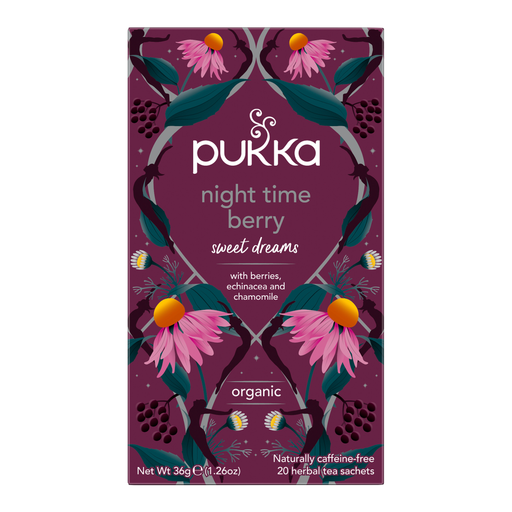
This organic-labelled berry tea comes in 20 sachets, but its Night Time positioning is worth considering for a mid-morning drink. Its listed ingredients include valerian root; check the pack’s ingredients, organic information and caffeine statement against your requirements.
 No image available
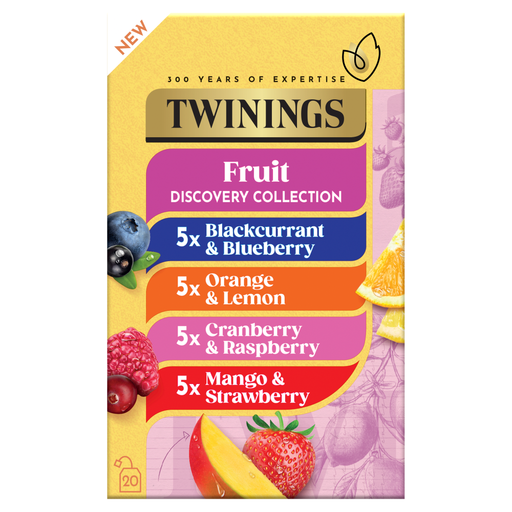
This 20-bag fruit selection offers a choice of blends for a snack break. Ingredients vary between them, with liquorice root listed in some; check the chosen blend’s ingredients and the pack’s organic and sugar information if those details affect your choice.
It is a regulated food claim, not another word for natural. The Department for Environment, Food & Rural Affairs says a product labelled organic must meet organic-production rules, including at least 95% organic agricultural ingredients; approved UK control bodies certify organic products. Check that the claim applies to the product, rather than only to an individual ingredient.
No: check the exact blend if avoiding caffeine matters. Clipper says most of its organic infusions are caffeine-free, while Pukka specifically describes its Elderberry & Echinacea tea as naturally caffeine-free. Those statements do not establish the caffeine status of other products.
Check the product-level organic claim, the full ingredient list, any caffeine statement and the brewing directions. The Department for Environment, Food & Rural Affairs says UK food labelling requires an ingredient list when a food has more than one ingredient; that list helps you spot botanicals beyond the fruit named on the front.
If sugar content is the reason for switching, check the individual infusion’s label. Twinings describes its fruit-and-herbal range as naturally sugar-free, but a range-level statement should not replace checking the particular product you plan to drink.