Shoppers who prioritise organic certification
If certified production is important to you, look for an organic claim on the particular fruit tea rather than relying on its flavour name or the brand’s wider range.


Choose an organic-labelled fruit infusion if certified production matters to you. Under UK guidance from the Department for Environment, Food & Rural Affairs, organic food must meet production rules, contain at least 95% organic agricultural ingredients and have the product and its suppliers certified by an approved organic control body. For an afternoon drink, check the individual blend’s caffeine claim, ingredients and pack size too: an organic label does not answer those questions.
If certified production is important to you, look for an organic claim on the particular fruit tea rather than relying on its flavour name or the brand’s wider range.
A fruit or herbal infusion may fit an afternoon snack, but check its own caffeine wording. Clipper, Twinings and teapigs describe the cited fruit or herbal options as naturally caffeine-free.
A fruit-led blend can also contain botanicals such as liquorice root. The full ingredient list matters if you avoid a particular herb; NHS guidance specifically advises avoiding teas containing liquorice root during pregnancy.
Start with the organic claim, then narrow the choice by caffeine wording, ingredients and a pack size that suits how often you expect to make a cup.
| Priority | What to check | Your needs |
|---|---|---|
| Organic status | Check the organic wording on the individual product and its packaging. UK guidance from the Department for Environment, Food & Rural Affairs ties organic food labelling to production rules, at least 95% organic agricultural ingredients, and certification of the product and suppliers by an approved control body. | I want certified organic production, not just a fruit flavour or natural-sounding name. |
| Caffeine | Look for an explicit caffeine-free statement on the blend. Check the ingredients rather than assuming every fruit-flavoured tea excludes green or black tea. | For an afternoon cup without caffeine, I would choose a product whose own label confirms it. |
| Ingredients | Read the complete botanical list, including any liquorice root. NHS pregnancy guidance advises avoiding teas containing liquorice root. | A berry flavour is not enough information if I need to avoid a particular herb or am choosing tea during pregnancy. |
| Flavour and pack | Compare the stated ingredients and number of bags or sachets. The cited products include 20-bag or 20-sachet packs and a 250-envelope catering pack. | I might try a smaller pack before committing to a berry-and-hibiscus or apple-and-spice blend; a catering pack suits a different pattern of use. |
Those descriptions do not establish an organic claim for the individual tea. A brand may have both organic and other products.
If certification is your reason for choosing a blend, check its own organic wording and packaging. UK organic food-labelling rules are set out by the Department for Environment, Food & Rural Affairs.
Clipper lists liquorice root in Organic Berry Burst. NHS guidance advises avoiding teas containing liquorice root during pregnancy.
Read the entire ingredient list before choosing a fruit infusion, particularly if pregnancy or a preference to avoid specific herbs affects your choice.
A 250-envelope catering pack is a different commitment from a 20-bag pack when you have not tried the flavour.
Check the bag count and ingredients together; a smaller pack may be more practical for trying an unfamiliar blend.
Organic labelling concerns production and certification. It does not establish that a fruit tea treats a health condition.
Base this purchase on the stated ingredients, flavour and organic-production claim, without substituting a herbal blend for medical advice or treatment.
These ranges and retailer listings illustrate why organic status, caffeine wording and ingredients need checking on the specific product.
Pukka presents its fruit-tea range as organic; Tesco lists its Wild Apple & Cinnamon infusion as organic and naturally caffeine-free.
Clipper describes Organic Berry Burst as a naturally caffeine-free infusion made with organically grown ingredients.
Twinings describes its Fruit & Herbal range as naturally caffeine-free and suitable for drinking hot or cold.
teapigs describes Super Fruit as a naturally caffeine-free infusion with a hibiscus base and berry character.
Tesco lists named organic fruit and herbal products alongside other options in its fruit-and-herbal-tea category.
Sainsbury's fruit-and-herbal-tea category includes own-label fruit infusions and branded organic herbal options.
This berry-labelled, 20-sachet blend is an option for an afternoon cup if you are considering a fruit tea with several botanical ingredients.
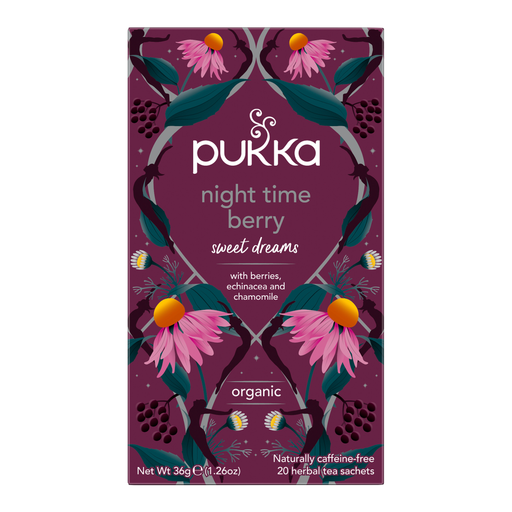 No image available
The 20-sachet, 36g format may suit an occasional afternoon cup if you want to try a berry-labelled botanical blend. Before choosing it for an organic-only or caffeine-free purchase, check the current pack for its certification details and caffeine wording. Read the full ingredient list as well: NHS guidance advises avoiding teas containing liquorice root during pregnancy.
It is a regulated production claim, not a description of flavour. Department for Environment, Food & Rural Affairs guidance says organic food must meet production rules, have at least 95% organic agricultural ingredients, and have the product and suppliers certified by an approved organic control body.
No; check the individual blend rather than its fruit flavour. Twinings describes its Fruit & Herbal range as naturally caffeine-free, and Clipper makes that claim for Organic Berry Burst, but a different product may have different ingredients.
No. Organic certification does not establish pregnancy suitability. NHS guidance advises avoiding more than four cups of herbal tea a day during pregnancy and avoiding teas containing liquorice root; Clipper’s Organic Berry Burst lists liquorice root.
Follow the directions for the particular blend. For Organic Berry Burst, the Clipper Tea Shop advises pouring freshly boiled water over the bag and infusing it for 2–5 minutes.
Search for the specific product at the store you intend to use rather than relying on a category listing. Sainsbury's Help Centre advises selecting a local store and searching for the product as specifically as possible in its stock checker.