Parents preparing after-school snacks
Pack size, chilled storage and whether a serving needs to be spooned out can matter as much as the yoghurt’s ingredients.


For an after-school snack, choose an organic Greek or Greek-style yoghurt by checking the individual pack’s ingredients, milk-allergen statement and serving format—not the organic claim alone. Plain pots and individual portions meet different needs, while a honey-flavoured organic pot can still contain added sugar. None of the dairy options suits a child who must avoid milk.
Pack size, chilled storage and whether a serving needs to be spooned out can matter as much as the yoghurt’s ingredients.
Check the organic claim on the particular product, then read its ingredients if avoiding added sugar is part of the choice. Organic and no added sugar are separate claims.
The Greek and Greek-style dairy yoghurts discussed here contain milk. Check the allergen statement rather than relying on the flavour or format to judge suitability.
Start with the product label and ingredients, then compare nutrition per 100g and the amount your household is likely to serve.
| Priority | What to check | Your needs |
|---|---|---|
| Organic claim | Check that the particular yoghurt is labelled organic; do not infer this from the brand or the words “Greek-style”. UK organic labelling rules require certification of suppliers. | I’m looking specifically for organic dairy, so the claim needs to apply to the pot I buy. |
| Ingredients and sugar | Read the ingredients alongside sugars per 100g. Sainsbury’s lists no added sugar for Yeo Valley’s plain Greek-style natural multipack, but its organic honey version contains honey and sugar and lists 13.4g sugars per 100g. The NHS distinguishes naturally occurring milk sugar from free sugars. | If I want a plain snack without added sugar, an organic label or a total-sugars figure alone does not answer that question. |
| Protein and fat | Compare the same per-100g measure on the exact variant. Tesco Groceries lists 10.0g protein for Yeo Valley Organic 0% Greek Recipe and 9.0g protein with 5.0g fat for its 5% version. Sainsbury’s lists 4.3g protein and 9.4g fat for the Greek-style natural multipack. | A 0% or 5% shared pot may suit my preferred fat level; separate Greek-style pots offer a different format and nutritional profile. |
| Serving and storage | Compare a shared 450g pot with a 4 x 110g multipack. Follow the current pack’s refrigeration, use-by and after-opening instructions. | Individual pots would make serving simpler, or we could use a shared pot if we expect to finish it within its on-pack storage period. |
| Milk allergen | Read the current milk-allergen statement and check any rules set by the child’s school or club. The Food Standards Agency identifies milk as an allergen found in yoghurt. | If the child must avoid milk, these dairy yoghurts are not an option, regardless of their organic status or portion size. |
Organic describes a certified production claim, not the absence of sweetening ingredients. Sainsbury’s lists both honey and sugar in Yeo Valley’s organic honey Greek-style yoghurt.
Check the organic statement and the ingredients separately. If no added sugar matters to you, look for that claim on the particular plain product.
Products with similar names can differ per 100g. Tesco Groceries lists 10.0g protein for Yeo Valley Organic 0% Greek Recipe, while Sainsbury’s lists 4.3g for its Greek-style natural multipack.
Compare the exact packs’ protein, fat, ingredients and serving sizes rather than choosing on the category name alone.
The dairy yoghurts discussed here contain milk, which the Food Standards Agency identifies as an allergen.
Do not choose one for a child who must avoid milk. Check the current pack and any school or club food-allergy rules before sending a snack.
A 450g pot needs portioning after opening, whereas a 4 x 110g multipack provides separate pots.
Choose a format that fits how often the yoghurt will be served, and follow the pack’s after-opening instructions.
An unfinished shared pot may be wasted if it cannot be used within the stated storage period.
These examples help distinguish particular product lines; a brand name alone does not establish a pot’s ingredients or organic status.
Retailer listings include 0% and 5% Greek-recipe shared pots, a natural Greek-style 4 x 110g multipack and a honey-flavoured multipack.
Tesco Groceries lists a Glenisk Organic Greek Style Natural 500g yoghurt made with organic whole milk, organic cream and cultures.
Tesco Groceries lists Fage Total Greek-recipe products in different fat levels and pack sizes.
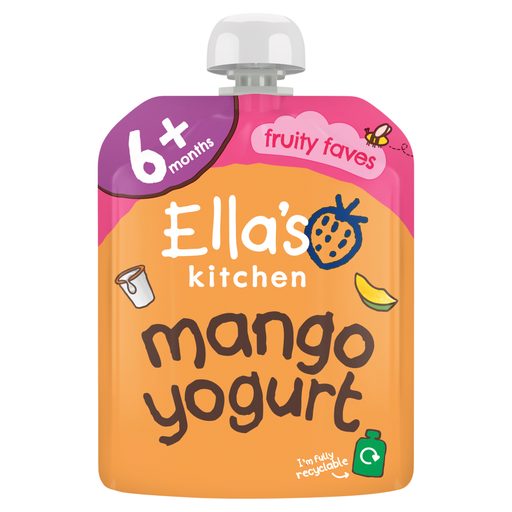
This fruit-and-yoghurt pouch is a different snack format from the plain Greek and Greek-style pots discussed above. Check its age label and serving directions when considering it for an older child.
 No image available
This 90g mango yoghurt pouch offers a different serving format from a plain pot and is labelled for babies aged 6+ months, not specifically for after-school snacks. It contains milk. Follow the stated directions to squeeze it into a bowl or onto a spoon, and check the current pack’s organic statement if certification details matter to your choice.
No. An organic claim does not tell you whether sugar or honey has been added. Sainsbury’s lists both ingredients in Yeo Valley’s organic honey Greek-style yoghurt, so check the ingredients on the particular pot.
No. The total-sugars figure also includes naturally occurring milk sugar. The NHS distinguishes sugar naturally present in milk from free sugars; read the ingredients as well as nutrition per 100g to compare plain and sweetened yoghurts.
No. The Greek and Greek-style dairy products discussed here contain milk. Check the current allergen statement on any snack and confirm the relevant school or club rules before packing it.
Keep it refrigerated and follow the current pack’s use-by and after-opening instructions. If a shared pot is unlikely to be finished within that period, separate smaller pots may be a more practical format.