Hosts prioritising organic tea
If you want plain green tea alongside scones, cream and jam, look for an explicit organic claim on the exact product. Clipper lists organically grown green tea as the ingredient in its Organic Fairtrade Pure Green tea.


A plain green tea explicitly labelled organic is a sensible starting point if you want the tea to take a quieter role alongside scones, clotted cream and jam; Clipper Organic Fairtrade Pure Green is one 80-bag example. Choose a green-tea-and-matcha blend such as Pukka Supreme Matcha Green if you want the tea itself to be more noticeable, and check the organic claim on the exact pack you buy.
If you want plain green tea alongside scones, cream and jam, look for an explicit organic claim on the exact product. Clipper lists organically grown green tea as the ingredient in its Organic Fairtrade Pure Green tea.
A green-tea-and-matcha blend offers a different style from plain green tea. Pukka describes Supreme Matcha Green as a blend of green teas and matcha; choose it when that distinction appeals to your guests.
Teapigs Mao Feng is listed as pure Mao Feng green tea, with an 80°C brewing instruction. If organic status is essential, check the exact pack for an organic claim rather than treating a speciality tea name as proof.
Start with the organic claim and tea style, then choose a pack and brewing method that work for the number of people you are serving.
| Priority | What to check | Your needs |
|---|---|---|
| Organic status | Look for an organic claim on the exact pack and check its label. UK government guidance requires applicable production rules and approved control-body certification for food labelled organic. | I want the tea I serve to meet an organic-shopping priority, not merely to have a name such as “pure” or “natural”. |
| Tea style | Compare the ingredient lists: Clipper Organic Fairtrade Pure Green lists green tea, while Pukka Supreme Matcha Green blends green teas with matcha. Check for any added flavours on other variants. | For a quieter accompaniment to scones and clotted cream, I would choose plain green tea. If I want guests to notice the tea more, a matcha blend is worth considering. |
| Pack format | Check the portion count against the gathering: Clipper lists 80 bags, Tesco lists Pukka Supreme Matcha Green in a 20-bag pack, and Teapigs lists Mao Feng in a 15-tea-temple pack. | A single afternoon with a few guests calls for a different quantity from tea I plan to serve repeatedly. |
| Brewing | Follow the chosen product’s directions. Clipper says to let boiled water cool for a minute and infuse for 1–3 minutes; Teapigs specifies 80°C water and three minutes for Mao Feng. | I want a method I can follow while preparing the rest of the cream tea, without assuming every green tea uses the same temperature or infusion time. |
| Caffeine | Check whether guests want a caffeine-free option as well. The NHS identifies tea as a caffeine source and advises a limit of 200mg of caffeine a day during pregnancy. | If guests are limiting caffeine, I would offer another drink rather than assume an organic green tea is caffeine-free. |
A plain green tea can meet your preferred tea style without meeting your organic-shopping requirement. A brand name or description of the tea does not establish the status of every product in its range.
Check for an explicit organic claim on the exact pack. UK government guidance sets production and certification conditions for food labelled organic.
The stated methods differ: Clipper gives a 1–3 minute infusion after boiled water has cooled for a minute, while Teapigs directs 80°C water and three minutes for Mao Feng.
Read the directions for the tea you actually serve rather than applying another product’s temperature or timing.
Green tea contains caffeine. The NHS advises that people who are pregnant should have no more than 200mg of caffeine a day from all sources, including tea.
Offer water or a caffeine-free drink too, so guests have another option.
These are references for particular teas and listings; an organic claim for one product should not be applied to an entire range.
Clipper Organic Fairtrade Pure Green is a plain green tea offered in an 80-bag pack.
Pukka Supreme Matcha Green is a green-tea-and-matcha blend listed by Tesco as organic.
Twinings Pure Green is a bagged green tea described by Twinings as steamed and pan-fired.
Teapigs Mao Feng is a pure green tea with an 80°C brewing instruction.
Tesco listings provide pack details for organic green teas including Clipper and Pukka products.
This plain green tea is an individual-bag option for a cream tea afternoon. If organic status guides your choice, check the claim and certification details on the exact pack.
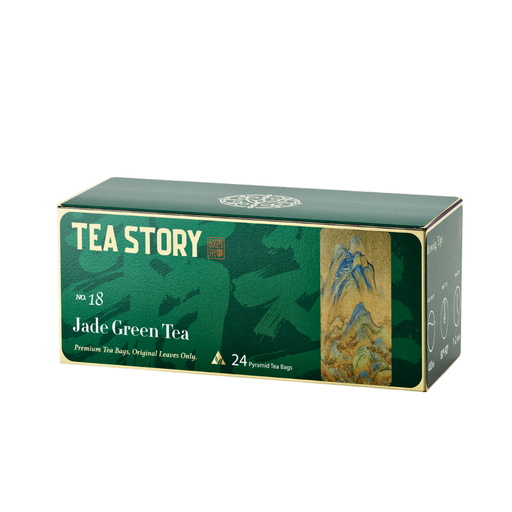 No image available
For serving plain green tea in individual portions, this pack contains 24 pyramid bags of 2g each, and its product information lists green tea as the ingredient. The listing claims ECOCERT organic status; check the exact pack’s label and certification details before relying on that claim. Its stated preparation uses boiling water and a 3–5 minute infusion, rather than the directions given for the other teas discussed here.
Look for an explicit organic claim on the exact pack and read its label, rather than relying on words such as “natural” or “pure”. UK government guidance says food labelled organic must meet the applicable production and approved control-body certification rules; it also sets a minimum of 95% organic agricultural ingredients for food sold as organic.
Choose plain green tea if you want the tea to take a quieter role alongside scones, cream and jam. Consider a blend if you want the tea itself to be more noticeable: Pukka describes Supreme Matcha Green as a blend of green teas and matcha.
Clipper’s instructions say to boil fresh water, leave it to cool for a minute, then infuse the tea bag for 1–3 minutes. Follow the directions on the pack you serve, as another green tea may specify a different method.
Yes. The NHS identifies tea as a caffeine source and advises that people who are pregnant should have no more than 200mg of caffeine a day in total, accounting for other sources as well as tea.
Check the delivered pack as well. Tesco advises shoppers that food information can change and that the product label, rather than the website listing alone, should be used for current details—particularly when an ingredient or dietary requirement matters.