First-time organic herbal tea buyers
If you are trying an unfamiliar flavour, a 20-bag box gives you a smaller quantity to assess before considering a larger pack.


For a first purchase, a 20-bag organic infusion in a flavour you already like lets you try a defined pack without committing to a large quantity. Check the organic claim on the exact product, then read its ingredients and allergen information: an organic label does not tell you whether a blend contains caffeine or herbs you want to avoid.
If you are trying an unfamiliar flavour, a 20-bag box gives you a smaller quantity to assess before considering a larger pack.
If you want a short ingredient list, look for an infusion such as Clipper Organic Peppermint or Organic Chamomile. Clipper lists one herb in each of those products and describes both as naturally caffeine-free.
If particular herbs or allergens matter to you, read the full information for the exact blend. Organic status does not replace that check.
Start with the exact product’s organic claim, then narrow the choice by pack size, flavour and ingredients.
| Priority | What to check | Your needs |
|---|---|---|
| Organic status | Check that the exact pack or listing says organic. Look at its certification information where shown; words such as herbal or natural are not substitutes. Soil Association Certification explains that certification demonstrates compliance with organic standards. | I want to know that the particular tea I buy carries an organic claim, rather than relying on the name of its wider range. |
| Pack and flavour | Confirm the bag count and read the flavour description and ingredient list. A 20-bag box may be a more manageable first quantity than a large multipack. | For a flavour I have not tried, I would rather start with one small box that I expect to use. |
| Caffeine | Look for an explicit caffeine-free statement on the exact infusion. Clipper describes its Organic Peppermint and Organic Chamomile infusions as naturally caffeine-free; organic status alone does not establish caffeine content. | If I am avoiding caffeine, I need to check the product itself rather than assume every herbal blend is caffeine-free. |
| Ingredients and allergens | Read the full ingredients and allergen information, especially for blends. Check for herbs such as liquorice root; Clipper lists it in Organic Lemon & Ginger. | A blend needs to suit my ingredient preferences and any allergies. If pregnancy is relevant, NHS guidance also advises avoiding teas containing liquorice root. |
Those words do not identify the exact tea as organic. Soil Association Certification distinguishes organic certification from general product descriptions.
Check the organic wording on the pack or listing and any certification information shown, then assess the ingredients separately.
Blends can contain several herbs. Clipper Organic Lemon & Ginger, for example, lists liquorice root; the NHS advises avoiding teas containing liquorice root during pregnancy.
Read the complete ingredient and allergen information for the exact product before choosing a blend.
A larger quantity may go unused if an unfamiliar herb or blend does not suit your taste.
Try a smaller box first, then consider a larger pack if it becomes a repeat choice.
Clipper lists several organic herbal infusions in 20-bag boxes, including single-herb peppermint and chamomile.
Twinings lists Organic Pure Camomile and Organic Pure Peppermint 20-bag products within its wider fruit-and-herbal range.
Pukka says its products are certified organic and offers a range of herbal blends.
These 20-sachet and 20-bag options include Pukka herbal blends and an English Tea Shop blend. Compare their ingredients and the organic information on the exact pack when choosing a small quantity to try.
 No image available
A 20-sachet option if you want to try a mint blend. The product description lists peppermint, spearmint and fieldmint and describes the infusion as caffeine-free; check the current pack for full ingredient information.
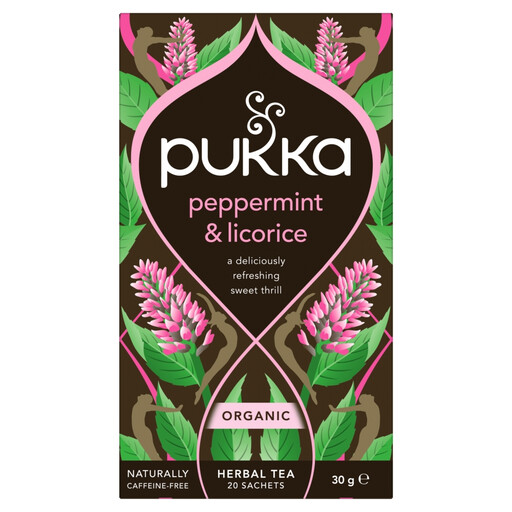 No image available
This 20-sachet mint blend contains liquorice root and is described as caffeine-free. Check the full ingredients before choosing it; the NHS advises avoiding teas containing liquorice root during pregnancy.
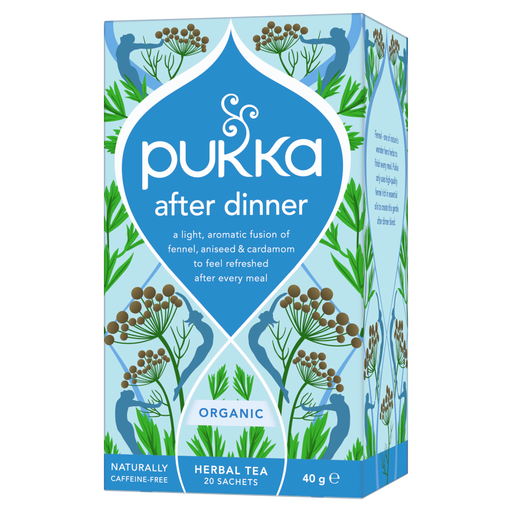 No image available
A 20-sachet herbal blend described as caffeine-free. Its product description flags possible celery traces from shared processing, so check the current pack’s allergen information if celery is relevant to you.
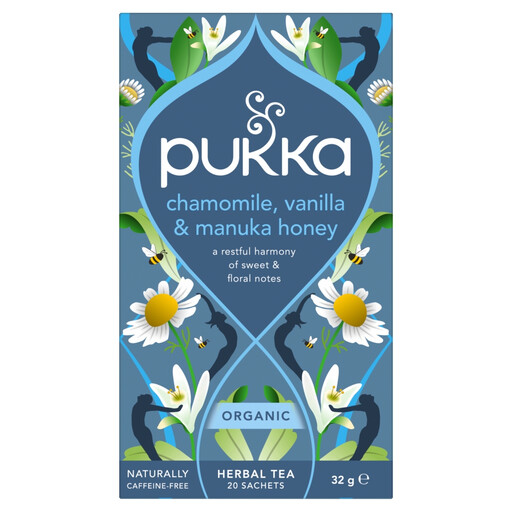 No image available
A 20-sachet chamomile blend described as caffeine-free. The product information lists fennel, liquorice, flavouring and vanilla among its ingredients; check the exact pack for its organic wording and full ingredient list. The NHS advises avoiding teas containing liquorice root during pregnancy.
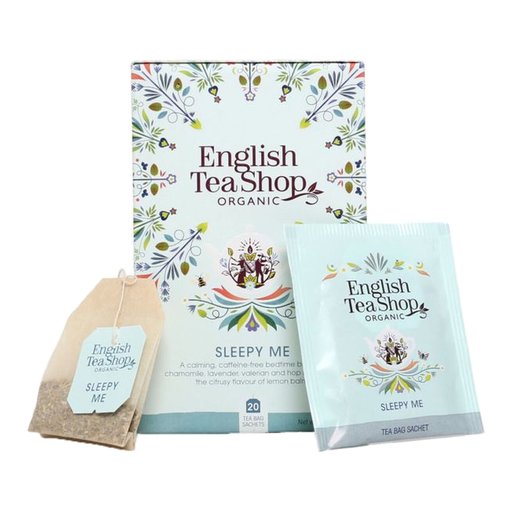 No image available
This 20-bag product is described as a caffeine-free, multi-herb blend containing valerian and hops. Read the current pack’s organic and ingredient information rather than judging suitability from its name.
Check that the exact pack or listing says organic and look for its certification information where shown. Soil Association Certification explains that certification demonstrates compliance with organic standards; “natural” and “herbal” are not equivalent claims.
No. Organic status does not establish caffeine content, so check the exact product description. Clipper explicitly describes its Organic Peppermint and Organic Chamomile infusions as naturally caffeine-free.
Read the complete ingredient and allergen information for the exact pack, especially when choosing a blend. An organic claim does not establish that a product is suitable for a particular allergy or ingredient restriction.
Yes. The NHS advises avoiding teas containing liquorice root during pregnancy. Check blend ingredients before purchase: Clipper Organic Lemon & Ginger, for example, lists liquorice root.
A 20-bag box is a smaller quantity to try before committing to a large pack. Check the herbs and flavour description first, then consider a larger quantity if you regularly use that infusion.