Shoppers choosing their own milk
An organic hot-chocolate mix prepared with separately chosen milk lets you use organic dairy milk or another preferred drink. Check the mix’s ingredients and allergen wording as well as the milk you add.


Choose an organic hot-chocolate mix if you want to select the milk yourself, or organic milk-chocolate flakes if a milk-containing drink suits you. If you avoid dairy, start with a product specifically labelled dairy free and check the exact pack: organic status alone says nothing about milk ingredients, allergen suitability or the nutrition of a prepared mug.
An organic hot-chocolate mix prepared with separately chosen milk lets you use organic dairy milk or another preferred drink. Check the mix’s ingredients and allergen wording as well as the milk you add.
If milk suits you, organic milk-chocolate flakes offer a different chocolate format for an after-dinner drink. Milk is an ingredient in the flakes, so check the pack and its serving information rather than treating the added hot milk as the only dairy.
Look for a hot chocolate whose exact pack identifies it as both organic and dairy free. An organic claim does not establish whether a product contains milk or carries a precautionary allergen statement.
Decide how milk should enter the drink, then compare the exact products’ organic claims, allergen information and prepared servings.
Choose when: You want to select the dairy milk or alternative used to prepare the drink.
Bear in mind: The milk you add affects the finished drink; an organic mix does not make separately added milk organic.
Choose when: Milk is suitable and you prefer flakes stirred into hot milk.
Bear in mind: Milk is already an ingredient in the flakes, so this is not a dairy-free route.
Choose when: Avoiding dairy is essential and the exact product’s labelling supports both requirements.
Bear in mind: Check the current ingredients and allergen wording; an organic claim alone does not establish dairy-free suitability.
| Priority | What to check | Your needs |
|---|---|---|
| Organic status | Check the exact product’s organic labelling and certification information. In the UK, Defra’s organic labelling guidance requires an organic food product to have at least 95% organic agricultural ingredients and certification by an approved organic control body. | I want the organic claim to apply to the hot chocolate I buy, not just to other products from the same brand. |
| Milk choice | Read the ingredients and preparation directions to see whether milk is in the product or added separately. If organic dairy matters to you, check the milk you plan to add too. | I’d like to choose my own organic dairy milk, or I need to know whether milk is already in the chocolate. |
| Allergens | Read the exact pack’s declared allergens and any precautionary wording. Ocado lists Green & Black’s organic mix as “may contain milk”, while Cocoa Loco declares milk in its organic flakes. | For milk avoidance or another allergy, I need product-specific information rather than an assumption based on an organic label. |
| Prepared serving | Note the amount of powder or flakes, the liquid and its volume. Check whether nutrition is given as sold or as prepared before comparing sugars or saturated fat. | For an after-dinner mug, I want to compare the drink I would actually prepare, not unlike portions of powder and finished drink. |
Green & Black’s organic hot chocolate is prepared with milk added separately. The powder’s organic status does not establish the status of that milk.
If organic dairy is part of your choice, check the preparation directions and select the milk separately.
Organic hot chocolates can have different milk declarations: Ocado lists “may contain milk” for Green & Black’s mix, while Cocoa Loco’s milk-chocolate flakes contain milk.
For allergy management, read the current pack’s ingredients, declared allergens and precautionary statements before choosing.
A drink prepared with milk and one prepared with water include different liquids. Their nutrition figures are not a direct comparison unless the stated serving bases are accounted for.
Check the powder quantity, liquid and volume, then compare figures stated on an appropriate prepared-serving basis.
Clipper describes its hot-chocolate range as organic on its brand page, but a brand description should not stand in for the labelling of a particular flavour or pack.
Check the organic claim and ingredients on the exact product you intend to buy.
These examples show how ingredients and preparation differ between products; a brand name alone does not establish the labelling of every item it makes.
Its Organic Hot Chocolate is a mix for shoppers who want to choose the milk added at preparation.
Its organic milk-chocolate drinking flakes are intended to be stirred into hot milk.
The manufacturer describes its Original Organic Drinking Chocolate as dairy free.
Clipper is useful for distinguishing hot-chocolate products prepared with water from those prepared with milk.
The Joybuy option here is cocoa powder for preparing your own hot chocolate, rather than a ready-to-mix drinking chocolate or milk-chocolate flakes.
 No image available
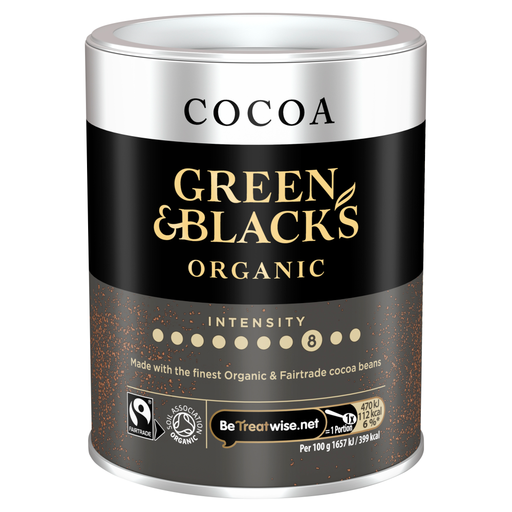
This cocoa powder is described for making hot chocolate when you want to prepare the drink yourself. Its ingredient information lists 98% organic cocoa, and its nutrition panel gives 0.8 g sugars per 100 g of powder—not per prepared mug. Check the exact pack’s organic certification, preparation directions and “may contain milk” wording before choosing it.
An organic food product must meet UK organic-production and certification rules. Defra’s guidance says at least 95% of its agricultural ingredients must be organic and the product and its suppliers must be certified by an approved organic control body. Check the exact pack’s claim and certification information.
No: milk added during preparation is a separate choice. Ocado’s directions for Green & Black’s Organic Hot Chocolate specify 250 ml hot semi-skimmed milk; if you want organic dairy in the mug, choose that milk separately.
No. Ocado lists “may contain milk” for Green & Black’s Organic Hot Chocolate, and Cocoa Loco declares milk in its organic milk-chocolate flakes. Read the current ingredients and allergen wording on the exact pack; organic certification is not an allergen claim.
For the drink you plan to make, start with the prepared-serving figures and check what the recipe includes. Ocado lists 19.2 g sugars for a Clipper Instant Hot Chocolate serving prepared with 200 ml hot water; a milk-made drink uses a different recipe, so its per-mug figure is not automatically like for like.
Check the exact product’s preparation directions for the liquid and quantity to use. Nib and Noble describes its Original Organic Drinking Chocolate as dairy free, but that description does not replace checking its current ingredients and allergen wording if you are avoiding milk.