Organisers with an organic procurement requirement
Check the organic claim against the exact loose-leaf tea in the order, rather than assuming that every product in a brand’s range qualifies.


If the conference brief requires organic tea, choose a loose-leaf product with an organic claim for that exact tea and confirm its label or supplier documentation before ordering. Also plan the quantity, brewing equipment and allergen information needed for service; a larger conventional pack or a separate decaffeinated tea may serve other needs, but neither automatically meets an organic-only brief.
Check the organic claim against the exact loose-leaf tea in the order, rather than assuming that every product in a brand’s range qualifies.
Match pack size and brewing instructions to the planned number of servings, with time and equipment for measuring, steeping and straining.
Consider a separately identified decaffeinated loose-leaf tea. Check its organic status independently if the requirement applies to every tea served.
Confirm any mandatory organic requirement for each product first, then work out how the tea will be brewed, served and described to delegates.
| Priority | What to check | Your needs |
|---|---|---|
| Organic status | Check the exact product label, ingredients and supplier documentation. GOV.UK says organic food claims depend on production rules, at least 95% organic agricultural ingredients and certification by an approved organic control body. | I need the tea ordered for this conference to meet an organic procurement requirement, not merely to come from a brand with an organic range. |
| Quantity and brewing | Compare pack weight with expected servings and replenishment plans. Follow the chosen tea’s stated dose and steep time, and arrange pots or urns and a way to strain the leaves. | Staff need to prepare successive batches during breaks without running short or changing the brewing method from pot to pot. |
| Caffeine choice | Check for an explicitly decaffeinated product and its pack size. Treat decaffeinated and organic as separate claims requiring checks for the same tea. | For an all-day event, I may want a clearly identified alternative to the main black tea. |
| Allergen information | Keep current ingredient and allergen information for each tea and addition, including milk. The Food Standards Agency says catering businesses must provide allergen information for prepacked and non-prepacked food and drink. | Delegates need to be able to ask about the drink as served, including any milk or other additions. |
A brand can have both organic and loose-leaf ranges without the particular tea selected meeting both descriptions. GOV.UK’s organic-labelling conditions apply to the product being sold.
Confirm the exact tea’s name, ingredients and organic documentation with the supplier before placing an organic-only order.
Loose leaves must be measured, steeped and strained. Fortnum & Mason and Bettys give product-specific brewing periods, so one generic timing rule should not replace the instructions for the tea served.
Test the intended batch size and assign staff to brewing and replenishment during breaks.
Allow for pots or urns, measuring tools, timers and strainers, as well as staff time to use them.
The Food Standards Agency says catering businesses must provide allergen information for food and drink, including non-prepacked items. Tea ingredients and additions such as milk need to be considered together.
Keep current product information accessible to staff and identify additions clearly where drinks are served.
Decaffeination describes a different characteristic from organic status; one claim does not establish the other.
If both are required, confirm both for the exact decaffeinated tea before ordering.
These brand references describe particular products or ranges, not an organic claim for every tea sold under each name.
Fortnum & Mason lists Highgrove Organic Prince of Wales Blend as a loose-leaf tea and states that its ingredients are Organic Black Tea (100%).
Bettys lists Yorkshire Gold leaf tea in a 250g pack with Black Leaf Tea as its stated ingredient.
Bettys lists several loose teas in larger formats, including 1kg products and Taylors Decaffeinated Leaf Tea in a 1kg bag.
Whittard’s loose-tea range includes different styles and a decaffeinated English Breakfast option.
Twinings has an organic tea collection and a separate loose-leaf range.
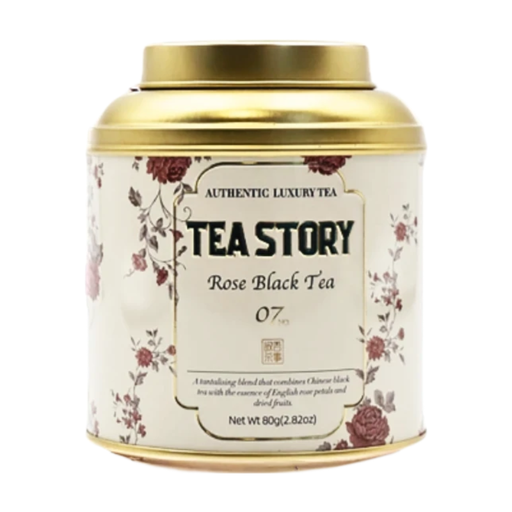
This loose-leaf option has an organic claim in its product name. For a conference with an organic purchasing requirement, confirm the claim for the exact tea and calculate how many 80g packs the planned service would require.
 No image available
The 80g rose black tea is an option to consider for a staffed loose-leaf service. Its name makes an ECOCERT organic claim; confirm current product and supplier documentation before relying on that claim for procurement, and check the pack quantity against expected servings.
For food sold under an organic claim, GOV.UK specifies organic-production rules, at least 95% organic agricultural ingredients and certification of the product and suppliers by an approved organic control body. For a conference order, check the label or supplier documentation for the exact tea.
No. Check both descriptions against the same product: Twinings has organic and loose-leaf ranges, but those range names alone do not establish the status of an individual tea. Fortnum & Mason, for example, identifies Highgrove Organic Prince of Wales Blend as loose leaf and lists Organic Black Tea (100%) as its ingredient.
Yes. The Food Standards Agency says catering businesses must provide allergen information for prepacked and non-prepacked food and drink. Keep information for each tea available to staff and identify additions such as milk separately.
Fortnum & Mason instructs customers to use freshly drawn water heated to 100°C, one and a half teaspoons per person and a five-minute brew. For conference service, plan how staff will measure and strain successive batches.
A separate decaffeinated tea is worth considering when delegates may want to limit caffeine. Bettys lists Taylors Decaffeinated Leaf Tea in a 1kg bag; if every tea must be organic, check that requirement independently for the decaffeinated product.