Shoppers seeking an organic, low-fat maize snack
If both conditions matter, check the organic information and the total fat per 100g on the same product. The NHS uses 3g of fat or less per 100g as its low-fat criterion for foods.


For an organic maize snack that meets a low-fat criterion, consider corn cakes with a confirmed nutrition value: Roots Fruits & Flowers Glasgow lists Kallø Organic Corn Cakes at 1.6g fat per 100g, within the NHS threshold of 3g or less per 100g for foods. Check baby puffs and sticks separately rather than relying on the organic label: Organix lists 14g fat per 100g for Sweetcorn Melty Rings, and Tesco lists the same value for Ella’s Kitchen Tomato + Basil Melty Sticks. Their age and supervision instructions also matter when choosing for a child.
If both conditions matter, check the organic information and the total fat per 100g on the same product. The NHS uses 3g of fat or less per 100g as its low-fat criterion for foods.
For a baby snack, the stated minimum age and eating instructions matter alongside ingredients and nutrition. An organic puff or stick does not necessarily meet the NHS low-fat criterion when compared per 100g.
If you are considering maize rings instead of corn cakes, compare their labels rather than assuming the formats have similar fat values. Tesco lists 23.9g fat per 100g for its Free From Onion Maize Snack Rings.
Start with fat per 100g if low fat is the deciding requirement, then check organic information, ingredients and any age-specific directions.
| Priority | What to check | Your needs |
|---|---|---|
| Total fat | Read total fat per 100g, not just per serving. The NHS low-fat criterion for foods is 3g or less per 100g; check the current pack for the exact product. | I want an organic maize snack that also meets a measurable low-fat criterion. A small portion value alone will not tell me that. |
| Organic status | Check the pack’s organic labelling and certification information for the product you are buying. Assess its nutrition separately. | Organic production matters to me, but I do not want to mistake an organic claim for a fat-content claim. |
| Age and eating directions | For baby finger foods, follow the stated minimum age and instructions for seated, supervised eating. Organix labels Sweetcorn Melty Rings for 6 months and over; Tesco lists Ella’s Kitchen Tomato + Basil Melty Sticks for 7 months and over. | When choosing for a child, I need a product intended for their age and clear directions for eating it. |
| Salt and ingredients | Read salt per 100g and the ingredients list separately from total fat. Check for oils and flavourings if those affect your choice. | I may prefer a particular flavour or ingredient list, as well as checking whether the snack meets my fat-content requirement. |
Organic status and fat content answer different questions. Organix lists 14g fat per 100g for its organic Sweetcorn Melty Rings, above the NHS low-fat criterion of 3g or less per 100g for foods.
Check organic labelling for that preference, then compare total fat per 100g for the low-fat requirement.
A small portion can contain little fat while the product has a higher value per 100g. That makes serving values alone a poor basis for comparing packs of different sizes.
Compare total fat per 100g first, then use the serving information to consider the amount you plan to eat.
A description such as baked does not establish a snack’s fat or salt content. Tesco lists 23.9g fat and 1.32g salt per 100g for its Free From Onion Maize Snack Rings.
Read the fat and salt values per 100g and check the ingredients rather than relying on a cooking-method description.
Baby finger foods have product-specific age guidance. Organix states that children eating Sweetcorn Melty Rings should sit down and be supervised.
Follow the age and eating directions on the exact pack, including adult supervision.
These examples show why the exact product matters more than the brand name when comparing organic status and fat content.
Its corn-cake range includes both organic and non-organic products, so check the label of the variant you choose.
Organix makes maize-based finger foods for babies, including Sweetcorn Melty Rings labelled for 6 months and over.
Its Tomato + Basil Melty Sticks are an organic maize-based finger food listed by Tesco for babies from 7 months.
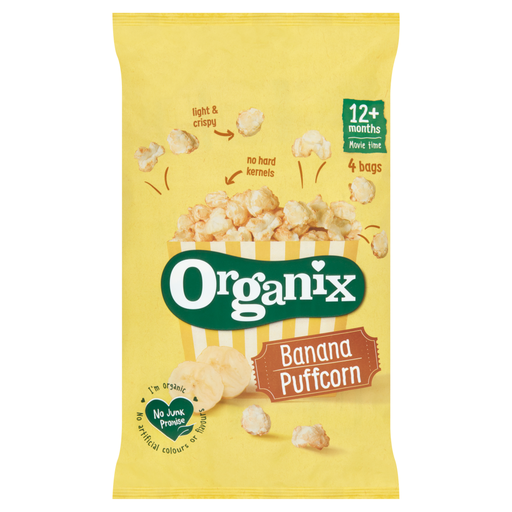
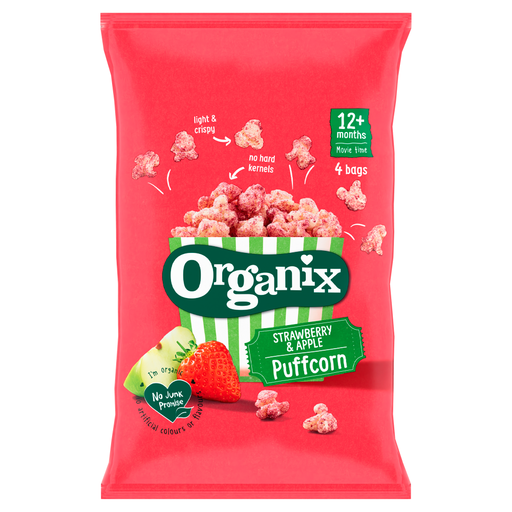
The options below are Organix puffcorn snacks labelled for children aged 12 months and over. Check each pack’s organic information and fat per 100g separately from its age guidance.
 No image available
For a toddler puffcorn choice, check the pack’s organic information and fat per 100g if those are your buying requirements. This banana variant is labelled for ages 12 months and over and comes as 4×10g; supervise the child while eating.
 No image available
This strawberry and apple puffcorn is labelled for children aged 12 months and over in a 4×10g pack. Follow the directions for seated, supervised eating, and check the pack’s organic information and fat per 100g before treating it as a low-fat choice.
No. Check total fat per 100g separately: the NHS low-fat criterion for foods is 3g or less per 100g. Organix lists 14g per 100g for its organic Sweetcorn Melty Rings, so an organic description alone cannot answer the low-fat question.
An exact product can be: Roots Fruits & Flowers Glasgow lists Kallø Organic Corn Cakes at 1.6g fat per 100g, within the NHS low-fat criterion for foods. Check the current pack, and consider any toppings separately when assessing the whole snack.
Check the organic labelling and certification information for the exact product, then read its ingredients and nutrition values. Organic status does not tell you its total fat per 100g.
Check the exact product rather than assuming so from its format or small serving size. Organix lists 14g fat per 100g for Sweetcorn Melty Rings, labelled for 6 months and over; Tesco lists 14g per 100g for Ella’s Kitchen Tomato + Basil Melty Sticks, labelled for 7 months and over. Follow each pack’s age and supervision directions.
Per 100g gives you a consistent basis for comparing packs and applying the NHS low-fat criterion of 3g or less per 100g for foods. A manufacturer’s serving size may differ from the amount you eat, so use both figures for their different purposes.