Batch cooks choosing organic ingredients
If you make soups, sauces, baked dishes or breakfasts in several portions, check both the carton’s organic label and whether its ingredients suit the recipes you plan to make.


Choose an organic oat drink if certified-organic ingredients matter to you, then match the formulation to the recipe: a standard drink for cooking and make-ahead breakfasts, or a barista drink if you also want to foam it for coffee. If oat drink regularly replaces dairy in your household, check its calcium, iodine and vitamin information rather than assuming an organic carton is fortified.
If you make soups, sauces, baked dishes or breakfasts in several portions, check both the carton’s organic label and whether its ingredients suit the recipes you plan to make.
If oat drink is an everyday dairy alternative, compare its calcium, iodine, vitamin and protein information. An organic label does not tell you which nutrients have been added.
If your routine includes overnight oats and coffee, decide whether you need a recipe drink, a barista formulation for foaming, or separate cartons for those uses.
Start with the recipes and quantities you plan to make, then compare the organic label, nutrition panel and storage instructions on the exact carton.
| Priority | What to check | Your needs |
|---|---|---|
| Organic status | Check the carton’s organic claim and certification details. For UK labelling, Defra says organic products must meet production rules, have at least 95% organic agricultural ingredients and be certified by an approved control body. | I want certified-organic ingredients, not just wording that suggests a natural product. |
| Recipe fit | Read the ingredient list and stated uses. Oatly presents its standard Organic Oat Drink for cooking and baking; Alpro presents Organic Oat for overnight oats and recipes. Minor Figures positions its Organic Barista Oat around coffee foam. | Most of my carton will go into sauces or make-ahead breakfasts, so coffee-specific features may matter less to me. |
| Nutrition | Compare calcium, iodine, vitamins and protein per 100 ml if the drink regularly replaces dairy. Marks & Spencer lists added calcium, iodine and vitamins D and B12 in its non-organic Plant Kitchen Whole Oat Drink; Oatly says its cited organic drink is not fortified. | When oat drink is our regular dairy alternative, I need to know what the particular carton contributes rather than relying on its organic label. |
| Sugars and allergens | Check the “of which sugars” line and the product-specific allergen statement. Tesco lists 4.6 g sugars per 100 ml for Rude Health Organic Oat Drink despite its no-added-sugar description; Minor Figures says its Organic Barista Oat may contain gluten. | I may need a gluten-free-labelled carton, or want to compare sugar figures for breakfast recipes. Neither requirement follows from organic certification alone. |
| Storage | Check unopened storage, refrigeration after opening, the stated opening life and any freezing instruction. Oatly says unopened packs of its standard Organic Oat Drink can stay at room temperature; the cited chilled Oatly carton says to use it within approximately five days of opening. | I want the carton size to match what I will use during a batch-cooking session and over the following days. |
Oatly says its cited organic oat drink is not fortified, while Marks & Spencer lists added calcium, iodine and vitamins in its non-organic Plant Kitchen Whole Oat Drink. That distinction matters if oat drink regularly replaces dairy.
Compare the exact cartons’ nutrition panels rather than treating organic and fortified as interchangeable. For a child’s dairy alternative or a medically restricted diet, seek individual clinical advice.
Tesco lists Rude Health Organic Oat Drink as having no added sugar, but its nutrition panel gives 4.6 g sugars per 100 ml.
Use the “of which sugars” figure when comparing cartons for overnight oats, smoothies or other recipes.
Minor Figures positions its Organic Barista Oat for coffee foam and lists rapeseed oil and potassium carbonate. Those features do not establish an advantage for soups, sauces or overnight oats.
If coffee foam is not part of your routine, compare standard oat drinks by their ingredients, stated recipe uses and nutrition information.
The cited chilled Oatly Organic carton calls for refrigeration and use within approximately five days of opening. Marks & Spencer gives a five-day period for its Whole Oat Drink and says that product is not suitable for freezing.
Check each carton’s instructions before choosing a pack size or planning to freeze unused drink.
A carton left open beyond its stated use period may leave drink unused.
Its standard Organic Oat Drink is presented for cooking and baking, while the chilled organic listing has its own after-opening instructions.
Alpro presents Organic Oat as a four-ingredient drink for overnight oats, smoothies and recipes.
Organic Barista Oat is positioned primarily for coffee and foamed hot drinks.
Tesco lists its Organic Oat Drink as gluten-free and without added sugar, gums or thickeners.
Whole Oat Drink is a non-organic comparator for shoppers considering added nutrients instead of an organic-only choice.
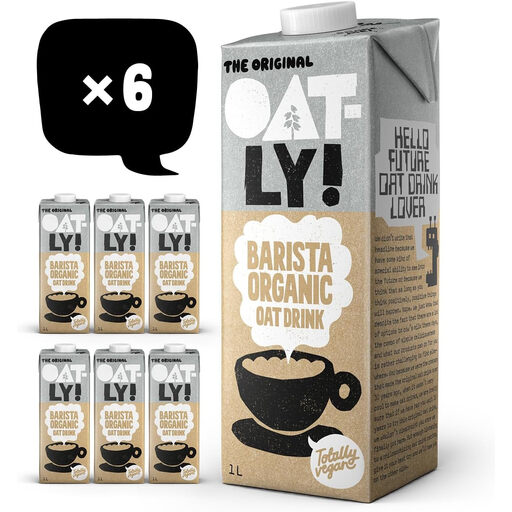
This barista-style oat drink is an option if your batch cooking also includes coffee. Check the pack’s organic certification, nutrition panel and storage instructions against your household’s needs.
 No image available
The listing presents this barista-style drink for coffee as well as cooking and baking. Its formulation includes rapeseed oil and potassium carbonate; after opening, refrigerate and use within five days. If certified-organic status or added nutrients affect your choice, check the exact pack’s certification and nutrition label.
Check the organic claim and certification details on the carton. Defra’s UK organic-labelling guidance says a product bearing that claim must meet organic production rules, have at least 95% organic agricultural ingredients and be certified by an approved organic control body.
Choose according to what you need from the particular drink: Oatly says its cited organic product is not fortified, whereas Marks & Spencer lists calcium, iodine and vitamins D and B12 in its non-organic Whole Oat Drink. For children using dairy alternatives, Royal Devon University Healthcare NHS Foundation Trust advises choosing products with added calcium, iodine and specified B vitamins, and notes that organic versions are not usually fortified.
Check the exact product before freezing it. Marks & Spencer explicitly says its Plant Kitchen Whole Oat Drink is not suitable for freezing; that instruction does not establish the rule for every other carton or finished recipe.
Follow the instruction on the carton you buy. The cited chilled Oatly Organic product says to refrigerate after opening and use within approximately five days; Marks & Spencer specifies refrigeration and use within five days for its Whole Oat Drink.
No. Check the individual product’s label: Tesco lists Rude Health Organic Oat Drink as gluten-free, while Minor Figures says its Organic Barista Oat may contain gluten. Organic certification does not establish gluten-free suitability.