Organic-first winter cooks
If you mainly add oat drink to porridge, baking or sauces, the organic claim may matter more to you than a barista formulation. Check the exact carton’s organic designation before buying.


For porridge, baking or hot drinks, choose an oat drink labelled organic if organic production is your priority; check the carton’s organic-control information rather than relying on words such as “natural”. An organic barista version is worth considering when the maker specifies it for the hot drinks you prepare. If the drink will regularly replace cow’s milk, compare fortified alternatives too: the UK Department of Health and Social Care states that plant-based drinks labelled organic in the UK cannot be fortified with nutrients.
If you mainly add oat drink to porridge, baking or sauces, the organic claim may matter more to you than a barista formulation. Check the exact carton’s organic designation before buying.
For coffee, tea or hot chocolate, look for an organic product whose maker explicitly names those uses. A barista label alone does not tell you its ingredients or gluten-free status.
If oat drink is an everyday milk substitute, compare its stated calcium, iodine and vitamin content as well as its organic status. The UK Department of Health and Social Care says plant-based drinks labelled organic in the UK cannot be fortified with nutrients.
Decide whether the carton is chiefly for cooking, prepared hot drinks or regular use instead of milk; that choice determines which label details matter most.
Consider it when: Organic production is your priority for porridge, baking or general cooking.
Bear in mind: An organic claim does not establish barista suitability or nutrient fortification.
Consider it when: You want an organic carton and the maker specifies it for the coffee or hot drinks you prepare.
Bear in mind: Barista wording does not establish gluten-free suitability or the same result across different drinks.
Consider it when: Oat drink regularly replaces cow’s milk and declared calcium, iodine or vitamin fortification matters to your choice.
Bear in mind: Under the UK rule described by the Department of Health and Social Care, a plant-based drink labelled organic cannot be fortified with nutrients.
| Priority | What to check | Your needs |
|---|---|---|
| Organic claim | Look for explicit organic wording and organic-control information on the carton. UK Department for Environment, Food & Rural Affairs guidance says food described as organic must meet the applicable rules, including at least 95% organic agricultural ingredients. | I want an organic oat drink for winter recipes, rather than assuming that “natural” or British-sourced oats mean organic. |
| Hot-drink use | Check which uses the maker names for the exact drink. Oatly describes its Organic Barista drink for coffee, tea, hot chocolate, cooking and baking; this does not establish how another carton will perform. | My carton needs to work for the hot drinks I make, not just for pouring over porridge. |
| Fortification | Read the ingredients and nutrition panel for declared calcium, iodine and vitamins. The UK Department of Health and Social Care states that plant-based drinks labelled organic in the UK cannot be fortified with nutrients. | If I use oat drink regularly instead of cow’s milk, its declared nutrients matter alongside my preference for organic production. |
| Gluten-free label | Check the exact oat drink for gluten-free wording if you require it; organic status is a separate attribute. Coeliac UK advises choosing oat products labelled gluten free when gluten-free oats are needed. | I need a clearly labelled option rather than assuming every drink made from oats meets my gluten-free requirement. |
An organic oat drink is not automatically a like-for-like source of the nutrients declared on a fortified alternative. The UK Department of Health and Social Care says plant-based drinks labelled organic in the UK cannot be fortified with nutrients.
If oat drink regularly replaces cow’s milk, compare cartons’ nutrition panels and consider where calcium, iodine and vitamins come from in the rest of your diet.
Manufacturers describe everyday and barista oat drinks for different uses; an organic label alone says nothing about steaming or foam.
For a latte or other prepared hot drink, check whether the maker specifies that use. For general cooking, decide whether you need a barista formulation at all.
Organic production does not establish gluten-free suitability. Coeliac UK notes that oats can come into contact with gluten-containing cereals during processing.
If you require a gluten-free diet, follow Coeliac UK’s advice to choose oat products labelled gluten free and check the exact carton.
Where oats were grown and whether a drink meets organic production rules are different questions. Alpro describes its use of British oats, but that statement does not certify every Alpro oat drink as organic.
If organic status is essential to your choice, check the individual product’s organic wording and control information separately from its sourcing claims.
These product-line and retailer references illustrate different label checks; a brand name alone does not establish that a particular carton is organic or fortified.
Oatly lists an Organic Oat Drink for general use and a separate Organic Barista drink that it describes for coffee, tea, hot chocolate, cooking and baking.
Minor Figures offers an Organic Barista Oat drink aimed at coffee preparation.
Alpro is a useful reference when comparing oat sourcing with an organic-first choice.
Tesco’s oat-drink category has listed named organic products alongside other oat drinks.
M&S Plant Kitchen Whole Oat Drink provides a fortified comparison for porridge or lattes, rather than an organic example.
This organic barista-format oat drink is an option to consider for winter coffee or hot chocolate and recipes calling for oat drink. Check its carton against the label requirements that matter to you.
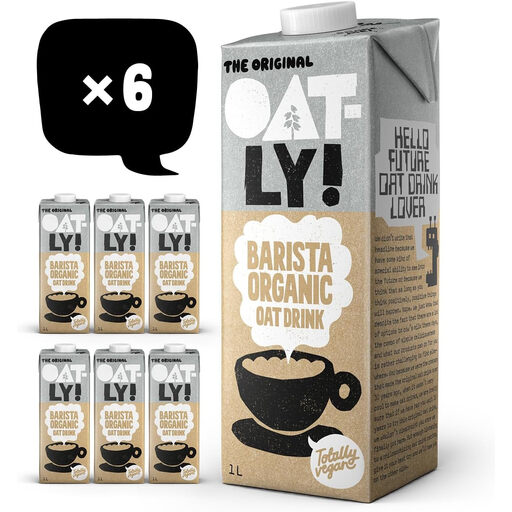 Image unavailable
Consider this barista-format pack if you want one oat drink for coffee or hot chocolate and winter cooking. The pack contains six 1L cartons. Check the carton’s organic-control information and, if required, its gluten-free wording; if you use it regularly instead of cow’s milk, compare its nutrition panel with your other options.
Look for an explicit organic designation and organic-control information, not just words such as “natural” or “local”. UK Department for Environment, Food & Rural Affairs guidance says food described as organic must meet the applicable production and certification rules, including a requirement that at least 95% of its agricultural ingredients are organic.
No: the UK Department of Health and Social Care states that plant-based drinks labelled organic in the UK cannot be fortified with nutrients. If oat drink regularly replaces cow’s milk for you, compare the declared nutrients on a fortified, non-organic alternative and consider the rest of your diet.
No. Organic status and gluten-free suitability are different claims, and oats can come into contact with gluten-containing cereals during processing. Coeliac UK advises choosing oat products labelled gluten free when gluten-free oats are required; check the exact drink rather than the brand alone.
Choose one if its stated uses match your hot drinks and you want an organic barista format. Oatly names hot chocolate, coffee and tea among the uses for its Organic Barista drink. That product description does not establish that every organic barista drink will perform alike, so check the carton you intend to buy.