What should you check first?
Decide whether the oat drink is a breakfast ingredient or a regular main milk, then read the current carton for the checks that apply to that use.
| Priority |
What to check |
Your needs |
| Age and use |
Check the child’s age, the carton’s age guidance and whether the drink is an ingredient or the main milk. North East London NHS Foundation Trust says plant drinks may be used in weaning foods from 6 months, but should not replace breast milk or formula as the main milk before age 1. |
I’m adding a little oat drink to breakfast food, not replacing an infant’s usual milk. |
| Nutrition for regular use |
For main-milk use after age 1, compare calcium, iodine, vitamin D and vitamin B12 fortification, plus protein and energy on the nutrition panel. North West Knowledge Now NHS guidance recommends unsweetened, fortified alternatives and identifies oat drinks as a lower-protein second choice in cow’s-milk-free diets. |
If this will be my child’s regular milk alternative, I need to judge its nutrition in the context of their whole diet, not just its ingredients. |
| Organic label |
Check that the exact drink is labelled organic, then assess its nutrition separately. GOV.UK’s organic food guidance concerns certification and labelling rules; an organic label is not a statement about toddler nutrition. |
I’d like an organic drink for porridge or cooking, without assuming that “organic” means it works as a main milk. |
| Allergens |
Read the current ingredient list and allergen declaration for milk, wheat and other cereals. Product warnings differ: Alpro describes its Organic Oat as dairy-free but says it may contain other cereals containing gluten, while M&S marks Plant Kitchen Whole Oat Drink as unsuitable for milk or wheat allergy. |
For a child with an allergy or coeliac disease, I need the statement for the exact carton I’m serving. |
Brand and product-line references
Compare named drinks rather than treating a brand’s organic, barista and fortified ranges as interchangeable.
Oatly
Oatly lists an Organic Oat Drink for general drinking and food use.
- Oatly lists water, organic oats and sea salt for its Organic Oat Drink, with 39 kcal and 1.1 g protein per 100 ml.
- For a toddler’s regular main milk, check the current pack’s fortification and the child’s wider diet rather than relying on its organic ingredients.
Alpro
Alpro’s Organic Oat and Oat Growing Up are different product lines.
- Alpro describes Organic Oat as dairy-free. Its Oat Growing Up listing gives 120 mg calcium and 1.3 g protein per 100 ml and lists iodine and vitamin D.
- Oat Growing Up is not presented as organic, and Alpro’s product page describes it as 3+. Check the current pack’s age statement before considering it for a younger child.
Rude Health
Rude Health Organic Oat Drink is listed as an option for cereal and cooking.
- Sainsbury’s lists the drink as organic and dairy-free, with 0.5 g protein per 100 ml.
- If it would become a regular main milk, assess its full nutrition and fortification against that use, not its organic label alone.
Minor Figures
Minor Figures positions its Organic Barista Oat for coffee preparation.
- The brand describes its barista drink in terms of texture and microfoam.
- The product says it may contain gluten. Coffee-oriented texture does not establish suitability as a toddler’s main milk; check its label for the child’s intended use.
M&S
M&S lists oat drinks with different ingredients, fortification and suitability statements.
- M&S lists calcium, iodine and vitamins D and B12 in its Plant Kitchen Whole Oat Drink.
- M&S marks that drink as unsuitable for milk or wheat allergy. Its separate ONLY INGREDIENTS oat drink is not fortified and is not recommended by M&S as a dairy replacement for children under 36 months.
Joybuy oat drink option
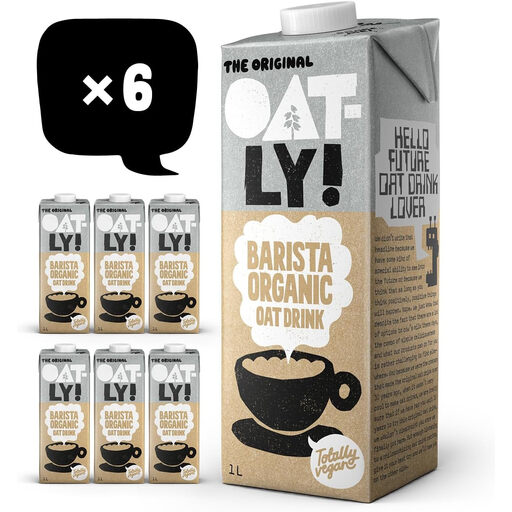
This organic barista oat drink is an option to consider for breakfast cooking or baking, rather than on the assumption that it can serve as a toddler’s regular main milk.
 No image available
Oatly Organic Barista Oat Drink 6x1L
Cooking and baking are stated uses for this organic barista oat drink, sold as a 6x1L pack. Before serving it to a child, check the current carton’s age guidance and allergen declaration; if it would be used regularly as a main milk, check its fortification and nutrition in the context of the child’s diet.
View on Joybuy
Questions about toddler breakfast
Can an organic oat drink replace breast milk or formula before age 1?
No. North East London NHS Foundation Trust says plant drinks may be introduced in weaning foods from 6 months, but should not replace breast milk or formula as a child’s main milk before age 1.
Does an organic label tell me whether an oat drink suits a toddler?
No. GOV.UK’s organic guidance covers certification and labelling, not whether a drink supplies the nutrients needed for regular main-milk use. For that use after age 1, check the exact drink’s fortification, protein and energy separately.
What matters if oat drink will be the main milk after age 1?
North West Knowledge Now NHS guidance advises an unsweetened alternative fortified with calcium, iodine, vitamin D and vitamin B12, with protein and energy considered too. For cow’s-milk-free diets, it identifies fortified oat drinks as a lower-protein second choice to fortified soya or pea alternatives.
Is every oat drink suitable for a child with a milk allergy?
No assumption about the whole category is safe. Alpro describes its Organic Oat as dairy-free, while M&S says its Plant Kitchen Whole Oat Drink is unsuitable for people with a milk allergy. Check the exact current carton and follow the child’s allergy advice.
How should an opened oat drink be kept for breakfast?
Follow the instructions on its carton. For example, Sainsbury’s listing for Oatly Organic Oat Drink says to refrigerate it after opening and consume it within approximately five days; instructions can differ between products.


