Hosts prioritising organic ingredients
You want an organic oat drink for BBQ sides, baking or drinks, and want to check an explicit organic claim rather than rely on plant-based wording alone.


Start with an oat drink explicitly labelled organic if organic status matters for your BBQ, then choose the carton for its intended use: a plainly labelled gluten-free option where that is required, or a barista formula for coffee service. Organic does not itself mean gluten-free, and even gluten-free oat drink contains oats, so check the exact pack before serving guests.
You want an organic oat drink for BBQ sides, baking or drinks, and want to check an explicit organic claim rather than rely on plant-based wording alone.
You need a carton explicitly labelled gluten-free. That claim does not make an oat drink suitable for someone with an oat allergy: the Food Standards Agency identifies oats as an allergen even in gluten-free food.
If the oat drink is mainly for coffee alongside the BBQ, a barista-labelled formula may fit that use. For baking or sauces, check the carton’s ingredients and stated uses instead of assuming the same formula suits every task.
Decide how the oat drink will be used, then check organic labelling, guest requirements and the exact carton’s ingredients.
| Priority | What to check | Your needs |
|---|---|---|
| Organic status | Look for an explicit organic claim and check the pack information. Defra’s UK guidance links organic food labelling to production rules and certification by an approved organic control body. | I want an organic carton for BBQ food or drinks, not just one described as plant-based. |
| Gluten and oats | Check for a specific gluten-free claim when needed, then read the allergen information. The Food Standards Agency says oats remain an allergen in food labelled gluten-free. | If a guest needs gluten-free food, I need that claim on the carton. If someone has an oat allergy, I need a suitable non-oat option. |
| Recipe fit | Compare ingredient lists and stated uses. The cited Plenish long-life carton lists water, organic gluten-free oats and sea salt; Rude Health’s organic oat drink also lists sunflower oil and is described as suitable for baking. Minor Figures positions its Organic Barista Oat for coffee foam. | For a side dish or baking, I want a formula that fits the recipe; for coffee, I may prefer a carton intended for that drink. |
| Added nutrients | Read the exact nutrition and ingredient panels for added calcium, iodine or vitamins. Organic status alone does not identify whether a carton is fortified. | If I use oat drink regularly for added nutrients, I want to compare what each carton actually lists. |
These labels answer different questions. Plenish and Rude Health have cited gluten-free products, while Minor Figures says its Organic Barista Oat may contain gluten.
If a guest requires gluten-free food, check for that claim and read the current carton’s allergen information.
The Food Standards Agency identifies oats as an allergen even when a food meets the gluten-free labelling condition.
Do not offer oat drink to a guest with an oat allergy; agree on a suitable non-oat drink instead.
A barista label describes a coffee-oriented use, while organic oat drinks also differ in their stated ingredients and baking uses. It does not establish how a carton will work in a particular sauce.
For BBQ sides or baking, check the recipe and the product’s stated uses before choosing a carton.
Organic status and fortification are separate product details. For example, M&S lists added calcium, iodine and vitamins on its Barista Oat Drink.
If added nutrients matter to your choice, compare the exact cartons’ labels.
These examples show differences between specific organic oat drinks; a brand name alone does not establish the ingredients or allergen status of another carton.
Oatly Organic Oat Drink Long Life is a three-ingredient carton for shoppers seeking an organic oat drink.
Plenish Organic Gluten Free Longlife Oat Drink combines explicit organic and gluten-free labelling.
Rude Health Organic Oat Drink is an organic, gluten-free option with a stated baking use.
Minor Figures Organic Barista Oat is positioned by the brand for coffee service.
Alpro Organic No Sugars Oat Drink is another labelled organic carton to compare by ingredient and allergen information.
This organic barista oat drink is an option for coffee served alongside a BBQ. Check the carton and your recipe before choosing it for another cooking use.
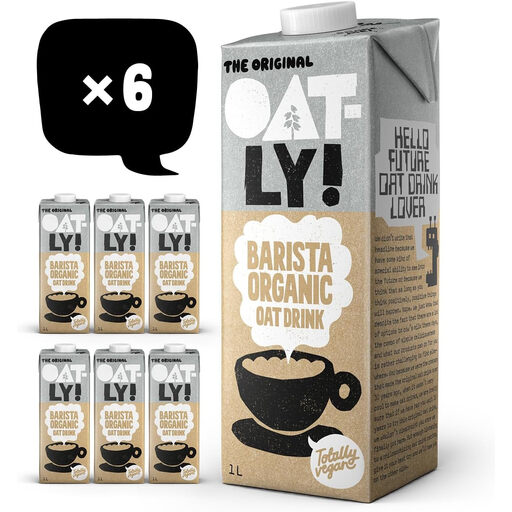 Image unavailable
A barista-labelled oat drink to consider for coffee alongside a BBQ. The listed pack contains six 1L cartons; check the current pack’s allergen information and look for an explicit gluten-free claim if a guest requires one.
Look for an explicit organic claim and read the pack information. Defra’s UK guidance says organic food labelling is tied to organic production rules and certification by an approved organic control body.
No. Organic and gluten-free are separate claims, so choose a carton explicitly labelled gluten-free when that is required. The Food Standards Agency says oats must still be identified as an allergen in gluten-free food.
No: a gluten-free claim does not remove oats. The Food Standards Agency identifies oats as an allergen, so offer a suitable non-oat alternative to a guest with an oat allergy.
Choose according to the recipe’s ingredients and intended use rather than assuming one carton fits every dish. Tesco describes Plenish Organic Gluten Free Longlife Oat Drink for general dairy replacement and lists baking as a use for Rude Health Organic Oat Drink; check the particular recipe before using either in a sauce.
No. An organic label does not tell you whether vitamins or minerals have been added. Read the exact carton’s ingredient and nutrition panels if fortification is important to your choice.