New parents buying for themselves
If the oat drink is for your own tea, cereal or cooking, compare everyday, chilled and barista cartons by use and storage. This is a separate decision from choosing a baby’s milk feed.


For adults in a new-parent household, choose an organic oat drink by how you will use it: an everyday carton for cereal and cooking, a chilled carton if that suits your routine, or a barista version for coffee. Do not use oat drink in place of breast milk or first infant formula during a baby’s first year, in line with NHS guidance. If a child over one needs a main milk alternative, check the exact drink’s nutritional suitability with a clinician or dietitian; Frimley Health NHS Foundation Trust cautions that organic milk substitutes may not be fortified with calcium.
If the oat drink is for your own tea, cereal or cooking, compare everyday, chilled and barista cartons by use and storage. This is a separate decision from choosing a baby’s milk feed.
For a child over one who needs a dairy-free main drink, the organic label alone does not establish nutritional suitability. Frimley Health NHS Foundation Trust advises attention to calcium fortification; discuss the choice with a clinician or dietitian when it has a main nutritional role.
An organic barista carton is worth considering if steaming or hot-drink texture matters more to you than a short ingredient list. Compare the particular recipe and its storage directions rather than assuming all barista drinks are alike.
Decide who will drink it first, then compare the carton’s ingredients, intended use and storage instructions.
| Priority | What to check | Your needs |
|---|---|---|
| Age and use | Separate adult drinks from a child’s main milk drink. The NHS says babies should continue to receive breast milk or first infant formula until at least one year old. | I’m buying for the adults, not replacing my baby’s milk feed. If the drink is for an older child, its nutritional role needs a separate decision. |
| Fortification | Read the exact carton’s ingredients and nutrition panel for added calcium and other nutrients. Frimley Health NHS Foundation Trust cautions that organic milk substitutes may not be calcium-fortified. | Organic ingredients matter to me, but I won’t assume that an organic drink provides the nutrients needed from a child’s main milk alternative. |
| Everyday use | Compare a simple organic recipe with chilled versions that include oil. Check whether the particular carton is labelled for cupboard or chilled storage before opening. | For cereal, tea or cooking, I’d rather choose a format that fits how often our household opens a carton. |
| Coffee | Look for a barista formulation if steaming matters. Tesco describes Minor Figures Organic Barista as designed to steam for microfoam; check ingredients and fat per 100 ml on the carton you choose. | Most of mine will go into coffee, so hot-drink use matters more to me than choosing the shortest ingredient list. |
| Allergens | Check the current pack for oats and any other ingredients relevant to your household. A dairy-free description does not settle suitability for every dietary restriction. | If someone at home avoids particular ingredients, I need to check this carton’s label rather than rely on the drink category. |
The NHS advises breast milk or first infant formula until at least one year old. Organic status does not make an ordinary oat drink an infant formula substitute.
Buy the oat drink for adult use. If a child over one needs a main milk alternative, check the exact product and seek clinical or dietetic advice about its nutritional suitability.
Barista recipes are positioned for hot drinks and can differ from simpler everyday recipes. Oatly Organic Barista and Minor Figures Organic Barista are described for coffee use, but that purpose alone does not make either necessary for cereal or cooking.
Choose by the drinks and meals you actually make, and compare the ingredients on the specific carton.
A chilled carton may be inconvenient if your household uses oat drink only occasionally. Tesco’s Oatly Organic chilled listing gives refrigeration and an approximately five-day period after opening.
Check both unopened and opened-carton directions; consider a long-life format if cupboard storage before opening suits your routine.
Tesco’s Oatly Organic chilled listing identifies oats in the ingredients. Avoiding milk or soya does not remove the need to check other ingredients.
Read the current pack’s ingredient and allergen information, particularly when anyone in the household has an allergy or a clinician-directed exclusion diet.
These examples illustrate differences between particular oat drinks; a brand name does not tell you whether every product in its range is organic or fortified.
Oatly has organic everyday and barista oat drinks, including long-life and chilled everyday formats.
Its Organic Barista Oat Drink is an adult coffee-use option listed by Tesco.
Alpro provides a useful contrast between an oat drink with declared added nutrients and products labelled organic.
This organic barista option is for adults choosing oat drink mainly for coffee or other hot drinks, with cooking and baking also described uses. Choosing a child’s main milk alternative requires separate nutritional checks.
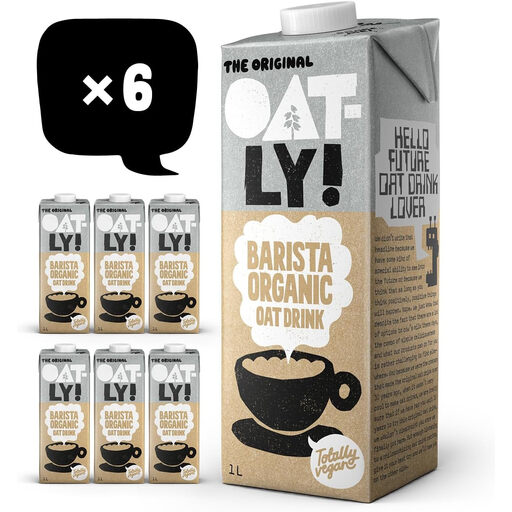 Image unavailable
An adult-use organic barista drink described for coffee, tea and hot chocolate, as well as cooking and baking. The product description lists 10% organic oats, rapeseed oil, sea salt and potassium carbonate, with 3.2 g fat per 100 ml. Refrigerate after opening and consume within five days; check the pack’s unopened storage and allergen directions. It is not a replacement for breast milk or first infant formula.
No. The NHS advises continuing breast milk or first infant formula until at least one year old. An ordinary organic oat drink is not a substitute for that milk feed.
Do not decide on the organic label alone. Frimley Health NHS Foundation Trust cautions that organic milk substitutes may not be fortified with calcium. If a drink will replace cow’s milk as a child’s main milk alternative, check the exact product and seek advice from a clinician or dietitian about suitability.
Check the specific carton. Oatly lists water, organic oats and sea salt for its Organic Oat Drink, without added calcium in that ingredient list. Another product’s formulation may differ.
Consider a barista format if steaming or hot-drink texture is important to you. Oatly describes its Organic Barista drink for coffee and other hot drinks, while Tesco describes Minor Figures Organic Barista as designed to steam for microfoam. Compare the current ingredients and storage directions before choosing.
Follow its own pack directions. The listed Oatly Organic Barista 6x1L product says to refrigerate after opening and consume within five days. Check unopened storage separately rather than assuming every organic carton can be kept in a cupboard.