What should you check before buying?
Start with carbohydrate per 100ml and the quantity you will pour. Then check the product label for the other features that matter to your use, rather than treating “organic”, “no sugars” or “barista” as a keto claim.
| Priority |
What to check |
Your needs |
| Carbohydrate |
Read total carbohydrate per 100ml, not just sugars. Multiply it by your planned amount in millilitres, then divide by 100. |
I want to know what my actual pour contributes to my carbohydrate allowance. Alpro UK lists 0g sugars but 5.2g carbohydrate per 100ml for Alpro Organic Oat. |
| Organic claim |
Check that the exact drink is labelled organic and look at its current pack information. For food described as organic in Great Britain, the Department for Environment, Food & Rural Affairs sets certification and organic-content conditions. |
If I am choosing an organic drink, I want the claim to apply to that product rather than assuming any oat drink meets it. |
| Fortification |
Read the current ingredients and nutrition panel for added calcium, iodine or vitamins. Oatly says its Organic Oat Drink is not fortified. |
When I regularly use oat drink in place of dairy, I need to know what the particular carton contains rather than assuming all alternatives have the same added nutrients. |
| Coffee use |
Check whether the product is intended for frothing, alongside carbohydrate for the amount used. Minor Figures lists 13.8g carbohydrate per 200ml serving for its Organic Barista Oat. |
I care about the texture of my coffee, but I also need to account for the oat drink in a larger serving. |
| Gluten-free requirement |
Look for an explicit gluten-free claim on the exact product and check the current carton’s allergen information. Do not transfer a claim between standard and barista variants. |
If I require a gluten-free product, an organic label alone does not answer that question. |
Organic oat drink brand references
These examples show how carbohydrate declarations and intended uses differ between particular organic oat drinks. Brand inclusion does not mean that every variant has the same ingredients or nutrition values.
Alpro
Alpro Organic Oat is an organic option to compare when total carbohydrate is the deciding figure.
- Alpro UK lists 5.2g carbohydrate and 0g sugars per 100ml for this product.
- The 0g-sugars declaration does not mean the drink is carbohydrate-free or automatically suitable for keto.
Oatly
Oatly Organic Oat Drink has a short declared ingredient list: water, 10% organic oats and sea salt.
- Its declared formulation may appeal to shoppers comparing ingredient lists.
- Oatly lists 7.2g carbohydrate per 100ml and says this organic drink is not fortified.
Plenish
Plenish has distinct standard chilled and Barista organic oat drinks; check which one you are considering.
- Tesco lists water, 10% organic gluten-free oats and sea salt for the standard chilled drink.
- Tesco lists 6.6g carbohydrate per 100ml for that drink, versus 9.1g per 100ml for Plenish Organic Barista.
Rude Health
Rude Health Organic Oat Drink is another labelled gluten-free organic option in this comparison.
- Tesco lists 11% organic gluten-free oats and organic cold-pressed sunflower oil in its ingredients.
- Its Tesco listing declares 6.2g carbohydrate per 100ml, which still needs checking against the amount you plan to use.
Minor Figures
Minor Figures Organic Barista Oat is a coffee-focused formulation.
- Its barista positioning is relevant if preparation in coffee is your main consideration.
- Minor Figures lists 13.8g carbohydrate per 200ml serving; compare that serving with your own pour.
Oat drink options on Joybuy
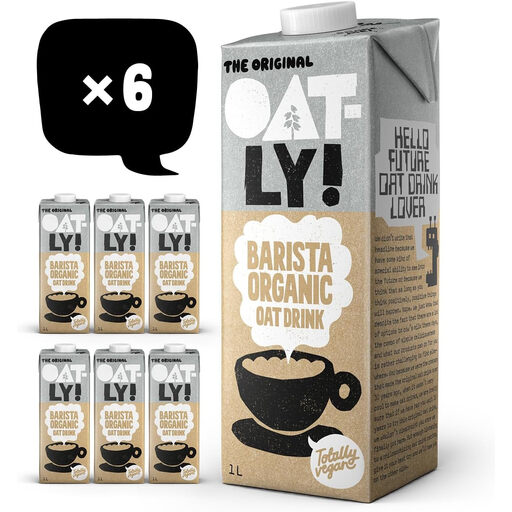
This organic barista oat drink is an option to consider for coffee. Its inclusion does not establish whether it fits a strict ketogenic plan; check the current carton’s carbohydrate declaration and your intended serving.
 No image available
Oatly Organic Barista Oat Drink 6x1L
The barista variant is relevant if you are choosing oat drink for coffee. This listing is for six 1L cartons; check the current pack’s organic information and carbohydrate per 100ml, then calculate the total for the amount you pour.
View on Joybuy
Questions about organic oat drink and keto
Is organic oat milk keto-friendly?
Do not assume so: the five organic oat drinks compared here declare 5.2g to 7.2g carbohydrate per 100ml, before accounting for how much you pour. Check the exact product and serving against your own plan; for medically supervised ketogenic dietary therapy, follow your care team’s instructions.
Does “no sugars” mean an oat drink has no carbohydrate?
No. Alpro UK lists 0g sugars alongside 5.2g carbohydrate per 100ml for Alpro Organic Oat. Read the total carbohydrate line and calculate it for your intended serving.
What does “organic” mean on an oat drink sold in Great Britain?
Under the Department for Environment, Food & Rural Affairs’ organic food labelling guidance, an organic claim is subject to production and certification conditions, including certification of the product and suppliers by an approved organic control body. The guidance states that at least 95% of the total product by dry matter must be organic for food described as organic.
Are organic oat drinks always fortified?
No. Oatly says its Organic Oat Drink is not fortified. If added calcium, iodine or vitamins matter to your choice, check the ingredients and nutrition panel of the exact drink and variant.
Should I choose a barista oat drink for coffee when keeping carbohydrates low?
Choose according to both your coffee-preparation needs and the carbohydrate total for your serving. Minor Figures lists 13.8g carbohydrate per 200ml serving for its Organic Barista Oat; barista positioning alone does not tell you whether a drink fits your carbohydrate allowance.


