Organic-label-first lunch planners
For consumers who want the sauce itself to be labelled organic, rather than assuming it qualifies because of a retailer, brand or individual ingredient.


For a low-effort office lunch, choose a ready-to-use sauce whose organic claim you can confirm on the exact jar. A passata-style base offers more scope to choose your own seasoning but needs extra preparation; with either format, check the portion size, ingredients, nutrition per 100g and instructions for storing leftovers.
For consumers who want the sauce itself to be labelled organic, rather than assuming it qualifies because of a retailer, brand or individual ingredient.
For consumers choosing a jar that fits their lunch portions and preparation routine, with a plan for refrigerating and using any sauce left after opening.
For consumers who need to check vegan labelling, allergens, salt, sugars and ingredients separately from the organic claim.
Confirm the organic claim on the specific sauce first, then choose a recipe and jar size that fit how you prepare and store office lunches.
| Concern | What to check | Who this matters to |
|---|---|---|
| Organic status | Check the organic information for the exact sauce and variant. The UK Department for Environment, Food & Rural Affairs says food may be labelled organic only if it meets the applicable production rules. | If organic status is the reason I am choosing this sauce, I need to confirm the claim applies to the jar I will buy. About 42% of consumers put that confirmation first. |
| Portions and leftovers | Compare pack weight and stated servings, then read the preparation and refrigerated-use instructions for the opened jar. | When I am packing one lunch at a time, I need a jar I can use without leaving more sauce than I can finish as directed. That is the primary concern for about 33% of consumers. |
| Dietary and nutrition details | Read the exact recipe’s dietary labels and allergen information; compare salt and sugars per 100g. | If an ingredient, allergen or nutrition value affects my choice, an organic label alone does not answer my question. About 25% of consumers make these details their first check. |
Organic status does not establish whether a sauce is vegan, free from a particular allergen, or lower in salt or sugars.
Check the selected jar’s dietary labels, ingredients, allergen information and nutrition panel separately.
Opened-jar instructions differ: Sainsbury’s SO Organic tomato-and-basil sauce states three days refrigerated, Mr Organic cherry-tomato sauce states 72 hours, and Daylesford Organic passata states five days.
Work out how many lunches the jar will cover and note its opening date so you can follow its own instructions.
Sauce left unused beyond the jar’s stated refrigerated-use period may be wasted.
The Mr Organic cherry-tomato sauce listed by Ocado is labelled no added sugar and has 1.27g salt per 100g. Those statements describe different aspects of the recipe.
Compare salt and sugars per 100g on the exact sauces you are considering, then look at the amount you expect to use.
A retailer category or a familiar brand name does not establish the organic status of every product sold alongside it.
Check the individual sauce, variant and seller rather than relying on the category heading.
Sainsbury’s lists a 350g organic tomato-and-basil pasta sauce with two stated servings.
Ocado lists a 350g organic cherry-tomato pasta sauce labelled vegan and no added sugar.
Ocado lists Biona Organic Tomato & Basil Sauce as suitable for vegans.
The M&S pasta-sauce category lists organic Daylesford products alongside other sauce lines.
Tesco’s organic pasta-sauce category lists an Organico tomato-and-basil sauce and a Sacla basil pesto.
This 190g sundried-tomato pesto is an option for stirring through pasta for a packed lunch. Check the organic information on the exact pack if that claim is essential to your choice.
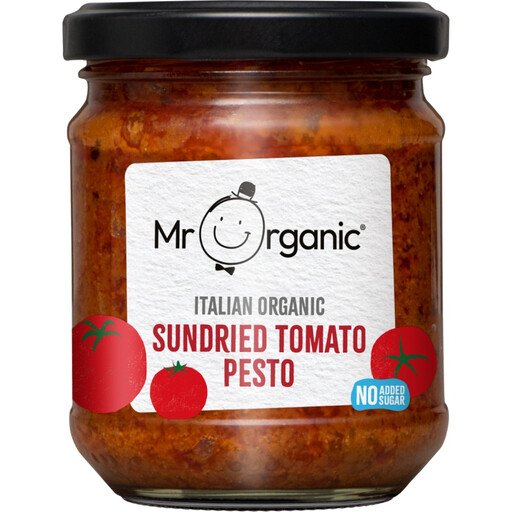 Image unavailable
For a pasta lunch where you want a smaller jar and a recipe described as suitable for vegans. The product information says to refrigerate it after opening and use it within three days; it lists 1.9g salt per 100g. It contains soya and may contain traces of nuts, celery and peanuts. Confirm the organic claim and allergen information on the current pack before relying on them.
The UK Department for Environment, Food & Rural Affairs says food may be labelled organic only if it meets the applicable organic production rules. Check the claim on the specific sauce, not just the retailer’s category or another product from the same brand.
No. Check the exact recipe’s dietary and allergen information: the Biona tomato-and-basil sauce listed by Ocado, for example, is described as vegan but contains celery. GOV.UK says specified allergens in prepacked food must be clearly identified in the ingredients list when present.
Follow that jar’s refrigeration and use instructions. Sainsbury’s SO Organic tomato-and-basil sauce states three days after opening, while the Daylesford Organic passata listing states five days; neither instruction should be applied to a different product.
Use per 100g to compare different sauces on the same basis, then consider the amount you plan to use. NHS food-label guidance explains that nutrition values are given per 100g or 100ml and may also be shown per portion.
Choose a passata-style base if you plan to prepare several lunches and want to add your own seasoning or other ingredients. If you want to heat a finished sauce and mix it with pasta, a ready-to-use jar involves less preparation; whichever you choose, check its opened-jar instructions against your lunch schedule.