People who want to season their own popcorn
Plain organic popping corn lets you choose what to add when you prepare it. Allow time to pop it before elevenses, and check the particular pack for any allergen warnings.


Choose organic plain popping kernels if you can prepare elevenses yourself and want to decide what oil or seasoning to add. A ready-to-eat organic bag avoids preparation but has a fixed recipe, so compare its ingredients and nutrition label. For children under 5, follow NHS advice not to give conventional popcorn; a toddler puff snack is a different product and must be checked for its stated age guidance.
Preparation time, recipe control and the age of the person eating the snack point to different formats.
Plain organic popping corn lets you choose what to add when you prepare it. Allow time to pop it before elevenses, and check the particular pack for any allergen warnings.
A ready-popped organic bag needs no morning preparation. Its oil and seasoning are already part of the recipe, so read the ingredients and compare the nutrition information per 100g if those details matter to you.
For a child under 5, conventional popcorn is not the right format: the NHS advises against giving popcorn to this age group. A toddler puff snack is a different product; follow its minimum-age guidance and supervise eating.
Decide whether you need a snack that is ready to eat or one you can prepare and season, then check the claim and label on the particular product.
| Priority | What to check | Your needs |
|---|---|---|
| Organic status | Look for an explicit organic claim on the pack or product listing. Check the control-body information where shown; the Minton & Donello listing, for example, names code GB-ORG-05. UK Department for Environment, Food & Rural Affairs guidance says organic labelling depends on the relevant product and suppliers being certified by an approved control body. | I want to identify an organic product from its own labelling, rather than assume a familiar brand name or a natural-sounding description means it is organic. |
| Preparation | Check whether the pack contains unpopped kernels or ready-popped popcorn. Plain kernels require preparation; a ready-to-eat bag has its recipe set in advance. | If I have time to make a batch, I can season it myself. If elevenses needs to travel with me, I would rather take something ready to eat. |
| Ingredients and nutrition | Read the ingredients for added oil and seasoning, then compare declared nutrition on the same per-100g basis. The Trafo organic sea-salted product lists sunflower oil and sea salt; Healthy Supplies gives its fat as 27g and salt as 2.2g per 100g. | I may want to choose the flavour and additions myself, or I may prefer the convenience of a fixed recipe. Organic labelling alone does not tell me how much salt or fat the finished snack contains. |
| Age suitability | Distinguish conventional popcorn from a toddler puff snack. The NHS says not to give popcorn to children under 5; for a toddler product, check its stated minimum age and serving guidance. | For a young child, I need a product intended for their age rather than simply an organic version of ordinary popcorn. |
| Allergens | Read the current pack’s ingredients and any ‘may contain’ or shared-handling statement. Assess a product against the individual’s allergy requirements; an organic claim does not address cross-contact. | If someone eating the snack has an allergy, I need the warning on that exact product and variant, whether I choose kernels, a ready-popped bag or puffs. |
Organic certification and the finished recipe are different considerations. Tesco’s Trafo organic sea-salted popcorn listing includes sunflower oil and 2.2% sea salt among its ingredients.
Choose plain organic kernels if you want to decide what to add, or read the ingredients and nutrition panel of a ready-to-eat bag before choosing it.
A short ingredient list does not replace the pack’s allergen and cross-contact information. That distinction matters when the snack is for someone with an allergy.
Check the current pack for the exact product and follow the individual’s allergy advice rather than relying on its organic status.
Organic status does not change the age-related choking concern. The NHS says not to give popcorn to children under 5.
Do not serve conventional popcorn to this age group. If considering a toddler puff snack instead, check its stated minimum age and supervise eating.
These examples illustrate different snack formats; their details apply to the products described, not to every item from the brand.
Its 250g organic popping corn is a plain-kernel option for preparing and seasoning at home.
Its 500g organic popping corn offers a larger pack of plain kernels for home preparation.
Its 50g organic sea-salted popcorn is a ready-to-eat option when preparation is inconvenient.
Its Strawberry & Apple Baby Popcorn Puffs are a toddler corn-and-rice puff snack, not conventional popcorn.
These Organix options are toddler puff snacks rather than conventional popcorn. If you specifically want an organic snack, check the organic claim and other labelling on the exact pack before choosing.
 No image available
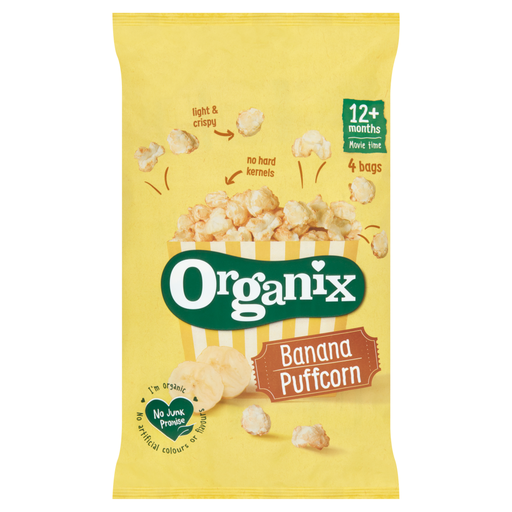
A banana-flavoured toddler puff snack for an elevenses option without conventional popcorn kernels. The pack is labelled for ages 12 months and over and contains four 10g bags; check its allergen information and supervise eating.
 No image available
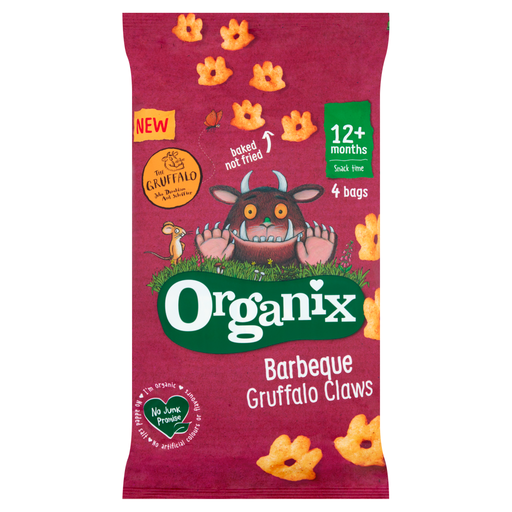
A savoury-flavoured toddler corn puff rather than conventional popcorn. This multipack contains four 15g bags and is labelled for ages 12 months and over; check the ingredients and allergen information, and supervise eating.
 No image available
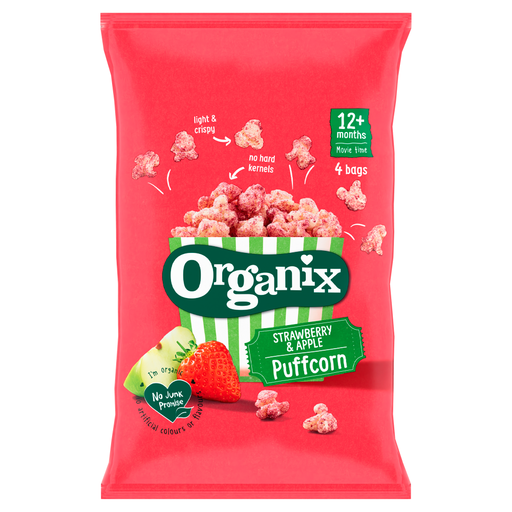
A strawberry-and-apple toddler puff snack instead of conventional popcorn. The pack contains four 10g bags and is labelled for ages 12 months and over; follow its allergen and supervision guidance.
Look for an explicit organic claim on the particular pack or product listing and check its certification information where shown. UK Department for Environment, Food & Rural Affairs guidance says organic food labelling depends on the relevant product and suppliers being certified by an approved control body. The Ocado listing for Minton & Donello Organic Popping Corn, for example, names code GB-ORG-05.
Not necessarily: organic status does not specify the finished recipe. Plain popping corn lets you decide what to add during preparation, while Tesco’s Trafo organic sea-salted popcorn listing includes sunflower oil and sea salt. Healthy Supplies lists 27g fat and 2.2g salt per 100g for that ready-to-eat product.
Yes. The Real Foods listing for Suma Organic Popcorn gives saucepan instructions using oil, a lid and shaking the pan once popping begins. Follow the instructions on the exact pack you buy and do not leave the heating pan unattended.
No. The NHS advises against giving popcorn to children under 5 because of choking risk, regardless of whether it is organic. A toddler puff snack is a different product: check its stated minimum age and supervise eating.