Choose plain organic popping kernels if you can prepare them and want to decide what oil or seasoning goes into the bowl. A ready-to-eat organic bag suits a snack that needs no preparation, but check its ingredients and nutrition: the listed Trafo sea-salted popcorn contains sunflower oil and has 27g fat and 2.2g salt per 100g, according to Tesco Marketplace and Healthy Supplies.
Who is each format for?
Organic-first snack shoppers
If organic status is essential, check the claim on the exact popcorn product rather than relying on a familiar brand name or the retailer’s category. Ocado’s Minton & Donello popping-corn listing, for example, names organic popping corn as its ingredient and gives a Soil Association Organic control-body reference.
People who prepare their own popcorn
Plain kernels suit someone with a pan or popcorn maker who wants to choose the amount of oil, salt or sweet topping added. They require preparation, so they are less convenient when the snack needs to be ready immediately.
People who need a ready-to-eat snack
A pre-popped bag removes the cooking step. Its recipe is already set, though: Tesco Marketplace lists sunflower oil and sea salt in Trafo Organic Sea Salted Popcorn, so check the pack if those ingredients affect your choice.
What should you check before choosing?
Decide whether you can prepare kernels first, then compare the exact product’s organic information, ingredients and nutrition for the portion you expect to eat.
| Priority |
What to check |
Your needs |
| Organic status |
Check that the exact pack is labelled organic. Look for its control-body information where shown; Ocado lists Soil Association Organic GB-ORG-05 for Minton & Donello popping corn. |
I want the organic claim to apply to the popcorn I am buying, not just to a brand or a shop category. |
| Preparation |
Check whether the product contains kernels that need popping or popcorn that is ready to eat. For kernels, consider the cookware, time and toppings you will use. |
If I want a snack straight away, a ready-popped bag fits. If I can make it myself, I would rather choose what goes into the bowl. |
| Ingredients and nutrition |
Compare ingredients and the nutrition panel per 100g, then check the portion you plan to eat. Healthy Supplies lists 27g fat and 2.2g salt per 100g for the finished Trafo sea-salted popcorn; a plain kernel label describes a different, unprepared product. |
I do not want to assume that an organic label tells me how much oil or salt is in the finished snack. |
| Allergen information |
Read the current pack’s ingredients and any cross-contact warning for the exact product. Do not infer those details from maize as the main ingredient. |
When I need to avoid an ingredient or potential cross-contact, the individual pack’s warning matters more than the type of popcorn. |
What can be easy to overlook?
-
Assuming organic means low in fat or salt
Organic status does not describe a popcorn product’s nutrition. Healthy Supplies lists 27g fat and 2.2g salt per 100g for Trafo Organic Sea Salted Popcorn.
Check the ingredients and nutrition panel of the exact bag, including its per-100g and portion information, rather than using the organic claim as a shortcut.
-
Comparing unpopped kernels with a seasoned bag as though they were the same food
A kernel product still has to be prepared, while the Trafo figures describe popcorn sold ready to eat with oil and salt in its recipe. Your additions to kernels change what ends up in the bowl.
Choose the kernel portion and toppings before comparing it with a ready-popped serving.
-
Assuming maize alone settles an allergen question
Ingredients and potential cross-contact information can differ between products and suppliers.
If you need to avoid an allergen, check the warning on the current pack of the exact product before buying or eating it.
Which brands provide useful reference points?
These products illustrate different formats to compare; a brand name alone does not establish that every product it sells is organic.
Minton & Donello
Ocado lists its 250g Organic Popping Corn as organic and gives organic popping corn as the ingredient.
- Plain kernels let you choose what to add during preparation.
- The kernels must be popped before eating; check the current pack for allergen and cross-contact information.
Trafo
Tesco Marketplace lists a 50g Organic Sea Salted Popcorn bag containing corn, sunflower oil and sea salt.
- The popcorn is ready to eat without cooking.
- Healthy Supplies lists 27g fat and 2.2g salt per 100g for this product; compare the nutrition panel if either value matters to your choice.
Propercorn
Sainsbury’s lists Propercorn ready-to-eat and microwavable popcorn as examples of different convenience formats.
- Its listed formats give shoppers a ready-to-eat or a microwavable product to compare.
- Do not assume a particular Propercorn pack is organic; check that product’s own label if organic status is required.
The Joybuy product option
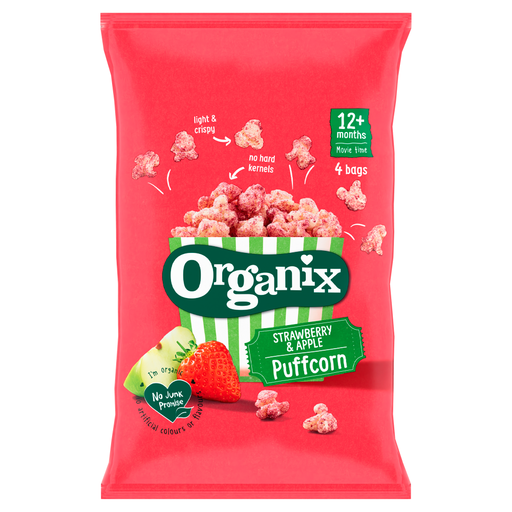
The listed Joybuy option is organic strawberry-and-apple puffcorn for children aged 12+ months. It is a ready-to-eat corn snack, not the popping kernels or ready-popped popcorn compared above.
 No image available
Organix Strawberry & Apple Puffcorn 12+ Months, 4x10g
This pre-packed organic snack needs no preparation, but it is fruit-flavoured puffcorn rather than conventional popcorn. It is labelled for children aged 12+ months and comes in four 10g packs.
View on Joybuy
Common questions
How can I check whether a popcorn product is organic?
Check the exact product’s label and organic-control-body information rather than relying on the brand or retailer category. For example, Ocado’s listing for Minton & Donello Organic Popping Corn identifies organic popping corn as its ingredient and gives the Soil Association Organic reference GB-ORG-05.
Does organic popcorn necessarily contain less salt or fat?
No. Check the finished product’s nutrition panel: Healthy Supplies lists 27g fat and 2.2g salt per 100g for Trafo Organic Sea Salted Popcorn. An organic claim does not replace those figures.
Should I buy kernels or a ready-popped bag for a midnight snack?
Buy plain organic kernels if you can prepare them and want to choose the oil or seasoning yourself. Choose a ready-popped organic bag when avoiding preparation matters more, and check its fixed recipe and the portion you expect to eat.
What should I check if I need to avoid an allergen?
Read the ingredients and any cross-contact warning on the exact current pack. Do not assume that two popcorn products have the same allergen information because both are made from corn.


