Parents packing an organic school lunch
If you want to add dried fruit to a secondary-school packed lunch, check the product’s organic labelling and ingredients alongside what the pupil will actually eat.


Plain organic raisins or sultanas can make sense in a secondary-school packed lunch when the pupil will eat them with lunch and the product fits the school’s allergy rules. Check the current pack for organic labelling, ingredients and allergens: organic status does not mean a lower sugar content, and fruit-and-nut mixes require a separate check for nuts.
If you want to add dried fruit to a secondary-school packed lunch, check the product’s organic labelling and ingredients alongside what the pupil will actually eat.
If an allergy requirement or school policy affects packed lunches, check both the exact product label and the school’s current rules before choosing a fruit-and-nut mix.
If dried fruit might be eaten throughout the school day, consider packing it as part of lunch instead of as a separate, repeatedly eaten snack.
Start with the organic claim and the school’s allergy requirements, then compare the exact ingredients, nutrition label and portion format for the lunch you are packing.
| Priority | What to check | Your needs |
|---|---|---|
| Organic status | Check the current pack’s organic wording and control-body information. UK guidance from the Department for Environment, Food & Rural Affairs says food labelled organic must meet organic production rules, have at least 95% organic agricultural ingredients, and have certified products and suppliers. | I want an organic claim I can check on the pack, rather than relying on the brand name or the look of the packaging. |
| Ingredients and nutrition | Read the ingredient list, sugars value and stated serving size for the exact product. Tesco Groceries lists raisins and sunflower oil for Tesco Organic Raisins; Sainsbury's lists raisins (99%) and high-oleic sunflower oil for its SO Organic Raisins. | A short ingredient list matters to me, but I still want to compare what is in the pack and what the nutrition figures describe. |
| When it is eaten | Decide whether the portion will be eaten with lunch or saved for another break. Oral-health guidance for children aged 3–12 from Wirral Community Health and Care NHS Foundation Trust advises keeping dried fruit to mealtimes. | I would rather put dried fruit alongside lunch than pack it for repeated snacking during the school day. |
| Allergies and school rules | Check the current ingredient and precautionary allergen statements, then check the school’s packed-lunch policy. Ocado lists almonds, Brazil nuts, hazelnuts and walnuts in Crazy Jack Organic Fruit & Nut Mix, with a warning concerning other nuts and sesame. | If nuts are restricted at school or unsuitable for the pupil, I need a product that fits those requirements—not an assumption that an organic mix is acceptable. |
Organic certification addresses how the food is produced, not its sugar content. Tesco Groceries lists 20.3g sugars per 30g serving for Tesco Organic Raisins, while Sainsbury's lists 19.8g per 30g for its SO Organic Raisins.
Compare the serving-size nutrition panels on the products you are considering rather than using the organic claim as a nutrition shortcut.
Wirral Community Health and Care NHS Foundation Trust’s oral-health guidance for children aged 3–12 advises keeping dried fruit to mealtimes.
For an older pupil’s packed lunch, put the dried fruit with the meal rather than planning it as something to eat repeatedly between meals.
Ocado’s listing for Crazy Jack Organic Fruit & Nut Mix declares several tree nuts and carries a warning concerning other nuts and sesame. A school may also have its own packed-lunch rules.
Check the exact pack and the school’s current policy before packing a mix; where nuts are unsuitable, assess a plain dried-fruit product instead.
Marks & Spencer says ingredients, nutrition and allergen information can change, so a pack bought before may not describe the one being packed today.
Read the current pack’s organic information, ingredients and allergen statement, particularly when an allergy or school restriction affects the choice.
These examples show why the exact product matters: ranges include plain raisins, other dried fruits and mixes with different ingredients and allergy considerations.
Tesco Organic Raisins are a plain-raisin example with organic-control information in the retailer’s listing.
The SO Organic range includes a 500g raisin product and other dried-fruit formats.
Waitrose & Partners describes its Duchy Organic Raisins as an option for lunchboxes.
Crazy Jack has both plain organic raisins and an organic fruit-and-nut mix listed by Ocado.
Marks & Spencer lists organic raisins, sultanas, soft apricots, dates and prunes in its fruit-snack range.
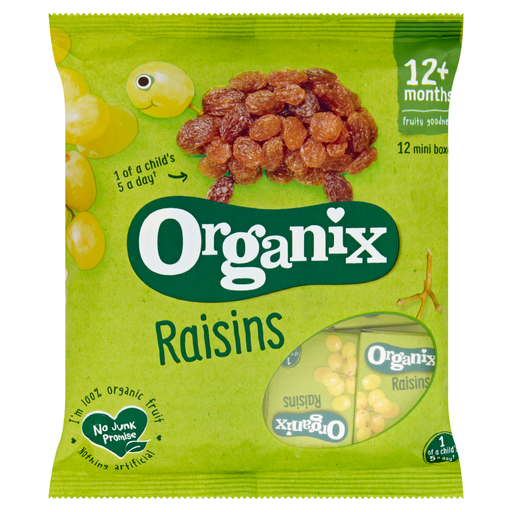
This selection covers individual raisin boxes that could be packed with lunch. Check the physical pack’s organic labelling and allergy information before deciding whether it meets your requirements.
 No image available
The 12 individual 14g raisin boxes provide a portion format to consider for a packed lunch. The 12+ Months wording may matter if the pupil prefers products without toddler-oriented packaging. Check the current pack for organic certification, ingredients and allergens.
An organic claim does not establish that a dried-fruit product has less sugar. UK organic rules from the Department for Environment, Food & Rural Affairs concern production and certification; for example, Tesco Groceries lists 20.3g sugars per 30g serving for Tesco Organic Raisins. Compare the nutrition panels of the exact products you are choosing.
Packing it with lunch follows the timing advised in Wirral Community Health and Care NHS Foundation Trust’s oral-health guidance for children aged 3–12, which says to keep dried fruit to mealtimes. For an older pupil, that is a practical distinction to consider rather than packing dried fruit for repeated snacking between meals.
Check the pupil’s allergy requirements and the school’s current packed-lunch policy first. Ocado lists almonds, Brazil nuts, hazelnuts and walnuts in Crazy Jack Organic Fruit & Nut Mix, with a warning concerning other nuts and sesame; its organic status does not override those considerations.
Read the ingredient and precautionary allergen statements on the current physical pack, particularly when an allergy or school rule affects the choice. The Food Standards Agency explains that precautionary allergen labelling communicates the possible unintended presence of an allergen, and Marks & Spencer notes that product information can change.