Viewers putting together a savoury snack plate
Plain or lightly salted rice cakes can hold dips and toppings without committing the whole plate to one flavour. Check the salt and allergen information for the cakes and anything served with them.


For a football-night snack plate, choose plain organic rice cakes if you want a base for dips and toppings, or an unsalted version if you are limiting salt from packaged snacks. Lightly salted cakes offer a savoury option straight from the pack, while chocolate-coated thins serve a different, sweet-snack purpose. Check the exact pack for ingredients and allergen warnings before serving guests.
Plain or lightly salted rice cakes can hold dips and toppings without committing the whole plate to one flavour. Check the salt and allergen information for the cakes and anything served with them.
An unsalted cake gives you control over what you add on top. The NHS advises adults to have no more than 6g of salt a day, including salt already in packaged foods.
Chocolate-coated rice-cake thins are an alternative to a plain topping base. Compare their per-thin nutrition information with the portion you intend to serve.
Decide first whether the cakes are for toppings, eating straight from the pack or serving as a sweet snack. Then compare the labels on the exact products you are considering.
| Priority | What to check | Your needs |
|---|---|---|
| Organic labelling | Look for an organic claim and certification information on the pack. UK government guidance says an organic-labelled food must meet certification requirements and contain at least 95% organic agricultural ingredients. | I want an organic product, rather than assuming that “wholegrain” or “natural” means the same thing. |
| Salt | Compare salt per 100g on like-for-like cakes, then consider the dips and toppings. Kallo’s product page lists 0.25g per 100g for its Organic Lightly Salted cakes; a Tesco listing gives 0.3g per 100g, so use the current pack for the product you buy. | If the rest of the spread includes salty foods, I may prefer an unsalted base. For a cake eaten on its own, lightly salted may suit the flavour I want. |
| Toppings | Choose a plain cake for a topping base or a lightly salted one for a savoury flavour without toppings. Check pack size and storage directions if you expect leftovers. | Will I put out dips and toppings for everyone, or serve the cakes straight from the pack? |
| Allergens | Read the warning on the exact pack. Kallo says its Organic Unsalted cakes may contain milk, sesame and soya; Biona says its No Salt cakes are unsuitable for people with a sesame allergy because of manufacturing methods. | I need to check each guest’s allergens before choosing a pack, even if it is described as gluten-free or vegan. |
| Sweet options | Compare nutrition per piece rather than treating coated and plain cakes as equivalent. Sainsbury’s lists 3.0g fat, 1.7g saturates and 2.7g sugars per Kallo Belgian Dark Chocolate Organic Rice Cake Thin. | For something sweet, I would choose chocolate-coated thins deliberately, rather than use them as a substitute for a plain cake with toppings. |
UK organic labelling rules address production and certification; they do not make a chocolate-coated cake nutritionally equivalent to a plain one.
Choose the type of snack you want, then read its ingredients and nutrition panel.
Salt in dips, sauces and other foods also contributes to the day’s total. The NHS advises adults to have no more than 6g of salt a day.
If you want more control over salt in the spread, start with unsalted cakes and check what you add to them.
Precautionary warnings differ between products. Kallo’s Organic Unsalted cakes may contain milk, sesame and soya, while Biona identifies a sesame-allergy restriction for its No Salt cakes.
Read the current warning on each exact pack before serving anyone with a food allergy.
Kallo has organic unsalted and lightly salted wholegrain rice cakes, alongside chocolate-coated organic thins for a separate sweet option.
Biona’s organic wholegrain rice-cake range includes a No Salt option for use with your own toppings.
Clearspring’s organic lightly salted rice cakes are described by Ocado as a base for dips, spreads and party snacks.
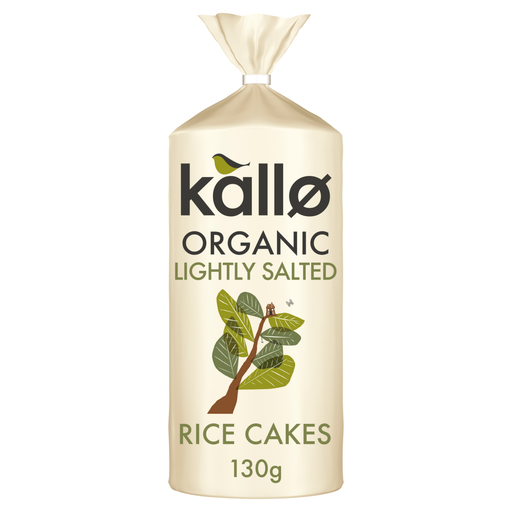
This lightly salted Kallo option is for a savoury rice cake that can also be served with toppings.
 No image available
A lightly salted organic rice cake for eating on its own or serving with toppings. Compare the salt declaration on the current pack if that affects your choice, and check its allergen warning before sharing.
UK government guidance says organic-labelled food must meet organic production and certification requirements, with at least 95% of its agricultural ingredients organic. Check the organic and certification information on the pack; “wholegrain” alone does not establish that a product is organic.
Choose unsalted cakes if you want a plain base for toppings or are limiting salt from packaged snacks; lightly salted cakes suit a savoury snack straight from the pack. Consider the whole spread: the NHS advises adults to have no more than 6g of salt a day, including salt already in food.
Not automatically. Kallo says its Organic Unsalted cakes may contain milk, sesame and soya, and Biona says its No Salt cakes are unsuitable for people with a sesame allergy because of manufacturing methods. Check the exact current pack before serving.
No: choose chocolate-coated thins as a sweet option, not as a like-for-like plain topping base. Sainsbury’s lists 3.0g fat, 1.7g saturates and 2.7g sugars per Kallo Belgian Dark Chocolate Organic Rice Cake Thin; use the nutrition panels to compare the portions you plan to serve.